

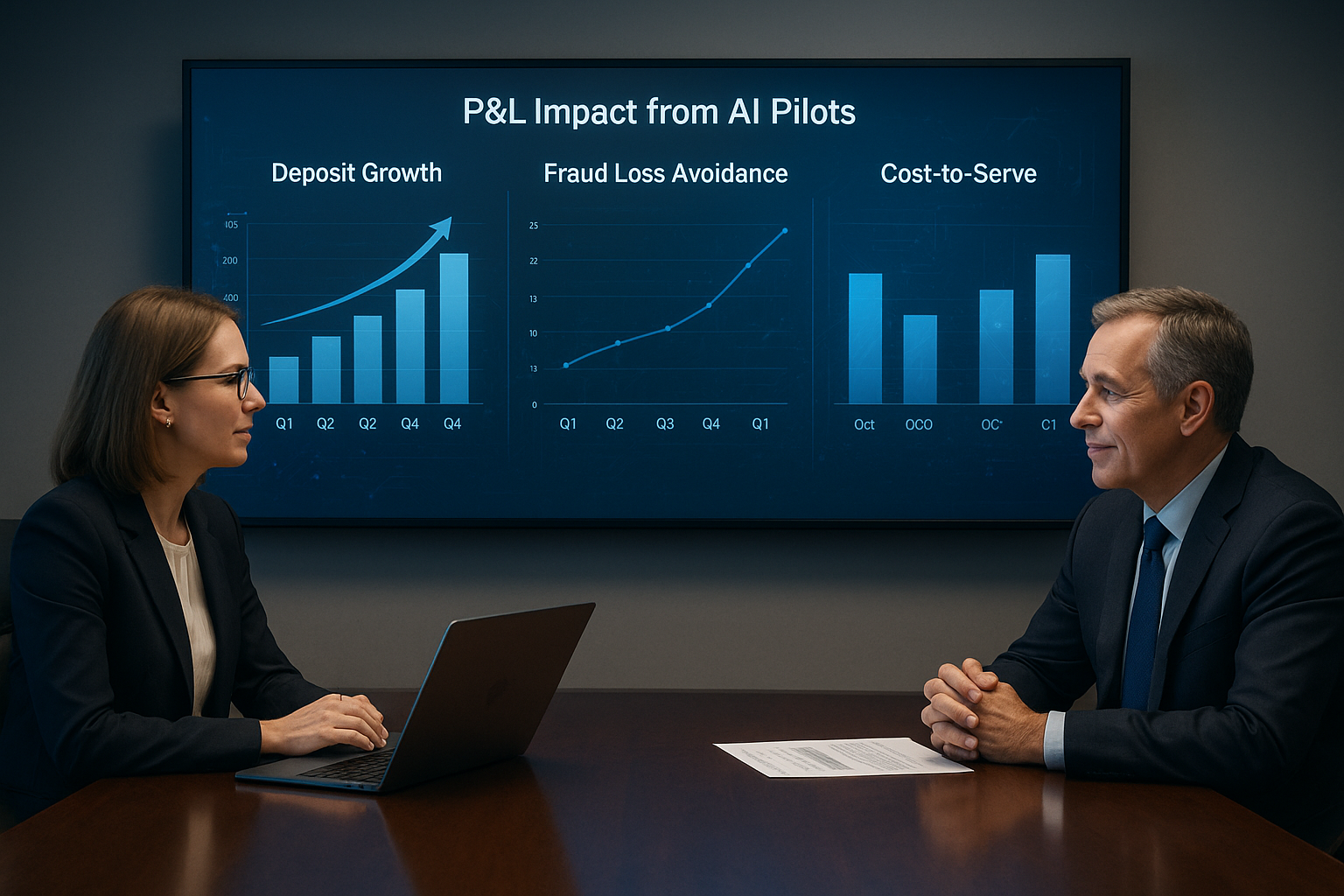

Why aligning AI with P&L matters now
Executives in regional and mid-market financial institutions hear two competing narratives about AI: one promises transformational top-line growth, the other warns of regulatory and reputational risk. The truth sits in the middle. AI delivers greatest value when it is deliberately tied to the balance sheet—when pilots are chosen for their direct impact on deposit growth, net interest margin protection, fraud loss avoidance, and cost-to-serve. This article maps a pragmatic path for CEOs and CFOs starting out, and for CIOs and Chief Risk Officers who must scale AI responsibly across the enterprise.
Part 1 — The CEO/CFO’s Guide to AI That Moves the Balance Sheet in Regional Banking
For a regional bank taking its first AI steps, the strategic question isn’t which technology is coolest; it’s which small number of initiatives will visibly move North Star metrics within 90 days. Think of AI as a portfolio of bets. Limit your first portfolio to two or three use cases that map cleanly to top- and bottom-line levers: revenue lift (for example, cross-sell and deposit offers), cost-to-serve reduction (contact center automation), risk loss avoidance (fraud/AML detection), and capital efficiency (faster credit decisions that reduce NPLs and provisioning).
Define a short list of North Star metrics—deposit growth, NIM protection, fraud loss rate, average handle time (AHT) in contact centers, digital containment rate, and loan cycle time—and make those the criteria for success. Use a simple scoring model so investment decisions are transparent: score each use case by value (estimated P&L impact), feasibility (data readiness and integration effort), and risk (regulatory or compliance exposure). Multiply or weight those dimensions to create a ranked shortlist.

Starter use cases that translate quickly to measurable P&L changes include intelligent triage in the contact center, next-best-offer engines for deposits and credit cards, KYC document automation, and SME loan intake automation. Each of these has a clear line to a North Star metric: reduced AHT, higher deposit balances, lower onboarding times, and fewer manual compliance hours.
Put discipline around a 90-day plan. In week 0–2 run a rapid discovery and data audit to validate the scoring assumptions and catalog the required data sources. Between weeks 3–6 build a lightweight MVP focused only on the signal needed to demonstrate impact. Weeks 7–10 are for a tightly controlled pilot and baseline KPI measurement. In weeks 11–12 convene stakeholders for a go/no-go decision tied to CFO scorecard thresholds and a scale plan for the chosen bets.
Risk controls must be baked in from day one. Maintain model documentation, apply explainability thresholds for any decision that affects credit or detection of fraud, and keep a human-in-the-loop for high-risk decisions. That combination protects customers and regulators while enabling the model to learn effectively.
How our services help: we work with finance leaders to translate P&L levers into AI use cases, apply ROI-driven prioritization frameworks, and deliver rapid MVPs that integrate into branch and operations workflows. We also train branch and operations leaders to interpret model outputs so the business captures the intended cost and revenue benefits.
Part 2 — The CIO/CRO Playbook for Governed AI Portfolios in Banking & Insurance
Once a handful of pilots have demonstrated tangible financial services AI ROI, the hard work begins: moving from project thinking to product thinking. CIOs and Chief Risk Officers must institutionalize AI value creation with a governed model portfolio, tiered funding, and quarterly value reviews that tie directly to enterprise OKRs.
Establish a governed model lifecycle that covers inventory, validation, backtesting, champion–challenger experiments, performance SLAs, and a retraining cadence. This is model risk management AI in practice: it is not an afterthought but the operating principle. Inventory and lineage let you demonstrate to auditors how a model was built and how data moved through the stack. Validation and backtesting provide counterfactuals that regulators expect. Champion–challenger ensures continuous improvement without exposing production risk.
The supporting reference architecture should include composable data products—customer 360 and transaction aggregates—an enterprise feature store, a model registry, CI/CD for models, and a monitoring layer that watches for drift, performance degradation, and bias. Secure PII handling and separation of duties are essential, especially when models influence pricing, underwriting, or claims decisions.

At scale, use cases expand into fraud graph detection, claims automation with document AI, collections propensity models, and personalized pricing within guardrails. Quantify ROI as you scale: measure fraud loss avoided, claims cycle-time compression, cost-to-serve deltas, and incremental revenue. Tie these metrics back to the enterprise’s financial targets so AI outcomes are visible in board reporting.
Risk and change management should be compliance by design. Implement explainability thresholds and lineage for audit, and apply red-teaming or adversarial testing to model inputs. Make sure GLBA and SOX obligations are reflected in the control framework. These activities protect the institution while enabling safe innovation.
How our services help: we help build AI portfolio governance, implement MRM-aligned MLOps, and operate high-risk models through a build-operate-transfer approach. Our work makes monitoring, validation, and retraining operational, and equips executives with the reporting they need to demonstrate financial services AI ROI and regulatory readiness.
Bringing the two perspectives together
CEOs and CFOs need clear financial thresholds and a disciplined 90-day approach to de-risk early AI bets. Meanwhile, CIOs and CROs must create the enterprise plumbing and controls—banking MLOps and model risk management AI processes—that let pilots become durable, audited products. When the two viewpoints align, AI spends become investments: a portfolio of tightly governed products that deliver measurable revenue, cost, and risk improvements.
Start small with P&L-oriented pilots that validate assumptions quickly. Then, invest in the governance, architecture, and operating model that allow those pilots to scale into enterprise change. That sequence—pilot to portfolio, tied to specific balance-sheet levers—is how financial services organizations convert AI potential into predictable financial outcomes.
For executives ready to move from experimentation to measurable impact, the right mix of CFO-aligned prioritization and CIO/CRO-grade controls will be the difference between an interesting pilot and an enduring competitive advantage.
If youd like help prioritizing AI use cases tied to your P&L or building governed MLOps, contact us to discuss a 90-day MVP and scaling plan.


Sign Up For Updates.