

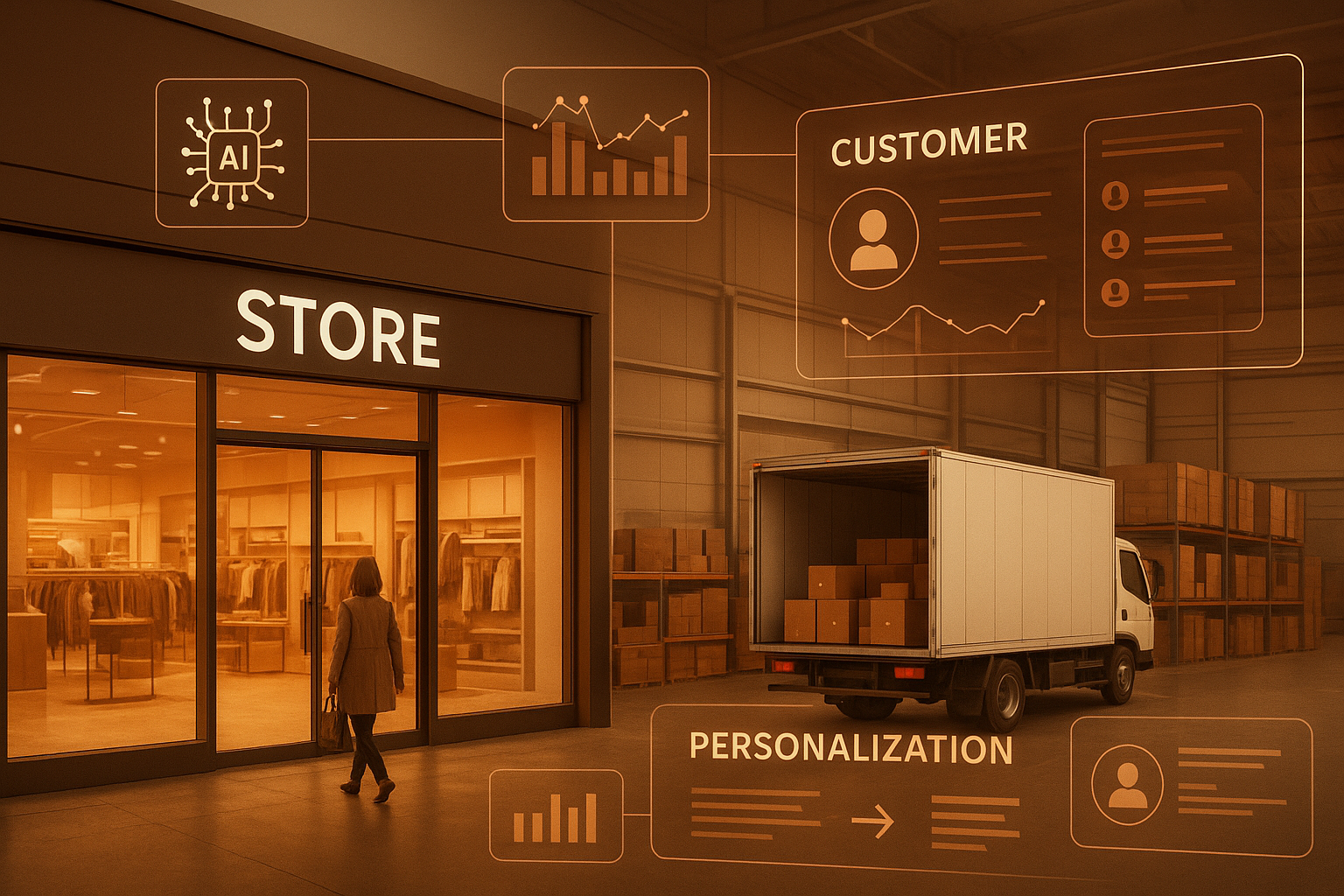

The growth-margin squeeze facing retail leaders in 2025 is more than a headline—it is a daily operational reality. Customer acquisition costs keep rising while shopper demand ricochets with macro shifts, weather, and trends. At the same time, stockouts and overstocks quietly erode brand experience and margin: missed sales from empty shelves; markdowns from bloated inventory. For CMOs and COOs, the most valuable capability is the one that both wins demand and protects margin. That is where retail AI trends 2025 converge: personalization and inventory intelligence acting as a double lever to grow revenue while tightening cost control.

The growth-margin squeeze and AI’s double lever
When marketing and operations are misaligned, investments amplify churn and waste. A campaign that drives traffic without an aligned fulfillment plan creates disappointed customers and returns. Conversely, operational efficiency without demand generation leaves shelf space unsold. AI creates precision: it helps marketers answer who to target, what creative will convert, and where offers should be served, while helping planners decide what to stock, how much to allocate, and which channels should fulfill. These twin capabilities—retail personalization AI and inventory optimization AI—are the core retail AI trends 2025 that actually move the needle.
2025 trends that move the needle in retail
Not every new capability labeled AI deserves executive attention. For 2025, focus on high-impact shifts that are practical and measurable. Generative models have matured enough to produce retail GenAI content at scale, but the value comes when they generate creative variation that is both brand-safe and on-brief. Parallel to that, real-time propensity scoring and next-best-offer engines let marketing treat customers as individuals across channels rather than segments on a spreadsheet. On the supply side, AI demand forecasting retail tools are moving from batch to streaming: demand sensing and allocation models that update with store-level signals reduce both stockouts and markdowns. Finally, store operations assistants and dynamic labor planning powered by inventory and traffic forecasts keep in-store experience consistent while containing labor costs.

Starting-out track: Fast wins in 60–90 days
For mid-market retailers or those beginning their AI journey, early wins build trust and deliver ROI quickly. A retrieval-augmented generation product knowledge assistant can be deployed for store associates in weeks, making every sales interaction better without replacing human judgment. On the content side, retail GenAI content used to draft email and onsite copy—paired with human QA and brand guardrails—reduces creative cycle time and improves test frequency. Finally, a basic demand-sensing model for your top 100 SKUs, using POS and promotional inputs, can immediately reduce stockouts on best-sellers. These are practical examples of retail AI trends 2025 that require limited engineering lift but provide measurable impact.
Scaling track: Platform plays for durable advantage
Once you have early wins, the challenge becomes scaling without fracturing systems. The durable advantage comes from a unified customer and product data layer with identity resolution, so personalization signals and inventory signals feed the same decisioning loop. A real-time feature store then powers both offers and inventory decisions, meaning the same propensity score that drives a next-best-offer also informs allocation and fulfillment logic. Scaling also requires institutionalizing test-and-learn: A/B and multivariate testing baked into marketing and planning operations so every release is an experiment that improves the flywheel.

Org model: CMO-COO-CTO coalition
Technology alone won’t deliver. The organizational model must break silos and assign decision rights. CMOs and COOs need a joint backlog that prioritizes initiatives delivering both conversion and sell-through improvements. Shared KPIs—conversion, return rate, sell-through, and markdowns—create clarity about tradeoffs. The CTO’s role is to provide the data fabric and maintain velocity through APIs and composable commerce integrations. Incentives need to align to total enterprise value so that growth is pursued without sacrificing margin.
Measurement that satisfies finance
Finance teams are skeptical of shiny AI promises, and they should be. To secure investment, rely on robust measurement frameworks. Holdout testing remains the gold standard for proving incremental lift from personalization or AI-generated assets. For creative investments, use media mix modeling augmented to account for AI-driven creatives. On the operations side, report improvements in forecast accuracy, inventory turns, and fulfillment cost per order. Finally, scenario modeling that links promotions and weather/events to expected margin outcomes helps executives make informed tradeoffs before campaigns go live.
Make-vs-buy portfolio for speed and control
Deciding what to build and what to buy is a pragmatic choice that depends on capabilities and timelines. Leverage platform creatives and retail personalization AI vendors for fast time-to-value, while customizing ranking and allocation models where you have unique data advantages. Ensure that any generative solution includes brand-safety filters and trademark protections so your retail GenAI content never strays. The technical glue will be APIs and a composable commerce approach that allows you to swap or upgrade components without expensive rewrites.
How we partner with retail leaders
Helping CMOs and COOs navigate retail AI trends 2025 requires a cross-functional approach. We work with leadership teams to design AI strategy and operating models that balance quick wins and long-term platform plays. Our services cover personalization engines, AI demand forecasting retail models, and inventory optimization AI implementations that tie directly to conversion and margin KPIs. We also focus on people: training marketers, planners, and store leaders to use AI outputs as decision inputs, not oracle pronouncements. The ultimate goal is an omnichannel AI strategy where marketing and operations share a single source of truth and a shared roadmap: the CMO COO AI roadmap that turns experimentation into repeatable advantage.
For executives, the prescription is simple: prioritize initiatives that align personalization with inventory. When offers are smarter and stock decisions are more precise, customers get what they want and the business protects margin. These are the retail AI trends 2025 that matter—not because they are novel, but because they are measurable, scalable, and tightly coupled to the economics of omnichannel retail.
Contact us to discuss how we can partner on personalization and inventory intelligence initiatives.


Sign Up For Updates.