Accounting 4.0: Intelligent Process Automation for CFO Advisory Services

Accounting firms today are standing at a crossroads, facing mounting pressure to reinvent their service offerings and internal operations. As CFOs and finance leaders increasingly look for strategic insights rather than rote number-crunching, intelligent process automation (IPA) fueled by AI is redefining what is possible. For mid-market firms, this shift can be daunting, but also presents an exciting opportunity to unleash higher-margin advisory services and truly differentiate from competitors. But what does Accounting 4.0 really mean for partners and their teams?

Diagram showing automated vs. manual accounting workflows, highlighting time savings and efficiency.

The Automation Imperative in Modern Accounting

The winds of change have grown stronger in recent years, with three dominant factors accelerating the need for digital transformation in finance. First and foremost is the talent gap. The cost of attracting and retaining skilled accountants continues to rise, with seasoned staff in especially high demand. Meanwhile, repetitive low-value tasks crowd workloads, burning out staff rather than inspiring them.

Simultaneously, clients are demanding more. Gone are the days when static year-end reports sufficed. Instead, organizations crave real-time insights, dynamic dashboards, and instantly actionable recommendations—capabilities fueled by the latest in AI in accounting. This expectation is reinforced by the rapid progress of tech-first competitors and fintech disruptors, who leverage sophisticated automation tools to promise both speed and superior value.

The combination of these pressures leaves no choice but to embrace intelligent process automation. Automation now means survival for mid-market accounting firms, not simply nice-to-have innovation—a powerful lever for retaining talent, slashing operational costs, and elevating client experience.

High-Impact Processes to Automate First

Intelligent process automation finance initiatives can feel overwhelming without a clear roadmap. The first step is to identify quick wins—those frequent, rules-based processes that rely on structured data and consume disproportionate amounts of staff time. These are the areas where AI in accounting delivers a measurable and immediate impact, freeing your people to focus on higher-order advisory work.

Screenshot-style visualization of an automated AP/AR dashboard with real-time financial metrics.

Consider processes like invoice classification, accounts payable and receivable reconciliation, or variance analysis during audits. These workflows are ripe for automation because they involve repetitive actions and clearly defined logic. Many firms have experienced dramatic efficiency gains with automation tools; for example, implementing an AP/AR bot that reduced the full cycle time of reconciliation tasks by up to 40%. This not only compresses audit timelines but also empowers consultants to deliver value-added strategic guidance faster.

The criteria for identifying such quick wins are straightforward: high transaction frequency, well-structured data availability, and processes governed by transparent rules. When looking across your own firm’s operations, ask which tedious workflows can be codified and where automation can best augment human insight.

Blueprint for Implementation

Delivering on the promise of accounting firm digital transformation starts with assembling a robust technology foundation. The most effective approach for partners is blending several technologies: Robotic Process Automation (RPA) for rule-based workflows, Optical Character Recognition (OCR) for digitizing paper documents, and AI-driven analytics for real-time decision support, all deployed via a secure cloud platform.

Deciding whether to buy off-the-shelf automation tools or commission custom development depends on firm size, internal IT resources, and unique process requirements. Many mid-market accounting firms find that a hybrid model is best: leveraging proven vendor solutions for common tasks while extending them with bespoke features for specialized workflows.

Seamless integration into existing General Ledger (GL) or ERP systems is non-negotiable. Automation solutions must interoperate with the firm’s current software stack to avoid siloed data or fragmented workflows. Most modern vendors offer pre-built connectors for popular platforms, but thorough due diligence is essential to avoid integration headaches.

Finally, security and compliance are critical. As more sensitive data is moved into automated, cloud-driven workflows, adherence to regulations such as SOX and GDPR must be enforced from day one. Robust audit trails, granular access controls, and ongoing monitoring ensure that digital transformation increases trust and reduces regulatory risk—not the opposite.

Measuring ROI and Building Client-Facing Value

For many firms, the initial objective of AI in accounting deployment is cost savings: reducing manual hours, lowering error rates, and freeing up staff for more strategic projects. Tangible KPIs might include hours saved on recurring tasks, decreases in error and exception rates, and improvements in staff productivity. However, the true power of intelligent process automation finance initiatives lies beyond back-office efficiency gains.

By embedding automation into your client service model, you unlock entirely new revenue streams. Automated processes generate a wealth of real-time data, which can be synthesized into premium dashboards or customized advisory reports. These tools enable CFO partners to deliver continuous, data-driven insights—not just after-the-fact reporting. Client satisfaction (often measured by Net Promoter Score, or NPS) can surge as firms provide always-on access to actionable financial intelligence.

The most successful digital transformation journeys treat automation as a way to reimagine what advisory can provide, not just lower operational costs. Firms that package automation-driven findings as premium products—real-time risk alerts, cash flow forecasts, or benchmarking visualizations—can confidently move up the value chain, differentiating on insight rather than just accuracy and timeliness.

As client needs evolve and the competitive landscape shifts, intelligent process automation in finance becomes not just a tool, but the backbone of modern accounting. For partners ready to lead this change, the journey to Accounting 4.0 promises both exciting innovation and sustainable growth in the decade ahead.

Creating an AI Center of Excellence in Professional-Services Organizations: The CIO Playbook

Across consulting, legal, and engineering firms today, a common refrain echoes through CIO corridors: AI success stories are multiplying, but so are duplicated costs, inconsistent approaches, and fragmented governance. Building significant, scalable value from artificial intelligence in professional services demands something more than scattered pilots and isolated innovation. It requires focus, discipline, and shared resources—a strategic transition only possible by establishing an AI Center of Excellence.

Why an AI CoE Matters Now

Most large-scale professional-services organizations have felt the growing pain of siloed AI efforts. Separate practice groups may spin up their own data science teams, chase after different technology platforms, and develop models in isolation. While this surge in experimentation can breed innovation, it often leads to costly redundancy. Duplicated data pipelines, repetitive code, and inconsistent performance monitoring all drive up operational expenses with little strategic gain. The inefficiency quickly becomes untenable at enterprise scale.

Moreover, without centralized governance, model quality becomes unpredictable. Sensitive legal, financial, or client data handled by AI systems can put the firm at risk if compliance standards aren’t consistently enforced. The absence of common frameworks or shared best practices means every group reinvents the wheel—sometimes with dangerous results.

Centralizing AI activities into a dedicated AI Center of Excellence effectively transforms chaos into opportunity. An AI CoE doesn’t just streamline costs; it drives standards, creates a shared catalog of reusable assets, and shortens the path from experiment to solution. By enabling teams to leverage proven components and governance processes, CIOs can accelerate enterprise AI’s time-to-value, amplifying the impact across multiple business units.

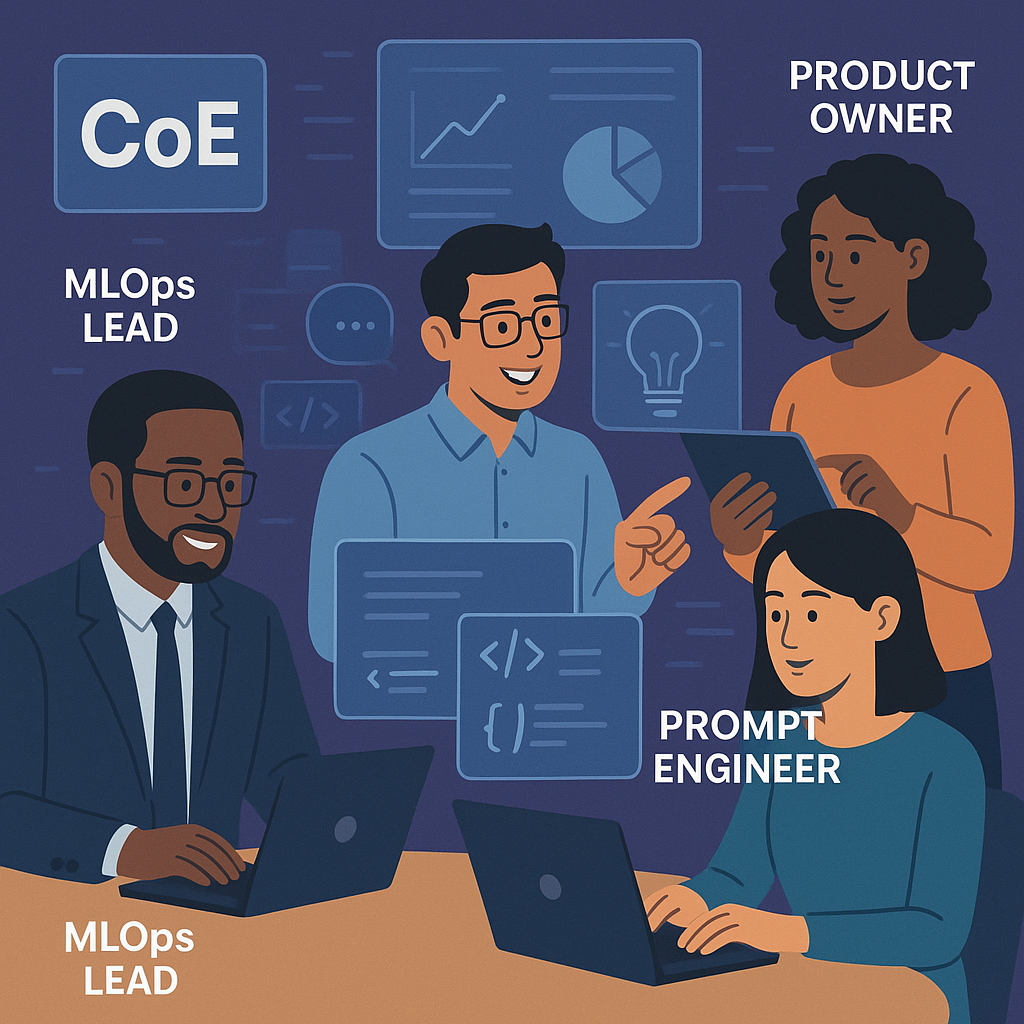
A team of diverse professionals collaborating around digital interfaces, representing key CoE roles such as product owner, MLOps lead, and prompt engineer.

Structuring the CoE: People, Process, Technology

Establishing an effective AI center of excellence is less about rigid hierarchy and more about encouraging collaboration. Hybrid hub-and-spoke models are especially suited to professional services CIOs. The central ‘hub’—the CoE—sets standards, maintains the reusable microservices catalog, and governs foundational models. Business units serve as the ‘spokes’, responsible for translating standards into real-world applications and innovation. This structure ensures that best practices are not only mandated but also adaptable to each group’s needs.

A high-impact AI CoE rests on well-defined roles. The product owner governs strategic AI priorities, balancing business needs with technological potential. MLOps leads handle the operationalization pipeline, ensuring models are deployed, monitored, and retrained consistently. Prompt engineers, increasingly critical with the rise of large language models, are charged with developing optimized prompts and fine-tuning system responses. Together, they form a cross-disciplinary core that enables robust enterprise AI scaling without sacrificing agility.

On the technology front, the CoE should curate a catalog of reusable microservices—modular APIs, data connectors, and model endpoints—that can be rapidly plugged into new projects. Standardizing on a set of platforms (cloud-based development, continuous integration pipelines, and centralized data repositories) makes adoption faster and maintenance easier. This not only supports scaling but directly enhances reusability, allowing the entire organization to capitalize on what works and learn from what doesn’t.

A conceptual org chart showing a hybrid hub-and-spoke AI governance model for a professional services firm.

Funding & KPI Framework

For most CIOs, securing and managing investment for enterprise AI is a balancing act between CAPEX (upfront technology and talent costs) and OPEX (ongoing support and operational expenses). An AI CoE creates a natural structure for a charge-back model, in which business units fund their consumption of shared assets, ensuring accountability while incentivizing prudent use of resources.

To drive value realization, the CoE should adopt a balanced scorecard approach to performance measurement. Key metrics might include innovation velocity (how many pilot projects move into production), efficiency gains (cost savings and time to deployment), and risk management (regulatory compliance and model accuracy). These indicators help drive transparent discussions about what’s working, what’s stalling, and where additional investment or upskilling is required.

A dashboard visualization detailing KPIs for AI initiative ROI and innovation in an enterprise setting.

Quarterly value-realization reviews, facilitated by the CoE, bring business units and leadership together to assess progress. This regular cadence anchors AI investments to strategic outcomes, solidifying the CoE’s role not just as a service provider, but as a trusted advisor helping steer the enterprise’s digital transformation journey.

Scaling and Continuous Improvement

As the AI landscape evolves, so too must the CoE’s strategy. Rapid advances in machine learning, generative AI, and automation mean technical debt can quickly accumulate if best practices aren’t continuously updated. The CoE must actively track and manage this debt—refactoring code, consolidating tools, and deprecating obsolete models as needed.

Upskilling talent is equally essential for sustaining a competitive advantage in enterprise AI. The CoE should design and facilitate learning pathways for both technical and non-technical staff, ensuring awareness of the latest technologies as well as responsible AI practices. Embedding these learning loops—through training, workshops, and peer collaboration—keeps the firm ahead of evolving standards.

Finally, partnerships are a powerful lever for continuous innovation. Engaging with leading vendors and academic institutions introduces fresh thinking and access to emerging technologies. Such collaboration can also unlock co-development opportunities, underpinning the organization’s reputation as an AI leader in the professional services sector.

Creating and operationalizing an AI center of excellence is a journey, not a destination. For the forward-thinking professional services CIO, it’s the linchpin that transforms scattered potential into enterprise-scale success—ensuring the organization not only keeps pace with change, but leads it.

If you’d like to discuss how to build an effective AI Center of Excellence tailored for your organization, contact us.

Predictive Analytics for Engineering & Design Consultancies: Driving Client Value Beyond CAD

The landscape for engineering and design consultancies is rapidly evolving. Traditional value propositions—rooted in precise drafting and detailed design—are being challenged by increasingly tech-savvy clients and commoditized markets. The arrival of predictive analytics consulting and digital twins is transforming how firms deliver value. Leaders at engineering firms must consider how to transition from transactional design to strategic, data-driven services. With the right engineering AI strategy, consultancies can unlock new growth and relevance by shaping insights that both protect assets and drive cost efficiencies for their clients.

A visualization of data integration between BIM/CAD systems and IoT sensors

Evolving from CAD Services to Data-Driven Insights

For decades, the core offering of most engineering and architectural consultancies has been to deliver accurate Computer-Aided Design (CAD) services. But as advanced drafting and modeling tools become more accessible, and offshoring pushes down costs, these services are increasingly viewed as commodities. The result: margins thin, and differentiation becomes ever more elusive.

At the same time, clients’ expectations are growing. Facility owners, operators, and investors now expect their engineering partners to deliver ROI projections, operational risk analyses, and actionable scenarios for future-proofing assets. Embedding predictive analytics into your services allows you to anticipate equipment failures, optimize asset lifecycles, and model future costs with new precision. Digital twins—dynamic models that mirror real-world structures and systems—are at the heart of this analytics shift. They enable consultancies to transition from static design delivery to ongoing, outcome-focused problem solvers.

With market forces accelerating the adoption of digital twin predictive maintenance and simulation, engineering firms who build robust analytics offerings are better positioned to secure long-term client relationships—and new, recurring revenue streams.

Data Foundations: Aggregating Design, IoT, and Maintenance Data

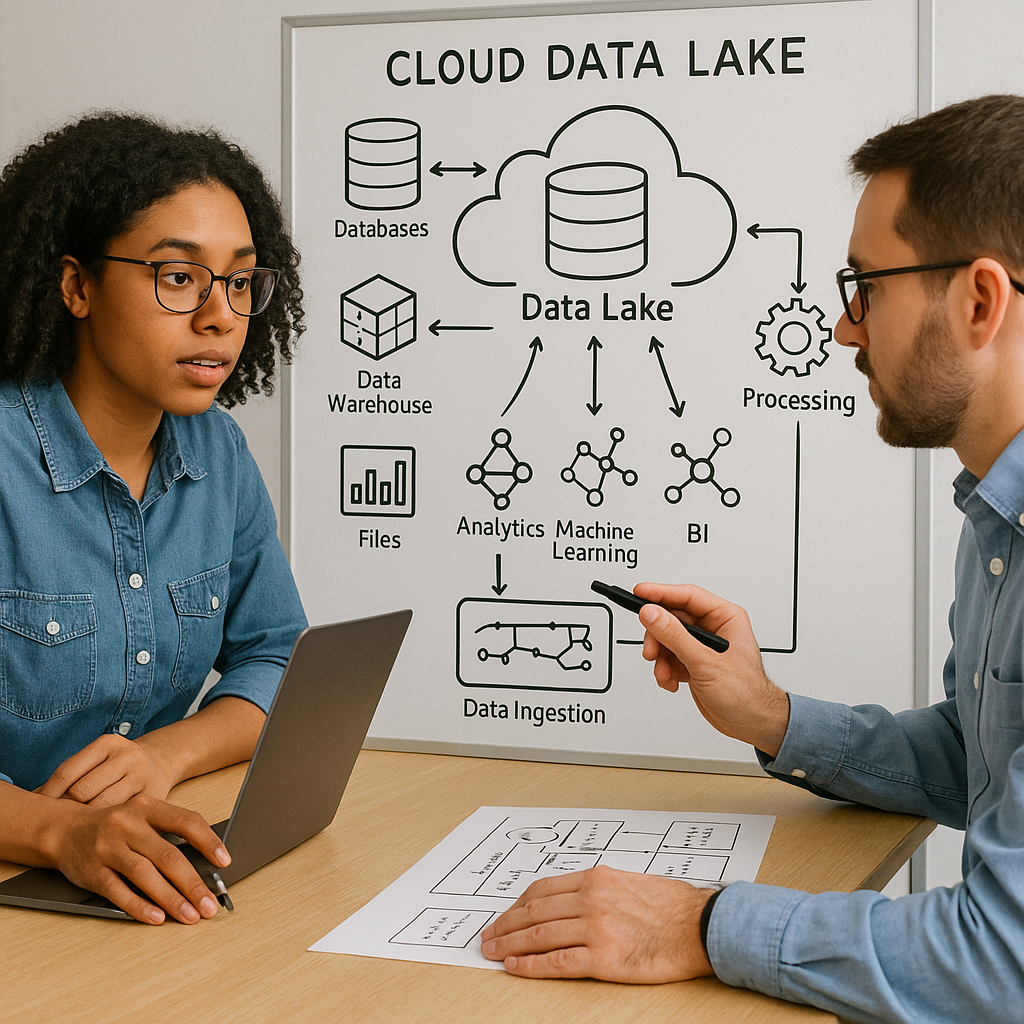
Engineers collaborating over cloud-based data lake architecture diagrams

Implementing predictive analytics consulting hinges on having clean, comprehensive data. Engineering data is scattered across BIM/CAD files, IoT sensor feeds, and maintenance logs—often siloed and inconsistent. To develop accurate predictive models, the first strategic move is to create a unified data foundation.

This typically begins with integrating historical CAD and BIM project files with streaming data from IoT devices; for example, sensors tracking energy use, temperature, vibration, or occupancy. Maintenance records, warranty information, and operational logs provide the ongoing context required to relate design intent to real-world performance.

A key challenge is data quality. Files may be formatted differently, units may not align, and sensor data might contain gaps or noise. Normalizing this data—standardizing formats, correcting errors, and filling gaps—is essential for robust modeling. Advanced firms are turning to cloud-based data lake architectures, centralizing structured and unstructured data at scale, while allowing for flexible querying and analytics access. Establishing this foundation enables rapid prototyping of predictive models and shortens time to deployment in live client settings.

Developing and Operationalizing Predictive Models

Once the data layer is established, the next challenge is to develop, validate, and operationalize predictive models tailored to your clients’ business outcomes. The process begins with careful feature engineering—identifying which design parameters, IoT signals, and historical maintenance records best predict the outcomes your clients care about. For example, features might include valve size from design data, vibration readings from sensors, and repair event frequencies from maintenance logs.

Models range from time-series forecasts (predicting when equipment may need service) to anomaly detection (identifying unusual operating patterns that signal risk). As models mature, firms must decide on the architecture for deploying insights: performing inference directly on edge devices (for real-time alerts), or in the cloud (enabling higher-complexity models and cross-asset benchmarking).

Crucially, model explainability is paramount when introducing predictive analytics into engineering workflow. Clients, many of whom are non-technical stakeholders, need clear, transparent rationales for every insight. Explainable AI methods—such as Shapley values or decision-tree visualizations—help build trust and ensure buy-in from clients’ operations, finance, and executive teams.

Packaging Insights as New Revenue Streams

A predictive maintenance dashboard showcasing cost savings projections

Transforming predictive models into monetizable offerings requires new business models and go-to-market strategies. Instead of one-time project fees, leading firms are launching value-added subscription dashboards that continuously update clients with health scores, risk flags, and optimized maintenance schedules across assets. These platforms can be tailored with role-based access and customized reporting to deepen client engagement.

Another powerful approach is outcome-based pricing, where consulting fees scale with proven improvements—such as a reduction in downtime or maintenance costs. By aligning incentives with client outcomes, consultancies become strategic partners instead of mere service providers. Engineering AI strategy coupled with digital twin predictive maintenance can be articulated directly in these pricing models, placing client goals at the center of the relationship.

The payoff is significant. Firms able to reduce clients’ annual maintenance costs by 10-20%, extend equipment life, or minimize downtime, can command premium positioning. As engineering decision-makers seek partners who proactively manage risk and deliver operational savings—not just drawings—consultancies that embrace predictive analytics will stand out for years to come.