Week 27 Theme — The Art of Prompt Engineering: Crafting Effective AI Prompts

For Health Care IT Directors: Prompt Engineering Basics with PHI Safety

When a Health Care IT director first starts exploring prompt engineering, the learning curve feels less like a single slope and more like a mountain ridge: many techniques to master, and a mandate to protect patient privacy at every step. Prompt engineering best practices in a HIPAA-bound environment start with prompt hygiene—clear statements of role, task, context, and constraints—and continue through secure retrieval, testing with synthetic data, and auditable output controls. These are not academic exercises; they are practical levers that improve accuracy and reduce legal and clinical risk.

Close-up of a prompt template on a laptop screen with placeholders for role, task, context, and constraints; hospital EHR UI blurred in background; clean, modern aesthetic

Start by defining templates that mirror clinical workflows. A care coordination template should specify the professional role (for example, “discharge nurse”), the task (summarize discharge instructions), the clinical context (diagnoses, meds, recent labs), and explicit constraints (no PHI in logs, citation required to source notes). This structured approach helps ensure consistency across similar prompts and makes outputs easier to validate against clinical standards.

Designing prompts that are PHI-aware requires several layers. First, implement redaction or tokenization at ingestion and ensure sandboxes use synthetic or de-identified datasets for development. Second, use retrieval-augmented generation (RAG for healthcare) so the model answers with evidence pulled securely from an access-controlled knowledge store rather than inventing facts. Third, add guardrails that detect and block inadvertent PHI leakage in outputs, and ensure audit trails record which documents were retrieved to create each response.

Evaluation at the edge matters because clinical nuance is non-negotiable. Assemble golden sets that represent the range of typical clinical questions and validate model outputs against medical ontologies such as SNOMED and LOINC for pattern checks. A human-in-the-loop review by clinical SMEs on a sampling basis keeps the system aligned to care standards, while automated ontological checks catch category-level errors early.

Hallucinations are a specific concern in clinical settings. To reduce them, favor retrieval-first prompting combined with short chain-of-thought patterns that summarize reasoning instead of exposing internal deliberations. Require citations and link answers back to discrete, auditable notes in the EHR. Where possible, integrate prompts directly with EHR context windows using SMART on FHIR or other APIs so the model sees a validated snapshot of the record rather than trying to infer context from a minimal prompt.

Operational realities influence prompt design. Latency and cost must be considered where clinicians work under time pressure. That means choosing lighter model paths for routine administrative tasks like coding assistance or prior authorization support, and reserving heavier, more costly models for complex clinical summarization. Quick wins often include drafting patient communications, pre-populating billing codes, and creating contact center scripts where a human reviews and signs off before release.

To scale safely, establish reusable prompt kits for common care operations: discharge summaries, prior auth templated requests, and follow-up communication templates. Pair those kits with RAG blueprints describing secure indexes, permission models, and encryption standards. Provide PHI-safe sandboxes for iterative testing and governance templates that define approval flows, retention policies, and incident response for suspected leakage.

These elements—structured templates, PHI-aware design, retrieval-first prompting, ontology-backed evaluation, and workflow integration—compose a practical, auditable approach to healthcare AI prompts that clinical leaders can deploy with confidence.

For Professional Services Partners: Scaling with Prompt Libraries and Evaluation Harnesses

Professional services firms face a different challenge: how to make prompt engineering repeatable and defensible across many teams, clients, and subject areas. The answer lies in reusable prompt patterns, rigorous evaluation harnesses, and organizational processes that institutionalize quality without stifling creativity.

A visual diagram of a prompt evaluation harness: golden dataset, human review loop, metrics dashboard, and version control; vector style, clear labels

Begin by codifying prompt libraries that capture the firm voice, citation norms, and deliverable standards. Each prompt pattern should include metadata: intended use case, applicable practice area, required context snippets, and a risk level. For research and drafting tasks, templates might encode citation formats and preferred source hierarchies. For analysis work, prompts should prescribe the model’s assumed role and the acceptable level of inference versus direct retrieval.

Evaluation harnesses turn subjective judgment into repeatable measurement. Move beyond raw BLEU or ROUGE scores; combine automated factuality checks that validate claims against a retrieval index with rubric-based human scoring for tone, relevance, and compliance. Implement AB testing across multiple LLMs to understand which base models perform best for particular prompt classes, and log differences to inform future prompt versions.

Versioning and approval are operational necessities. Treat prompts as first-class code artifacts: prompt PRs, lineage metadata, and release cycles tied to client deliverable types. A prompt change that affects how proposals are drafted or how legal memos are summarized should flow through a review board that includes subject matter stewards and quality assurance reviewers. That creates traceability and reduces surprises when a prompt update changes downstream outputs.

Security and privacy in professional services require workspace isolation and clear data retention policies. Use watermarking and model access controls to separate sensitive matter work from generic research. Implement logging to answer client questions about data usage and to comply with firm policies. Where client confidentiality is paramount, deploy models within the client’s cloud or an approved secure enclave and restrict exports of raw outputs until they are vetted.

Commercially, well-governed prompt libraries and evaluation pipelines increase utilization and realization by reducing rework and accelerating turnaround times. Faster proposal drafting, cleaner deliverables, and more consistent analysis all translate into improved matter economics. Capturing these productivity gains requires an operating model: create prompt guilds, appoint knowledge stewards, and publish playbooks for each practice that combine templates, evaluation rubrics, and escalation paths.

To support adoption, firms often invest in an LLM evaluation harness that automates testing against gold standards, surfaces regressions, and records human scores. That harness becomes the backbone of continuous improvement: every prompt iteration runs through it, and results feed into the prompt library’s release notes. This disciplined cadence helps firms scale AI safely while preserving quality and client trust.

Finally, align these technical and operational practices with vendor and cloud decisions. Whether the firm needs AI training services to tune models on proprietary data, AI development services to integrate with case management systems, or secure deployment on a preferred cloud, a clear roadmap for integration and governance is essential. A mature prompt governance framework turns one-off experiments into sustained capability.

How We Help

We support both healthcare IT leaders and professional services partners through practical deliverables: prompt kits for care operations, RAG blueprints for secure retrieval, PHI-safe sandboxes, governance templates, prompt library design, and LLM evaluation pipelines. Our approach focuses on reproducible patterns, clear risk controls, and operational integration so teams can realize the promise of AI without creating new liabilities.

Whether your organization needs to harden healthcare AI prompts to meet HIPAA requirements or to build an enterprise prompt library with an LLM evaluation harness, the art of prompt engineering is fundamentally an exercise in translation: turning human workflows and policy constraints into precise, auditable instructions for models. As you apply these techniques, prioritize safety, measurement, and repeatability—those priorities will determine whether AI becomes a partner in your operations or a costly experiment.

Contact us to discuss how our prompt engineering services can help your team scale safely and effectively.

Week 28 Theme — Industry-Specific AI Prompting: Tailoring Interactions to Your Sector

As companies move beyond pilot projects into production-grade AI, one thing becomes clear: prompts cannot be generic. Industry-specific prompting is a practical discipline that encodes domain context, governance checks, and multimodal cues into conversational and generative flows so models behave like specialists. This two-part exploration focuses on how plant leaders and CTOs can apply domain-aware prompting in smart factories, and how marketing executives in financial services can get hyper-personalization without losing brand safety or compliance.

Manufacturing: Domain-Aware Prompting for Smart Factories

Close-up of a maintenance technician using a tablet with annotated defect images and sensor graphs overlayed; industrial interior, realistic

In manufacturing, the cost of ambiguity can be measured in downtime. Domain-aware prompting begins by baking equipment taxonomies, failure codes, and OEE metrics into the prompt context so the model reasons with plant-level facts instead of vague assumptions. When a maintenance engineer asks for root-cause hypotheses, a grounded prompt supplies the model with the right vocabulary: asset IDs, spindle speeds, bearing codes, and recent SPC measurements. That small change shifts outputs from generic troubleshooting to actionable recommendations tied to parts, lead times, and MTTR targets.

Multimodal prompting is a big unlock for visual quality assurance. Imagine feeding a defect image from a vision system alongside the last three maintenance logs and an SPC chart. A well-crafted prompt instructs the model to cross-check the image against known defect ontologies, follow SPC and control-chart rules to flag out-of-control signals, and escalate anything that meets severity thresholds. When combined with structured outputs, these prompts can produce work orders and parts lists that hook directly into CMMS or ERP systems.

Structured outputs are especially important on the factory floor. Rather than asking a model to produce free-text recommendations, prompt designers include a JSON schema requirement: work_order, part_ids, estimated_downtime_minutes, recommended_action_codes. Returning machine-parseable JSON reduces human transcription errors and enables automated tracking of MTTR and preventive maintenance KPIs. For example, a prompt could require this JSON payload so downstream systems consume it reliably:

{
  "work_order": "WO-2025-0987",
  "asset_id": "MILL-42",
  "priority": "high",
  "estimated_downtime_minutes": 120,
  "recommended_action_codes": ["REPLACE_BEARING", "ALIGN_SHAFT"],
  "parts_list": [
    {"part_id": "BRG-1234", "qty": 1},
    {"part_id": "SHFT-222", "qty": 1}
  ]
}

Edge considerations must be explicit in prompt design. Safety-critical stations often need low-latency inference, offline modes, and on-device models that can operate without cloud connectivity. Prompts used at the edge have to be compact, deterministic where possible, and paired with local validation rules. Implementing validation loops—SME sign-off, synthetic fault injection, and A/B testing of remediation recommendations—creates a feedback mechanism that improves prompt context over time and prevents dangerous drift.

From an implementation perspective, the work starts with ontology capture: mapping equipment taxonomies, failure modes, and operational thresholds into a machine-readable form. Next you build multimodal pipelines that align images, sensor streams, and narrative logs into a single prompt context. Finally, plan for deployment patterns that include on-device inference for critical paths and cloud orchestration for analytics and long-term model updates. These are the practical steps manufacturing teams need to make manufacturing AI prompts go from interesting demo to reliable part of operations.

Financial Services Marketing: Compliant Prompting for Hyper-Personalization

A creative team in a bank marketing room reviewing AI-generated campaign drafts with compliance checkmarks and brand guidelines on screens; corporate office environment

Marketing in financial services lives at the intersection of creative performance and strict regulation. Hyper-personalization AI can lift engagement dramatically, but only when brand voice controls and compliance guardrails are built into the prompting layer. The most effective approach treats the prompt as a policy document: encode style guides, mandatory disclosures, readability constraints, and channel-specific tone rules into system prompts that shape every generation request.

Data minimization techniques are essential: prompts should never send raw PII to general-purpose models. Instead, use Retrieval-Augmented Generation (RAG) from approved content libraries, attribute-level tokens, or hashed segment identifiers. This allows the model to craft tailored messaging without accessing sensitive fields. For suitability checks, prompts include segment-level constraints—age, income band, product eligibility—so outputs are pre-filtered for compliance before they reach a creative reviewer.

Brand-safe AI requires both creative and audit-ready outputs. Prompt libraries can include guardrail recipes that enforce language around risk disclosures, non-deceptive claims, and equal-treatment across segments to minimize bias. It is also important to provide measurement signals for creative experiments: include uplift vs. control, CPA calculations, and creative diversity indices in the reporting pipelines so teams can quantify trade-offs between personalization depth and creative variability.

Operational workflow matters. Prompted content should pass through a staged review: creative review first for brand fit, legal checkpoints for regulatory suitability, and content fingerprinting for provenance and takedown capability. Governance tooling that logs prompts, model responses, and retrieval sources enables audit trails necessary for financial services compliance. That auditability is a cornerstone of AI governance for marketing and helps defend against later questions about targeting and claims.

For marketing teams, the value proposition of industry-specific prompting is clear: better creative performance with lower legal risk. We help clients by developing brand-safe prompt libraries, integrating governance workflows, and building marketing copilots that combine RAG, compliance checks, and human-in-the-loop review. Our focus is on practical guardrails—designing prompts that are auditable, minimize PII exposure, and produce channel-ready variants that align with brand voice and campaign KPIs.

Both manufacturing and financial services illustrate that prompts are not just interface text — they are policy, context, and integration code wrapped together. Industry-specific prompting makes AI predictable, auditable, and useful in domain-heavy environments. Whether you are tuning multimodal prompting for SPC and AI on the plant floor or shaping brand-safe AI for financial services marketing, the right prompt architecture accelerates adoption and reduces operational risk. The immediate next step for leaders is to map the domain ontologies that matter most, define the compliance and safety checks you cannot compromise on, and iterate prompts with real SME feedback so your AI becomes a trustworthy collaborator rather than an unpredictable black box.

Contact us to learn how industry-specific prompting can transform your operations and marketing strategy.

Week 29 Theme — Designing AI Training Programs: Building AI Literacy Organization‑Wide

Organizations that want AI to be more than a pilot need training programs that scale literacy, protect people and data, and connect learning to measurable outcomes. Designing AI training programs is less about a single course and more about building pathways that are role-aware, policy-aligned, and performance-driven. This week’s theme explores two practical routes: launching public sector AI literacy at scale and embedding retail upskilling tied to operational KPIs. Both paths prioritize AI enablement, change management, and governance so teams can adopt tools responsibly and effectively.

Close-up of a public sector training session showing a facilitator demonstrating AI policy guidelines on a screen with attendees taking notes, professional government office setting

Government L&D: An AI Literacy Blueprint for Civil Servants

When a government HR or learning and development leader begins planning public sector AI training, the first step is to see staff through the lens of role-based competencies. Caseworkers, call center agents, data analysts, and program managers will each need distinct profiles of proficiency. Caseworkers benefit from procedural AI literacy—how automated recommendations interact with confidentiality, how to validate outputs before they influence case decisions. Call center teams require prompt craft, handling sensitive PII, and escalation procedures. Analysts need a deeper understanding of model limitations, data lineage, and reproducible workflows. Program managers need to evaluate AI projects against policy goals and citizen outcomes.

Policy alignment anchors every learning decision. Public sector AI training cannot be divorced from data handling requirements, accessibility standards, transparency around automated decisions, and records management obligations. Designing modules that foreground these constraints—illustrating not just how to use a tool but when a human must intervene—creates equitable and defensible practice. Scenario-based lessons that simulate freedom-of-information requests or accessibility assessments make the rules tangible rather than abstract policy text.

Learning design must be pragmatic and modular. Microlearning short courses introduce core concepts such as bias, explainability, and data minimization. Complementing microlearning with hands-on labs—using synthetic data that mirrors common public sector formats—offers safe, realistic practice. Scenario-based assessments demonstrate competency by simulating adjudication tasks, call transcripts, or data cleansing exercises so that proficiency rubrics reflect actual job performance rather than quiz scores.

The enablement stack for government AI training should include sandbox environments, curated model endpoints, and a library of pre-approved prompts and templates. Sandboxes let learners experiment without risking citizen data. Pre-approved prompt libraries and safe evaluation tasks reduce the cognitive load for frontline staff and create consistent, auditable interactions with AI. Coupling these tools with clear escalation and auditing workflows helps compliance teams sleep easier while enabling everyday users.

Measurement focuses on meaningful adoption metrics: number of trained users by role, active usage in sanctioned sandboxes, and transfers of learning into improved service delivery. Quality-of-service changes—reduced case processing times, fewer errors in records, quicker response times in call centers—are compelling signals of success. Tracking citizen satisfaction and time saved on routine tasks gives leaders the ability to justify ongoing investment in AI training programs and to tie AI strategy enablement to real service outcomes.

How we help: For government clients starting out, the most valuable support is practical. We conduct needs assessments to map skills by role, design curricula that marry policy and practice, provision sandboxes with synthetic datasets, and deliver change communication kits for unions and stakeholders. That blend of curriculum design, sandbox provisioning, and governance helps move public sector AI literacy from policy statement to measurable capability.

Retail store employees using tablet copilots on the sales floor while a manager monitors dashboards, vibrant store environment, realistic

Retail CIOs: Scaling AI Training for Store, Ops, and CX Teams

Retail organizations seeking to scale AI across stores, operations, and customer experience must build training programs that tie directly to daily workflows and operational KPIs. Retail AI upskilling succeeds when training streams are aligned to concrete outcomes: shorter average handle times on customer interactions, lower forecast error in merchandising, higher conversion rates online, and reduced shrink in stores.

Curriculum streams should reflect the diversity of retail roles. Store associates need concise copilots training that shows how to use assistive tools at the point of service—inventory lookups, returns handling, and personalized upsell prompts—while preserving brand voice and privacy. Merchandising teams require forecasting-focused modules that combine demand planning theory with hands-on exercises using synthetic demand data. CX teams train on routing, QA, and content generation under brand constraints. IT and MLOps teams need operational training around model deployment, monitoring, and rollback procedures.

Live labs are the bridge between theory and daily impact. Replicating real ticket triage, content generation with brand guardrails, or demand planning exercises using synthetic transaction logs gives learners an immediate sense of relevance. These labs should mimic the cadence of retail work—short exercises for store managers between shifts, longer workshops for merchandising cycles—and include performance feedback loops that tie back to KPIs like forecast error delta and conversion uplift.

Tooling choices matter: low-code builders enable citizen developers to automate common processes, but only if paired with guardrails and approval workflows. Citizen developer governance ensures that store managers or merchandisers who build simple automations follow security and compliance checklists, use pre-approved connectors, and route model changes through a lightweight review process. This governance is the backbone of scalable AI process automation training: it allows rapid experimentation without creating operational risk.

Driving adoption in retail requires behavioral levers as much as training. Champions networks in stores, nudges embedded within the tools themselves, and recognition programs tied to performance incentives make training stick. When a store associate’s speed at checkout improves because of a trained copilot, celebrate and quantify that success. Visibility into performance—via dashboards that show AHT reduction, conversion uplift, or shrink reduction—turns training into a visible contributor to the bottom line.

How we help: For CIOs scaling AI, we design role-based academies that map learning to KPI outcomes, create governance frameworks for citizen developers, and build performance dashboards that correlate training completion with operational metrics. Our approach bundles scalable content, sandboxed live labs with synthetic retail data, and adoption playbooks so that AI upskilling becomes an engine of continuous improvement rather than a one-off initiative.

Both public sector and retail audiences share a common truth: successful AI training programs marry role-specific skills, policy and governance, hands-on practice, and measurable outcomes. Whether the goal is government AI literacy across civil servants or retail AI upskilling across stores and ops, program design should always start with the work people do, the risks they must manage, and the performance signals leaders care about. That is how AI enablement becomes sustainable, accountable, and genuinely transformative.

If you’d like to talk about building a scalable, policy-aligned AI training program for your organization, contact us.

Week 30 Theme — Emerging AI Roles: From Prompt Engineers to AI Ethicists

Emerging AI Roles: Building Reliable, Governed AI for Energy and Professional Services

Board-level conversations about artificial intelligence have moved quickly from theory to practical questions: who to hire, what to keep in-house, and how to make AI work within existing risk and commercial models. For leaders in reliability-driven sectors like energy and for CTOs scaling AI across professional services, the same reality is clear — emerging AI roles must be selected and organized around an AI operating model that prizes safety, repeatability, and measurable outcomes.

Part: Energy CEOs — The First Five AI Roles to Stand Up

Illustration showing an AI org chart for a reliability-driven utility: AI Product Owner, Data Product Manager, Prompt Engineer, MLOps Lead, Model Risk/Validation — connected to OT, IT and Compliance teams, flat modern design.

When an energy or utilities CEO is deciding the first hires for an AI program, the focus should be operational reliability and minimizing disruption to critical systems. Emerging AI roles should therefore be pragmatic: they must bridge data, operations technology (OT), and governance. A concise, high-impact initial team typically includes an AI Product Owner, a Data Product Manager, a Prompt Engineer, an MLOps Lead, and a Model Risk/Validation expert.

The AI Product Owner owns value and prioritization — translating use cases like predictive maintenance or grid optimization into deliverables that align with reliability goals. The Data Product Manager ensures high-quality, observable data products and interfaces with SCADA and historian systems. Prompt Engineers are increasingly important for rapid prototyping and safely harnessing foundation models in augmentation tasks, while the MLOps Lead builds repeatable CI/CD, monitoring, and incident response pipelines so models behave predictably in production. Finally, a Model Risk/Validation role focuses on model risk management, validation frameworks, and regulatory compliance, ensuring model change control and retraining criteria are auditable.

Deciding whether to build or borrow is central to an energy AI staffing strategy. Early on, partner with trusted AI development services and AI strategy consulting firms to accelerate pilots and to borrow interim leadership. Use external partners for heavy cloud infrastructure and specialized MLOps platforms, but hire permanent talent for roles that require deep institutional knowledge of OT and safety culture: Data Product Manager and Model Risk/Validation. Prompt Engineering and initial MLOps leadership can be contracted or seconded initially, then transitioned in-house as maturity increases.

Safety and compliance must be embedded into the AI operating model from day one. That means formalizing incident response for models, including runbooked procedures for model degradation, drift detection thresholds, and roll-back mechanisms. Change control must be applied to model versioning and data schema changes; every model deployment should include a human-in-the-loop decisioning step until validated performance and reliability history justify more autonomy.

Operational interfaces are vital. A clear RACI that maps AI Product Owner and Data Product Manager to responsibilities with OT, IT, and Compliance reduces finger-pointing. For example, OT remains accountable for physical actuation and emergency shutdowns; IT supports identity, network, and cloud controls; Compliance signs off on model risk and data sharing agreements. A human-in-the-loop policy specifies when operational decisions require approval by certified engineers rather than automated model outputs.

For most energy organizations, a practical 12-month staffing plan looks like a phased progression: months 0–3 hire or contract an AI Product Owner and a senior Data Product Manager and engage an MLOps platform partner; months 3–6 add a Prompt Engineer and an interim MLOps Lead while beginning model risk assessments; months 6–12 hire a permanent Model Risk/Validation lead and transition MLOps ownership in-house. Budget ranges vary by region and scale, but a conservative estimate for initial staffing plus tooling is generally in the mid-six-figure range for smaller utilities and rises into low seven figures for larger grid operators — aligned to deliverables such as a production pilot, monitoring pipelines, and validated model governance artifacts.

How we help: Our services provide interim AI leadership, detailed hiring profiles for each role, playbooks for reliability-first deployments, and a fast-track CoE jumpstart that integrates with OT governance. We focus on practical outcomes: safe deployments, auditable model risk controls, and the handoff plan to permanent staff.

Part: Professional Services CTOs — The AI Delivery Guild and Governance

Image of a professional services team in a workshop setting building an AI delivery guild: whiteboards with capability map, reusable asset catalog on screen, governance flowcharts, diverse team.

For CTOs in professional services firms, the challenge is different: scale AI delivery across diverse practices while keeping work billable, compliant, and reproducible. Emerging AI roles here align to a capability map that includes solution architects, RAG (retrieval-augmented generation) engineers, evaluation specialists, MLOps, data governance leads, and ethics or AI policy advisors.

Institutionalizing an AI Center of Excellence or an AI delivery guild creates reusable assets and governance mechanisms. In practice this means formal design reviews, a model risk board to approve high-risk engagements, and a reusable asset catalog with vetted prompt templates, RAG connectors, and deployment scaffolding. Operating mechanisms include periodic design reviews, a peer review process for architecture and prompts, and a centralized registry for model versions and lineage to support model risk management.

Commercial alignment is essential: pricing for AI-accelerated work should reflect incremental value and the cost of governance and quality assurance. Firms should set utilization targets for AI specialists and define quality SLAs for deliverables, especially where outputs are client-facing and potentially composable into client IP. A governance structure that ties commercial incentives to the AI operating model reduces leakage and ensures consistent margins on AI-enabled engagements.

Talent strategy in professional services should emphasize career ladders and mentorship: junior engineers rotate across practices to build breadth, senior architects mentor and maintain the asset catalog, and a core set of MLOps leadership ensures production readiness and monitoring for repeatable offerings. Cross-practice rotations increase knowledge transfer and reduce single-point dependence on specialist individuals.

Quality bars must be explicit: Red teaming, adversarial testing, and thorough evaluation protocols should be required for any client-ready model. Documentation standards — including threat models, evaluation datasets, expected failure modes, and client handover guides — are non-negotiable to scale safely and to support billable AI work without surprising clients.

How we help: We set up AI guilds, define governance frameworks and model risk boards, and build asset libraries and MLOps platforms tuned for professional services. Our focus is on turning one-off experiments into repeatable AI development services that are profitable, compliant, and auditable, while supporting a clear AI talent strategy that retains and grows expertise.

Both energy CEOs and professional services CTOs face the same imperative: emerging AI roles must be organized into an AI operating model that balances innovation with discipline. Whether the priority is grid reliability or predictable billable AI, defining the right roles, governance, and talent pathways early reduces risk and accelerates value. If you are planning hires or designing an AI operating model, start with the interfaces that matter — OT, IT, compliance, and commercial delivery — and build toward a repeatable, auditable capability that can scale.

To discuss tailored staffing plans, governance templates, or a CoE jumpstart for your organization, reach out to explore a practical roadmap aligned to your risk profile and commercial objectives.

AI Jumpstart for Mid-Sized Consulting Firms: Building Your First Automated Research Assistant

The consulting industry is experiencing a sea change, and mid-sized firms stand at a crossroads. Clients are more discerning than ever, demanding not just insightful recommendations but the operational speed and data sophistication once reserved for the largest strategy players. Against this backdrop, the emergence of generative AI technologies offers both a challenge and an unmatched opportunity. For managing partners and innovation leads in mid-sized consulting firms, there is a pressing question: how can you capture the value of AI quickly, safely, and with discernible ROI? The answer, for many, is to deploy an automated AI research assistant—a generative AI tool that liberates consultants from research drudgery and delivers rapid, actionable insights for client work.

Why Consulting Firms Can’t Wait on AI Any Longer

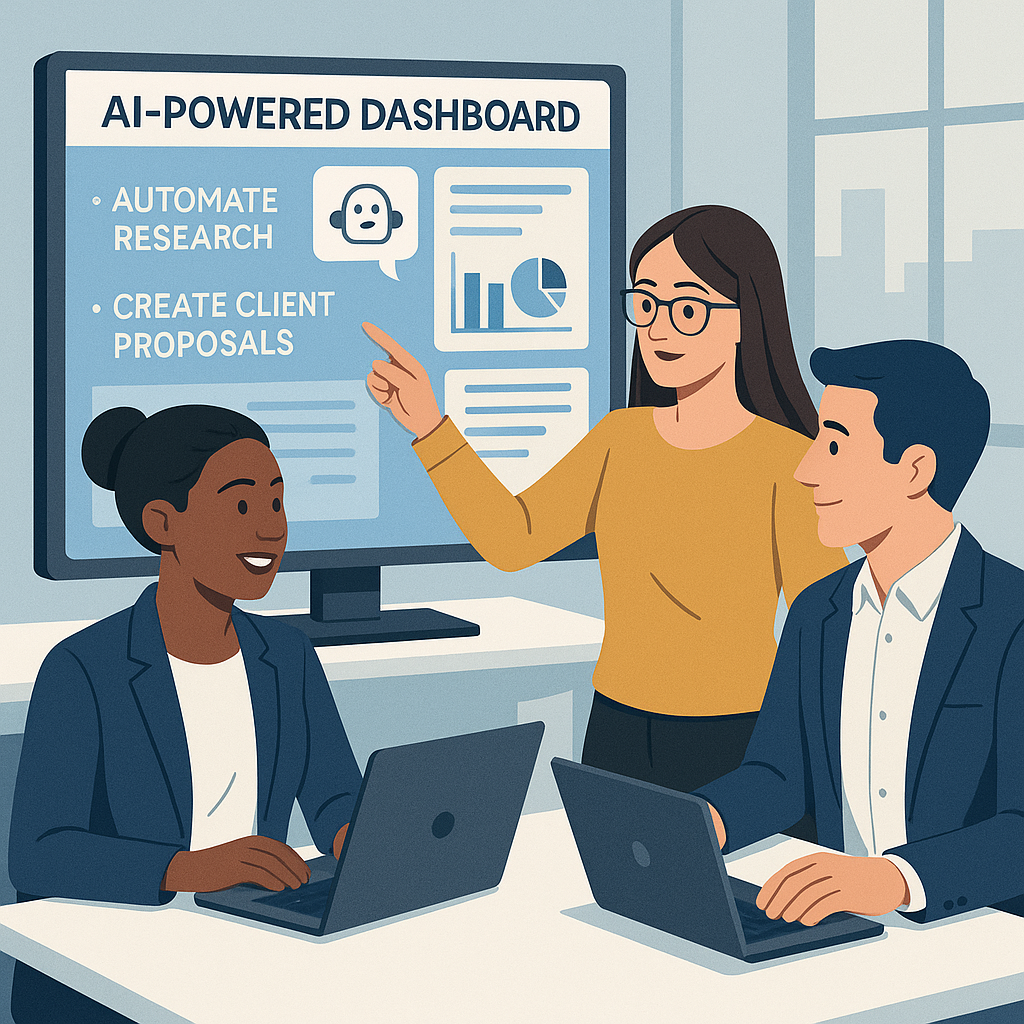
It wasn’t long ago that the terms AI and consulting rarely crossed paths, except perhaps in PowerPoint slides describing the future. Today, that future is here. Consulting clients—especially in sectors like finance, healthcare, and technology—expect proposals and deliverables enriched by AI-driven insights. The lines have shifted: AI-powered research, competitor benchmarking, and industry trend analyses are no longer differentiators; they are table stakes for winning new business. This imperative is especially clear during competitive bake-offs, where buyers pit multiple consulting teams against each other. Early adopters of AI aren’t just winning more frequently—they’re setting new standards for research velocity, data accuracy, and proposal creativity. Meanwhile, mid-sized firms face margin pressures and need every tool available to extend their consultants’ reach. The good news? The rise of cloud-based large language models (LLMs), available through mature APIs, drops the barrier to entry. Firms no longer need in-house data science teams or massive infrastructure investments to compete. Consulting team using an AI-powered dashboard to automate research and create client proposals, contemporary style.

Selecting the Right First Use Case: Automated Research Assistant

The path to AI adoption starts with the right use case—one that is manageable, impactful, and demonstrably valuable. For most firms, an automated research assistant epitomizes this profile. Why? First, consultants spend an enormous portion of their time gathering information, scanning news sources, digesting competitor activities, and crafting the backbone of proposals. This is high-value knowledge work—but much of it is repetitive and ripe for automation. An AI research assistant can swiftly pull, summarize, and contextualize data from diverse, trusted sources, trimming hours or even days from the proposal process. Second, the research domain is relatively contained. Unlike more ambitious AI deployments that require sensitive client data or custom modeling, automated research assistants work well within general business intelligence boundaries. This confines operational risk and simplifies governance compared to enterprise-wide automations. Finally, the output is directly client-facing. Faster, richer, and more accurate research not only improves internal efficiency but also becomes a tangible point of differentiation in client presentations and proposals. In a services business, where time is money and impressions matter, this is a compelling combination.

Architecture & Tooling on a Mid-Market Budget

Building an effective AI research assistant does not have to break the bank. The modern toolkit for mid-sized consulting firms is powerful and resource-efficient: Most commonly, the engine at the heart of the research assistant is a commercial LLM API, such as OpenAI’s GPT series or Google’s Gemini. These cloud-based models offer enterprise connectivity, robust documentation, and the competitive advantage of frequent updates. For firms with strict data privacy requirements, private-cloud LLM options exist from various vendors, but these come with higher setup and maintenance costs. The decision often hinges on the sensitivity of the data involved and client compliance obligations versus the speed and economy of SaaS platforms. Diagram of a generative AI research assistant architecture for consulting firms, including cloud LLMs, data ingestion, and secure document management. To transform these LLMs into consulting tools, the architecture typically relies on retrieval-augmented generation (RAG). Here, the AI model doesn’t just answer questions based on its training, but fetches current, firm-approved information from your secure document repositories and trusted market data feeds. This prevents hallucinations and ensures your research outputs are rooted in real, verifiable sources. Smart process automation is another pillar, with Robotic Process Automation (RPA) tools used to ingest, scrape, and structure source material such as news alerts, earnings reports, and market analysis. This automated data flow means less manual research and cleaner, more consistent input for the AI assistant. Don’t overlook governance, either. Any professional AI deployment must offer audit logging to track research queries and outputs, role-based access management to protect firm and client data, and clear procedures for model updates. Most mature AI platforms provide these features out of the box, but firms must still define access policies and review mechanisms tailored to their client commitments and regulatory landscape.

Change-Management & ROI Tracking

The technology is only half the equation—the other half lies in driving adoption among your consultants and demonstrating real business value. Change, even when positive, rarely happens automatically. Start with a clear 30-60-90 day adoption roadmap:
  • First 30 days: Build excitement with hands-on demos and pilot workshops. Encourage consultants to use the research assistant for one or two real client scenarios. Capture immediate feedback and surface quick wins—perhaps a story of a proposal prepped in half the usual time, or a client manager impressed by a new research angle the AI unearthed.
  • At 60 days: Track productivity KPIs that matter to your firm. A primary metric is hours saved—a direct measure of consultant capacity reclaimed for value-added work. You can also monitor the number of deliverables produced, average proposal turnaround times, and user adoption rates across teams.
  • By day 90: Begin storytelling to the broader firm and stakeholders: share anonymized stats, consultant testimonials, and examples of how AI-enabled research enhanced client outcomes. Use these narratives to win buy-in for next-phase funding, whether for deeper automation, vertical-specific models, or expanding the AI research assistant across practices.
Launching an AI research assistant in your consulting firm is not just a technical project—it is a statement of intent. Done right, it turns AI from an abstract risk into a practical partner, delivering cost savings, speed, and a foundation for broader transformation. The window for easy wins won’t stay open forever. Now is the time for mid-sized consulting firms to make AI a part of their everyday toolkit, starting with the research that underpins your client success. Ready to see how AI-enabled research could reshape your consulting practice? Contact us today to schedule a personalized demo and discuss the right launch strategy for your firm.

From Pilot to Practice: Scaling AI-Driven Document Review in Law Firms

Across the legal sector, the adoption of AI-powered document review has shifted dramatically from conceptual pilot projects to initiatives with the weight and scrutiny of full-scale business operations. For CIOs and knowledge-management directors in regional law firms, the question is no longer whether AI-driven document review has merit but how to industrialize its benefits without sacrificing the profession’s uncompromising standards on confidentiality, compliance, and trust. The road from a successful pilot to operational reality is paved with both technical and cultural hurdles, but a thoughtful roadmap can help management bring AI’s promise to scale.

Lessons Learned from Pilot Projects

The initial wave of AI document review pilots in law firms often brings enthusiasm and optimism, but many stall once the spotlight moves toward broader deployment. Several lessons recur in these efforts, each vital to consider as firms plan their next move.

One prominent discovery is model drift—AI models trained on generic language sources often falter when exposed to the specialized jargon and nuanced constructs found in legal writing, particularly in niche practice areas. This gap can undermine confidence amongst practitioners accustomed to precision. Furthermore, associate resistance remains tangible. Many younger attorneys worry that automation may threaten billable hours or disrupt established workflows, and seasoned lawyers may mistrust outputs from a ‘black box’ system.

Finally, pilots frequently stumble due to uncertain ownership. With responsibility divided between IT and various practice groups, initiatives risk being orphaned post-pilot, ultimately losing momentum. Without clear lines of accountability and ongoing stewardship, these projects rarely transition to business-critical platforms.

Building a Production-Grade AI Review Platform

Operationalizing AI document review calls for a robust technical foundation, emphasizing repeatability, security, and adaptability. Central to this is adopting a production-grade architecture built for legal work’s unique requirements. Many leading firms are choosing private-cloud large language models (LLMs), fine-tuned on thousands of firm-specific precedents and tailored content. This approach not only sharpens accuracy but also preserves client confidentiality by keeping sensitive data within controlled environments.

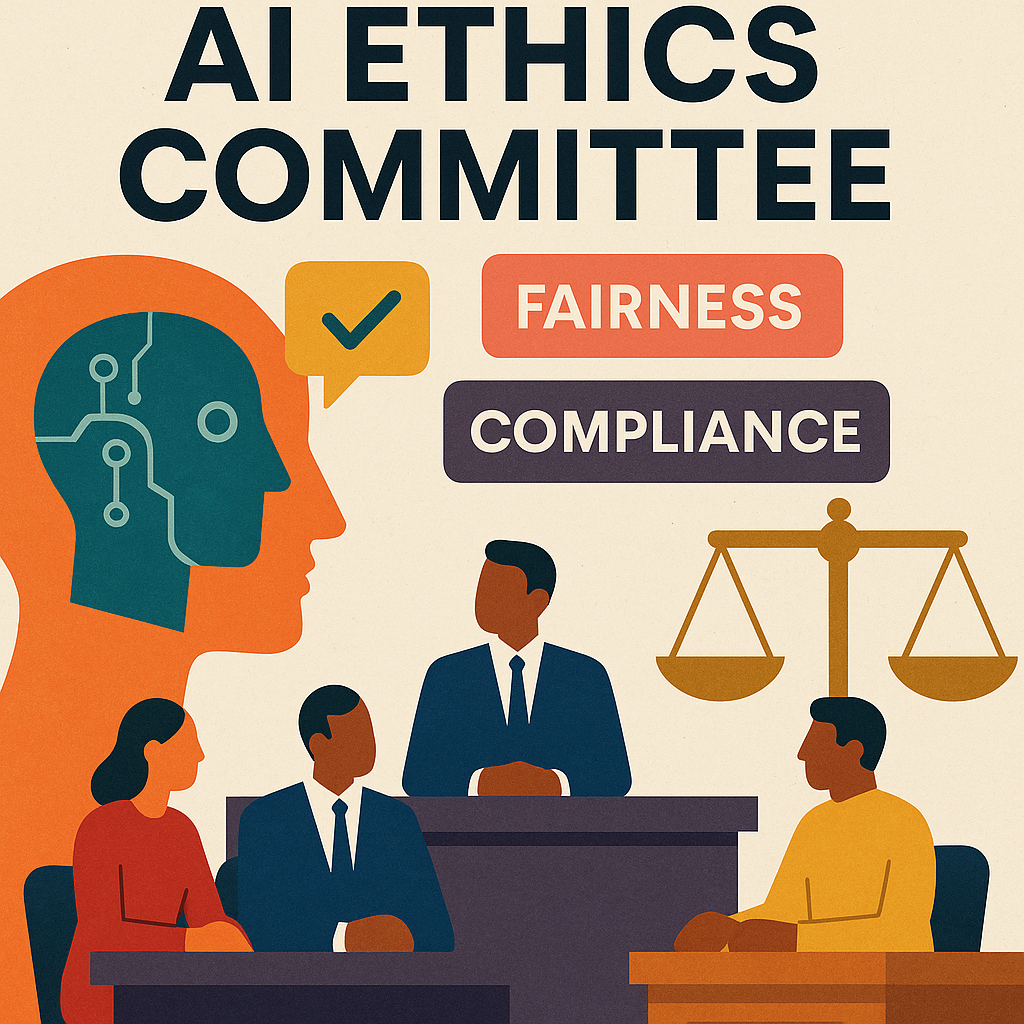
An abstract illustration of an AI ethics committee panel discussing fairness and compliance in a legal setting

Process automation is essential to scale: auto-redaction of personally identifiable information (PII), logging of every interaction, and integration with active directory systems for granular access control. MLOps frameworks further automate model retraining, helping curb model drift and reinforce reliability. Active-learning loops—where human reviewers validate and correct the AI’s work—continuously tune results and surface subtle errors that only seasoned legal professionals would detect.

Compliance and data integrity are just as paramount. Automated audit trails ensure every edit and annotation is recorded—critical for both regulatory compliance and internal investigations. A multi-tenant architecture enables different practice areas or even entire offices to work securely in parallel, each with isolated datasets and customized AI models, supporting firm-wide scalability without compromising on segregation demands.

A technical architecture diagram for AI document review, showing secure private cloud, data pipelines, and multi-tenant user flows

Governance, Ethics, and Client Trust

Scaling AI in a law firm context cannot succeed on technical prowess alone. Governance and ethics must advance in lockstep with process automation and technology. One cornerstone is explainability—legal teams must be able to articulate how AI tools produce their suggestions or classifications. This transparency is not just reassuring to skeptical lawyers; it’s also increasingly a regulatory expectation, with some bar associations providing guidance on the use of AI in the practice of law.

Client trust is built on transparency and explicit consent. Updating engagement letters to include AI disclosures and client consent clauses is becoming a best practice. These not only inform clients about how their data will be handled but preempt potential concerns about automation’s role in workflows central to their matters.

Law firms are also establishing AI ethics committees, composed of stakeholders from IT, legal practice, risk, and client relations. These bodies set policy on data governance, monitor for bias, and oversee audit trail reviews. Such committees provide the cross-functional oversight necessary for aligning practice innovation with the profession’s ethical standards and client commitments.

Change Enablement & Talent Strategy

Even the most advanced AI document review platform will underperform if attorneys and staff do not embrace it. Successful change enablement combines education, process redesign, and incentive alignment. Human-in-the-loop training programs offer a dual benefit: associates learn to vet AI outputs, improving model accuracy through feedback, while simultaneously gaining confidence in the technology. Training should not only teach the mechanical usage of tools but also focus on how to interpret results and navigate edge cases unique to legal practice.

A stylized chart showing increasing associate productivity and adoption rates as AI document review is scaled

Redefining workflows is essential for embedding these tools into daily operations. Rather than seeing AI-powered review as an ancillary or optional service, forward-thinking firms model the impact on billable hours, client turnaround, and firm-wide productivity. Transparent communication around these models can help alleviate associate concerns about utilization rates and compensation.

Finally, incentives must be institutionalized. This could include recognition programs for early adopters, integration of AI usage metrics into performance reviews, or making AI training a requirement for advancement. As adoption spreads, the firm can measure ROI not only through the cost savings of faster document review, but also via improved quality, enhanced client satisfaction, and reduced burn-out among junior staff who historically handled the most tedious review work.

The journey from pilot to production demands strategic commitment, the right investments in secure and intelligent infrastructure, and a cultural plan that engages rather than alienates attorneys and clients. By addressing legaltech process automation holistically—balancing technical excellence with responsible governance and change leadership—law firms can transform AI document review from isolated experiments into an enduring operational advantage.