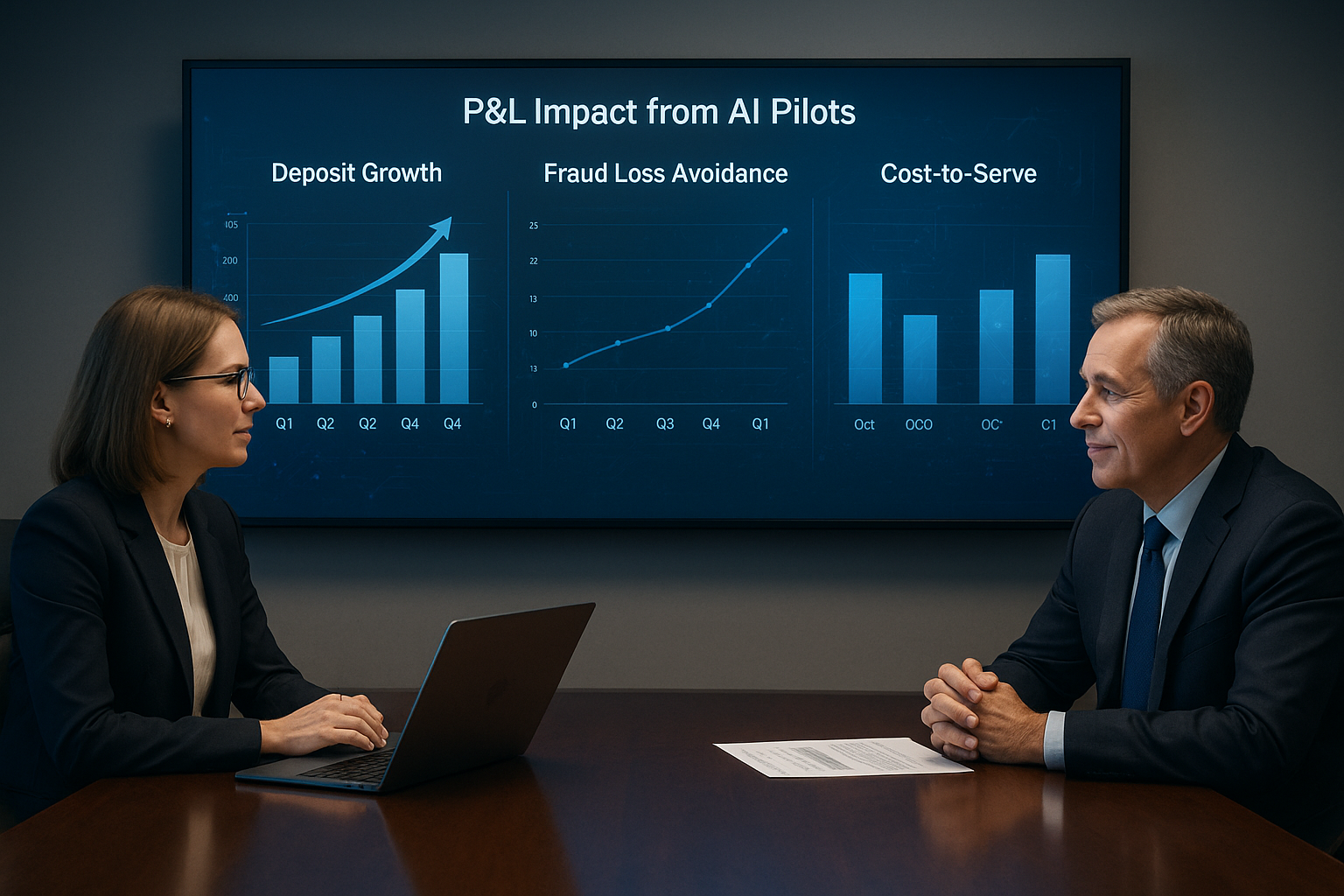
Aligning AI With P&L in Financial Services: From Pilot to Portfolio

Why aligning AI with P&L matters now

Executives in regional and mid-market financial institutions hear two competing narratives about AI: one promises transformational top-line growth, the other warns of regulatory and reputational risk. The truth sits in the middle. AI delivers greatest value when it is deliberately tied to the balance sheet—when pilots are chosen for their direct impact on deposit growth, net interest margin protection, fraud loss avoidance, and cost-to-serve. This article maps a pragmatic path for CEOs and CFOs starting out, and for CIOs and Chief Risk Officers who must scale AI responsibly across the enterprise.

Part 1 — The CEO/CFO’s Guide to AI That Moves the Balance Sheet in Regional Banking

For a regional bank taking its first AI steps, the strategic question isn’t which technology is coolest; it’s which small number of initiatives will visibly move North Star metrics within 90 days. Think of AI as a portfolio of bets. Limit your first portfolio to two or three use cases that map cleanly to top- and bottom-line levers: revenue lift (for example, cross-sell and deposit offers), cost-to-serve reduction (contact center automation), risk loss avoidance (fraud/AML detection), and capital efficiency (faster credit decisions that reduce NPLs and provisioning).

Define a short list of North Star metrics—deposit growth, NIM protection, fraud loss rate, average handle time (AHT) in contact centers, digital containment rate, and loan cycle time—and make those the criteria for success. Use a simple scoring model so investment decisions are transparent: score each use case by value (estimated P&L impact), feasibility (data readiness and integration effort), and risk (regulatory or compliance exposure). Multiply or weight those dimensions to create a ranked shortlist.

Diagram-style image showing a simple AI portfolio scoring matrix: impact × feasibility × risk with green/yellow/red scores, clean fintech design
Scoring matrix: impact × feasibility × risk, with green/yellow/red scores for prioritizing AI use cases.

Starter use cases that translate quickly to measurable P&L changes include intelligent triage in the contact center, next-best-offer engines for deposits and credit cards, KYC document automation, and SME loan intake automation. Each of these has a clear line to a North Star metric: reduced AHT, higher deposit balances, lower onboarding times, and fewer manual compliance hours.

Put discipline around a 90-day plan. In week 0–2 run a rapid discovery and data audit to validate the scoring assumptions and catalog the required data sources. Between weeks 3–6 build a lightweight MVP focused only on the signal needed to demonstrate impact. Weeks 7–10 are for a tightly controlled pilot and baseline KPI measurement. In weeks 11–12 convene stakeholders for a go/no-go decision tied to CFO scorecard thresholds and a scale plan for the chosen bets.

Risk controls must be baked in from day one. Maintain model documentation, apply explainability thresholds for any decision that affects credit or detection of fraud, and keep a human-in-the-loop for high-risk decisions. That combination protects customers and regulators while enabling the model to learn effectively.

How our services help: we work with finance leaders to translate P&L levers into AI use cases, apply ROI-driven prioritization frameworks, and deliver rapid MVPs that integrate into branch and operations workflows. We also train branch and operations leaders to interpret model outputs so the business captures the intended cost and revenue benefits.

Part 2 — The CIO/CRO Playbook for Governed AI Portfolios in Banking & Insurance

Once a handful of pilots have demonstrated tangible financial services AI ROI, the hard work begins: moving from project thinking to product thinking. CIOs and Chief Risk Officers must institutionalize AI value creation with a governed model portfolio, tiered funding, and quarterly value reviews that tie directly to enterprise OKRs.

Establish a governed model lifecycle that covers inventory, validation, backtesting, champion–challenger experiments, performance SLAs, and a retraining cadence. This is model risk management AI in practice: it is not an afterthought but the operating principle. Inventory and lineage let you demonstrate to auditors how a model was built and how data moved through the stack. Validation and backtesting provide counterfactuals that regulators expect. Champion–challenger ensures continuous improvement without exposing production risk.

The supporting reference architecture should include composable data products—customer 360 and transaction aggregates—an enterprise feature store, a model registry, CI/CD for models, and a monitoring layer that watches for drift, performance degradation, and bias. Secure PII handling and separation of duties are essential, especially when models influence pricing, underwriting, or claims decisions.

Reference architecture visual: customer 360, feature store, model registry, CI/CD pipeline, monitoring dashboard, secure data layer, modern enterprise style
Reference architecture showing customer 360, feature store, model registry, CI/CD, monitoring, and secure data layer.

At scale, use cases expand into fraud graph detection, claims automation with document AI, collections propensity models, and personalized pricing within guardrails. Quantify ROI as you scale: measure fraud loss avoided, claims cycle-time compression, cost-to-serve deltas, and incremental revenue. Tie these metrics back to the enterprise’s financial targets so AI outcomes are visible in board reporting.

Risk and change management should be compliance by design. Implement explainability thresholds and lineage for audit, and apply red-teaming or adversarial testing to model inputs. Make sure GLBA and SOX obligations are reflected in the control framework. These activities protect the institution while enabling safe innovation.

How our services help: we help build AI portfolio governance, implement MRM-aligned MLOps, and operate high-risk models through a build-operate-transfer approach. Our work makes monitoring, validation, and retraining operational, and equips executives with the reporting they need to demonstrate financial services AI ROI and regulatory readiness.

Bringing the two perspectives together

CEOs and CFOs need clear financial thresholds and a disciplined 90-day approach to de-risk early AI bets. Meanwhile, CIOs and CROs must create the enterprise plumbing and controls—banking MLOps and model risk management AI processes—that let pilots become durable, audited products. When the two viewpoints align, AI spends become investments: a portfolio of tightly governed products that deliver measurable revenue, cost, and risk improvements.

Start small with P&L-oriented pilots that validate assumptions quickly. Then, invest in the governance, architecture, and operating model that allow those pilots to scale into enterprise change. That sequence—pilot to portfolio, tied to specific balance-sheet levers—is how financial services organizations convert AI potential into predictable financial outcomes.

For executives ready to move from experimentation to measurable impact, the right mix of CFO-aligned prioritization and CIO/CRO-grade controls will be the difference between an interesting pilot and an enduring competitive advantage.

If youd like help prioritizing AI use cases tied to your P&L or building governed MLOps, contact us to discuss a 90-day MVP and scaling plan.

Manufacturing ROI: Aligning AI to OEE, Yield, and Energy Intensity

Part 1: Plant Manager’s Field Guide to AI for OEE in 90 Days

When a plant manager first hears promises about AI manufacturing OEE improvements, the natural reaction is skepticism — until you frame the work as a focused, measurable change to availability, performance, or quality. The quickest high-probability win for many lines is computer vision quality control at a bottleneck station. Imagine a single camera trained on the last inspection point before packaging. Properly executed, that one model can drop scrap, reduce rework routing time, and move OEE by double digits within three months.

Close-up of a camera above a conveyor belt capturing product images for computer vision quality control with annotations, bounding boxes, and yield stats overlaid
Camera-based vision inspection above a conveyor with annotated defect detections and yield statistics.

Translate AI into the OEE Language

OEE is simple to speak but complex to influence. Translate AI objectives into availability (unplanned downtime), performance (throughput), and quality (scrap and rework). For a starter project, choose quality because vision-based detection maps directly to scrap and yield. A well-tuned computer vision quality control system reduces false accepts and flags defects early so automated rework routing or line-side repair can keep throughput steady.

Data Prep and Pilot Design

Data is the practical barrier. Capture a balanced image set that represents the full variability of the line: lighting changes, conveyor speed, product orientation, and marginal defects. Annotate consistently to your QC spec and align image timestamps with MES event labels so that each detection maps to a unit ID and production batch. During model development, run shadow mode: the AI scores images without acting on them, while humans continue to verify. Track baseline scrap rate, false positive/negative rates, and cost per good unit. When the model reaches acceptable FP/FN levels, move to human-in-the-loop acceptance where operators confirm AI flags and the system learns over a short feedback loop.

Change Management on the Line

Trust is earned. Start with transparent thresholds and escalation protocols that route ambiguous cases to experienced operators rather than an automatic shutdown. Update standard work and provide short, focused training sessions that show operators how the system helps them reduce manual inspections. Track acceptance metrics like time-to-verify flagged units and rework cycle time. Small operational wins — fewer line stops due to manual inspection, faster rework routing — compound into measurable OEE uplift.

The 90-Day Cadence

A pragmatic timeline keeps stakeholders aligned: discovery (2 weeks) to pick one line and defect class; data collection and model development (4 weeks) to build and validate the vision model; OT integration (2 weeks) to connect to PLCs and MES and enable routing commands; and a pilot (2 weeks) in human-in-the-loop production. This cadence emphasizes speed over scope and creates early ROI evidence to expand to adjacent lines.

For plant managers starting out, the immediate ROI comes from reduced scrap, lower inspection labor, and fewer rework loops. Emphasizing how the work ties back to AI manufacturing OEE metrics helps get buy-in from production supervisors and finance alike.

Part 2: CTO Playbook for Multi-Site AI—Predictive Maintenance and Edge Ops

Scaling from one successful line to a portfolio of plants requires a different conversation. The CTO’s job is to make AI repeatable, governable, and measurable across sites so that industrial AI ROI is not a collection of anecdotes but a reliable part of operations planning.

Aligning AI with Corporate KPIs

Start by translating corporate goals — OEE uplift, energy per unit, warranty claims — into an AI roadmap. Prioritize use cases with portfolio-level impact: predictive maintenance for critical assets, energy optimization for compressors and HVAC, and autonomous parameter tuning on key bottlenecks. Predictive maintenance edge AI often lands highest on the list because it directly reduces unplanned downtime and maintenance costs while improving availability.

Reference Architecture for Scale

A reliable architecture balances edge inference with centralized governance. Deploy compact inference on site to meet latency and connectivity constraints, while central services maintain a model registry, feature store, and APM integration. Use lightweight messaging (MQTT or Kafka) for telemetry and a standardized schema for sensor features to simplify cross-site analytics. The architecture should support federated model updates: templates that are tuned locally but versioned centrally.

Edge AI hardware (compact industrial computer) mounted on a production line with MQTT and cloud icons connecting to a dashboard showing predictive maintenance and manufacturing MLOps pipelines
Edge inference hardware on the shop floor with cloud connectivity and a centralized MLOps dashboard.

Manufacturing MLOps on the Shop Floor

Manufacturing MLOps is about procedures as much as tools. Version models per line, maintain clear rollback plans, and instrument drift monitors that alert when sensor distributions or label accuracy diverge from training. Integrate with change control and quality management (ISO 9001) so that model changes follow the same audit trail as firmware or equipment modifications. For predictive maintenance edge AI, include sanity checks that prevent hazardous automated actions and route decisions through maintenance approvals when required.

Rollout Pattern and ROI Verification

The recommended pattern is lighthouse plant → playbook → federation. Deliver a repeatable playbook from the lighthouse deployment that includes data schemas, deployment scripts, operator training modules, and KPIs. Then roll out in cohorts, allowing localized tuning while measuring cohort-level ROI: reduction in mean time between failures, energy per unit improvement, or warranty claim reduction. This cohort approach builds confidence and helps quantify industrial AI ROI at scale rather than as isolated wins.

Workforce Enablement and Governance

Long-term success rests on people. Build a Center of Excellence that trains maintenance techs as AI-aware practitioners and appoints AI champions at each site to own day-to-day operations and feedback loops. Update SOPs and provide lightweight diagnostics and visualization tools so teams can interpret model outputs. Governance should include model performance SLAs, data retention policies, and a compliance checklist that maps to safety and quality audits.

For CTOs and VPs of Operations, the technical challenge is only half the equation. The cultural and procedural elements — standardized templates, clear KPI alignment, and an MLOps backbone — are what turn pilot gains into sustainable portfolio-level improvements.

Both starting projects and scaled deployments share a common thread: they must demonstrate predictable industrial AI ROI anchored to operational metrics. Whether you’re a plant manager launching your first computer vision quality control pilot or a CTO building manufacturing MLOps across sites, prioritize measurable outcomes, clear timelines, and operator trust to translate AI into lasting improvements in OEE, yield, and energy intensity.

If you want help moving from idea to impact, our services cover line assessments, rapid CV model development, PLC/MES integration, enterprise architecture, edge deployments, and CoE setup to accelerate and govern industrial AI ROI across your manufacturing network. Contact us to discuss a pilot or portfolio rollout.

Government Administration: Mission-First AI that Improves Service Levels and Trust

Government Administration: Mission-First AI that Improves Service Levels and Trust

When Agency CIOs and Program Executives talk about AI in government automation, the conversation often divides into two camps: quick wins that reduce backlogs and large-scale programs that promise enterprise efficiencies. The real opportunity sits between those extremes—deploying mission-first AI that measurably improves service-level KPIs while building governance, procurement, and transparency practices that earn public trust.

Part I — Agency CIO Starter Kit: Automate Intake to Cut Backlogs and Improve SLAs

For an agency just beginning its public sector AI journey, the most persuasive wins come from reducing time to decision and shrinking backlog size. Citizen services automation starts with simple, defensible use cases: document classification and extraction, eligibility triage, and drafting FOIA responses for human review. These are document AI public sector scenarios that produce measurable service-level improvements quickly.

Begin by tying every automation directly to mission metrics. Ask: will this reduce average time to a decision? Will it lower error and rework rates? Will it improve citizen satisfaction (CSAT)? A 90-day plan aligned to those metrics keeps teams focused. Spend two weeks triaging use cases and cataloging intake forms and queues. Choose one to two high-volume, low-risk forms for a six-week pilot that implements document classification and extraction. Finish the sprint with a two-week measurement window to compare SLA lift and error reduction against baseline metrics.

Diagram of a 90-day AI starter plan: discovery, pilot, measure. Minimalist icons, timeline, government setting.
Diagram: 90-day AI starter plan showing discovery, pilot, and measurement phases for a government agency.

Data readiness is crucial. Complete a records inventory, identify PII and sensitive fields, and confirm retention schedules and privacy policies before any model sees live data. Automated redaction and masking are part of responsible document AI public sector implementations. Design human-in-the-loop checkpoints so caseworkers approve decisions and maintain an audit trail that preserves content provenance for public records. Those approval workflows and immutable change logs are not optional when records compliance and transparency are on the line.

Operationally, the starter kit should include clear roles: data stewards to manage records inventories and retention; quality owners to review model outputs; and a rollout owner to track SLA and CSAT improvements. Keep the initial scope small, instrument everything for measurement, and prepare simple explainability notes for reviewers so they can understand why a document was routed or a field extracted. This builds confidence and supports future expansion.

Our services for this phase focus on translating mission goals into a public sector AI roadmap: use-case triage workshops, document AI implementation, staff training on human-in-the-loop processes, and change communications that set expectations with service teams and the public.

Part II — Program Executive Guide: From Point Automations to Enterprise Platforms

Once a few pilots demonstrate measurable SLA and backlog improvements, the conversation shifts to scale. Program executives must think in platforms, not point solutions. A shared document AI service, common virtual assistant frameworks, reusable prompt libraries, and centralized knowledge bases reduce duplicate spend and make it easier to maintain consistent governance policies.

Governance becomes the backbone of scaling. Establish an AI ethics board to set acceptable use, run bias checks on eligibility models, and require content provenance for all generative outputs. Government AI governance should mandate explainability reports and audit logs for any system that influences citizen outcomes. Integrate those requirements into your procurement language so vendors build them into deliverables rather than bolt them on later.

Integration patterns matter. Design APIs that connect document AI to case management systems and ERP platforms, and adopt event-driven automations so downstream systems receive transactions when human approvals occur. A zero-trust architecture is essential for inter-agency data access—every call should authenticate and log, and sensitive fields should remain encrypted at rest and in transit.

Architecture diagram showing shared document AI platform connecting to case management, API layers, and zero-trust security. Clean vector style.
Architecture: shared document AI platform connected to case management, APIs, and zero-trust security components.

Procurement should favor modular contracts with outcome-based milestones and clear acceptance criteria tied to SLA improvements or backlog reduction. Encourage small business participation and align security requirements to FedRAMP or StateRAMP levels appropriate for the data classification. These procurement patterns keep momentum while protecting the agency from vendor lock-in.

Transparency and trust are program-level responsibilities. Publish plain-language documentation about what the AI does, how decisions are made, and how citizens can appeal automated outcomes. Create community feedback loops and public explainability reports so stakeholders understand model behavior. These practices not only reduce complaints; they build legitimacy for broader citizen services automation.

At this scale, our services shift to platform blueprints, governance frameworks, procurement support, and build-operate-transfer engagements that help agencies own and run their platforms. We help define reusable components—prompts, knowledge bases, connectors—and operational playbooks for security, monitoring, and continuous model validation. The goal is to enable agency teams to sustain and evolve the platform without overreliance on external vendors.

Operationalizing Trust and Mission Outcomes

Whether you are an Agency CIO building a first pilot or a Program Executive orchestrating enterprise adoption, alignment to mission outcomes is the guiding principle. Start with document-centric automations that produce clear SLA and CSAT gains. Protect citizens and records with PII handling, retention alignment, and human-in-the-loop safeguards. As you scale, bake government AI governance into procurement and platform requirements, design integration patterns for secure interoperability, and make transparency a public policy.

AI in government automation is not a technical problem alone; it is an operational, legal, and communications challenge. A public sector AI roadmap that centers mission KPIs and trust will reduce backlogs, improve service levels, and position the agency to expand automation responsibly. If the first 90 days are disciplined and the scaling phase is governed, the payoff is faster decisions, fewer errors, and stronger public confidence in digital services.

To learn more about building a mission-first approach, agencies can pursue targeted workshops, pilot implementations, and governance frameworks that translate policy into practice. Our team supports these steps with practical services designed for the public sector: AI roadmaps for mission outcomes, document AI implementation, staff training and change communications, platform blueprinting, governance frameworks, and procurement assistance for build-operate-transfer transitions.

Start with a small, measurable automation linked to a mission metric. From there, design for scale with governance, procurement discipline, and openness. That is how AI improves service levels and earns the public’s trust.

Healthcare ROI: Align AI to Patient Outcomes and Operational Throughput

Healthcare ROI: Align AI to Patient Outcomes and Operational Throughput

When hospital leaders think about artificial intelligence, the conversation often drifts into promising demos, vendor roadmaps, and abstract potential. The most valuable pathway, however, starts by asking one simple question: which AI investments measurably free capacity and improve access for patients? For CEOs standing at the intersection of finance, quality, and operations, the priority is not novelty—it’s measurable return tied to patient outcomes and throughput. This article lays out a pragmatic blueprint for beginning that journey and a companion guide for IT leaders who must scale pilots into a HIPAA-safe AI platform with robust clinical AI governance.

Close-up of a hospital executive reviewing an AI-driven patient access dashboard on a tablet, clean UI, diverse hands
Hospital executive reviewing an AI-driven patient access dashboard on a tablet.

CEO Blueprint—AI That Frees Capacity and Improves Access

Imagine walking the halls of your hospital and seeing waiting rooms move faster, fewer patients leaving without care, and clinicians spending more time at the bedside than on clerical work. That future is accessible when leaders choose AI use cases that directly reduce no-shows, shorten length of stay, lower readmissions, and increase provider productivity. Focusing on these outcomes clarifies both the clinical value and the financial return. AI in hospitals ROI is not an abstract metric—it’s hours reclaimed, fewer ambulatory slots lost to no-shows, and lower administrative cost per encounter.

For executives starting out, the earliest wins come from targeted, high-impact use cases. Appointment no-show prediction paired with automated outreach converts potential revenue back into scheduled visits, improving access and reducing leakage. Automated prior authorization packet assembly cuts days from authorization cycles, reduces denials, and speeds care. Nurse staffing forecasts aligned to predicted patient demand prevent bottlenecks on the floor and lower overtime expense. A patient FAQ copilot reduces call center volume and improves patient experience without adding headcount. Each example ties to measurable throughput or cost-of-care improvements and can be measured against your hospital scorecard.

Clinical AI governance must be baked into each pilot. That means medical director sponsorship, a safety review before deployment, clear escalation paths for unexpected outcomes, and a plan to measure quality and equity impacts. Governance is not an afterthought; it is the mechanism that turns an intriguing model into a dependable operational tool. When clinical leaders sign off, the organization better understands the tradeoffs and the benefits that contribute to AI in hospitals ROI.

Practical timelines matter. A 90-day plan that executives can approve is often the fastest path from concept to demonstrable value: two weeks of discovery to align stakeholders and success metrics; two weeks to prepare data and set guardrails; six weeks to build and run an MVP pilot that integrates with workflows; and two weeks for executive review and decision. This disciplined cadence creates momentum and provides early evidence of return so leaders can choose next steps confidently.

Our services support that cadence by aligning strategy to hospital scorecards, delivering rapid automation for targeted workflows, training care teams, and tracking benefits. When ROI is defined as improved access and reclaimed capacity, the investments and the metrics fall into place.

IT Director Guide—From Pilots to a HIPAA-Safe AI Platform

IT director in a server room looking at screens showing model registry and audit logs, muted colors, tech-focused
IT director reviewing model registry and audit logs in a server room.

Once the executive team has approved prioritized pilots, the conversation shifts to reliability, compliance, and scale. IT directors and chief digital officers must transform one-off models into an enterprise-grade foundation that supports repeatable delivery. That foundation must be PHI-safe, auditable, and resilient. A HIPAA-safe AI platform is not a single product—it’s an architecture of de-identified data products, secure pipelines, a model registry, prompt libraries with guardrails, and comprehensive audit logging.

Start by unifying data into PHI-safe data products. Build de-identification pipelines where appropriate and maintain secure enclaves for sensitive functions. A centralized model registry keeps models versioned and traceable. A prompt library with approved templates and response constraints reduces prompt drift and preserves consistent clinician experience. Audit logs that record inputs, model versions, and human approvals are essential to both clinical AI governance and regulatory compliance.

Scaling use cases requires attention beyond architecture. Radiology triage, ambient clinical documentation, bed/OR optimization, and revenue cycle denials prediction are operationally transformative, but each comes with unique reliability and safety considerations. Bias monitoring needs to run continuously; safety constraints must be baked into inference; and human-in-the-loop sign-off should be required for high-risk clinical decisions. Every rollout should include a clear rollback plan and defined thresholds for automated intervention cessation.

Clinician using ambient scribe AI on a wearable device during patient interaction, subtle, respectful depiction
Clinician using an ambient scribe AI on a wearable device during patient interaction.

Change enablement is the connective tissue between technology and impact. Clinician champions must help shape workflows so tools augment rather than disrupt. Integrations with the EHR should be seamless—data where clinicians expect it, suggestions where they act. Training and feedback loops translate early adoption into sustained usage. IT teams that pair technical delivery with structured clinician engagement see far higher adoption and better healthcare AI operations outcomes.

Economics should be transparent. Track hours reclaimed, throughput gains, and denials avoided. Use those savings to finance scale: a reinvestment model where service lines that benefit contribute to shared platform costs ensures sustainability and clear accountability for value. This approach strengthens the case for wider investment and cements the connection between technology and institutional priorities.

We help technical teams by building HIPAA-aligned platform engineering, operational MLOps capabilities, governance committees, and a center of excellence that transfers both tooling and know-how to internal teams. This combination accelerates safe scaling while preserving compliance and control.

Putting Outcomes and Governance at the Center

Across both the CEO and IT director perspectives, a few themes recur. First, prioritize AI that materially affects patient access and operational throughput if you want clear AI in hospitals ROI. Second, invest early in healthcare AI operations practices—secure data products, model governance, and auditing—to avoid downstream risk and rework. Third, make clinical AI governance visible and respected so that safety and equity are measured alongside productivity and cost savings. And finally, treat ambient scribe AI and other clinical automation not as curiosities but as capacity multipliers that improve clinician experience and patient throughput when deployed with strong change enablement.

Leaders who align AI investments to measurable outcomes and enforce guardrails will unlock ROI and build trust simultaneously. The practical combination—CEO focus on high-impact use cases and IT-led delivery of a HIPAA-safe AI platform—creates a sustainable path from pilot to enterprise value. That path is how hospitals realize the promise of AI in better patient access, improved throughput, and responsible, governed innovation.

If you are planning the next steps, consider mapping two parallel workstreams: a business-led 90-day delivery for immediate wins and an IT-led platform program for long-term scale. Together they form the operating model that turns experimentation into dependable value and keeps clinical safety at the center of every decision.

Professional Services (Management Consulting): From Proposal to Profit with AI-Aligned KPIs

Part A — Partner Playbook: Use AI to Improve Win Rate and Proposal Cycle Time

Partners who live and die by a quarterly pipeline understand that small improvements in win rate and proposal velocity compound quickly into revenue. Introducing AI in consulting is not about replacing expertise; it is about amplifying the firm’s ability to capture and convert opportunities faster. If you start with the business outcome—more wins, shorter sales cycles, and higher average deal size—you avoid the classic trap of experimenting with models that look impressive but don’t move the needle.

Close-up of a consultant using a laptop with a copilot UI drafting a proposal; text snippets and RAG knowledge nodes floating above the screen, clean enterprise aesthetic.
Consultant drafting a proposal with a copilot UI using retrieval-augmented generation from a sanitized case library.

Begin by linking AI investments to measurable outcomes: proposal win rate, proposal cycle time, average deal size, and the cost of sales. A pragmatic starter focus is proposal automation AI: a copilot that drafts tailored proposals from a sanitized case library, performs capability mapping against client RFPs, and generates crisp competitor and market briefs. That scope keeps risk low because the content is derived from internal IP and curated external sources rather than ungoverned internet retrieval.

Data and IP safety must be built into day one. Curate source content, apply redaction and client consent policies, and enforce access controls so only cleared team members and the copilot prototype can use sensitive materials. A simple content taxonomy and siloing approach dramatically reduces leakage risk and accelerates acceptance among partners who are rightly protective of client confidentiality and IP.

A practical 90-day playbook helps translate ambition into outcomes. Spend the first two weeks on a content audit—identify client-ready case assets, proposals, and capability statements and map them to common RFP asks. Weeks three to six are for a working prototype copilot that uses retrieval-augmented generation (RAG) against the sanitized library and exposes a proposal draft workflow integrated with version control. The final month pilots the copilot on five live bids with partner oversight, measuring proposal cycle time, time saved per draft, and any signal in win rate.

Throughout the pilot, measure not only velocity but also downstream delivery impact. Track the utilization buffer needed for delivery teams to absorb new work and monitor changes in cost of sales. Those metrics make the business case for scaling and frame the conversation with partners around profit, not novelty.

Our services for partners focus on lowering the barrier to capture value: strategy and data preparation, building a proposal copilot tailored to your firm’s language and IP, hands-on partner and staff training, and ongoing ROI tracking to demonstrate the real impact on win rates and proposal velocity. Early wins create the credibility you need to expand AI in consulting across practices.

Part B — CTO/COO Guide: Firmwide Copilots and Knowledge Graphs for Utilization and Margin

Once partners see measurable uplift, CTOs and COOs must build the scalable platforms and governance that turn prototypes into firmwide capabilities. The core KPI set shifts slightly when you move from capture to delivery: consultant utilization, engagement margin, delivery cycle time, and the quality of the proposal-to-delivery handoff become the levers that drive margin expansion. Consulting utilization AI becomes a central theme—using AI to reduce non-billable work, accelerate research, and improve forecasting.

Abstract enterprise architecture diagram overlay: knowledge graph nodes, entitlements, and secure RAG pipelines connecting firm content repositories and client silos; sleek infographic style.
Enterprise architecture of a secure RAG knowledge graph with entitlements and client silos to enable auditable retrieval.

Architecturally, enterprise-grade RAG knowledge management is the backbone. Combine a knowledge graph of reusable assets—methodologies, deliverables, code snippets, slides, and sanitized case artifacts—with entitlements that enforce firm and client silos. This structure enables retrieval that is both accurate and auditable, and it lets copilots deliver relevant content without exposing sensitive material.

Scaling use cases include delivery accelerators for research and synthesis, QA checklists that augment human reviewers, code accelerators for analytics and modeling, and engagement health prediction models that flag margin or utilization risks early. These features shorten delivery cycles and directly influence engagement margin by reducing rework and enabling faster billable ramp-up.

Robust governance is non-negotiable. An AI governance professional services framework should include data residency rules, client-specific silos, watermarking of copilot outputs, and usage analytics that show who accessed what and why. Define clear policies for charging or discounting AI-accelerated work and ensure that pricing and billing practices reflect the productivity delta delivered by the technology.

Change management is the human side of scaling. Establish communities of practice and AI champions within each service line, publish playbooks for common engagement types, and align incentives for reuse so consultants are rewarded for contributing high-quality artifacts to the knowledge graph. These cultural and process changes are how consulting utilization AI goes from a novelty to a durable advantage.

Our services for CTOs and COOs are designed to create a secure, scalable foundation: knowledge platform build-out, secure RAG implementation with entitlements and logging, copilot rollout tailored by practice, an operating model for governance, and enablement programs that drive adoption. We focus on measurable KPIs—utilization uplift, margin improvement, and faster delivery cycles—so you can tie technology investments directly to firm profitability.

Bringing Both Parts Together

When partners and technology leaders align, AI in consulting becomes a strategic amplifier rather than a collection of pilots. Start with proposal automation AI to deliver rapid, visible ROI for partner-led capture activities. Use those wins to fund RAG knowledge management and consulting utilization AI at scale, backed by a governance model that protects IP and client data while enabling reuse. The result is a cleaner pipeline, faster proposals, higher utilization, and healthier engagement margins—KPIs that speak the language of firm leadership.

Choose interventions that map directly to measurable business outcomes, keep IP safety central, and sequence investments so you unlock value quickly while building for scale. That is how consulting firms move from experimenting with AI to running it as a reliable lever for proposal-to-profit performance.