Designing a Regulator‑Ready AI Academy for Mid‑Market Banks: A Blueprint for CIOs

For mid‑market banks and credit unions, artificial intelligence is no longer a speculative advantage — it is a regulatory touchpoint, a competitive lever, and a staff capability challenge all at once. Bank CIOs who build AI literacy without simultaneously satisfying model risk, privacy, and audit expectations risk expensive rework and missed opportunity. Designing an AI academy that is regulator‑ready means blending pragmatic skills development with controls, measurable outcomes, and clear lines of accountability. This article outlines a blueprint that ties role‑based learning to governance, practical automations, and metrics that speak to both the boardroom and the regulator.

Flowchart showing role-based learning paths for executives, risk, IT, and frontline staff with icons representing KYC, AML, and underwriting
Role-based learning paths connecting KYC, AML, and underwriting to specific job families.

Why AI Literacy Is Now a Compliance and Growth Imperative

Regulators increasingly expect banks to treat AI and machine learning like any other model in production: documented, validated, explainable, and monitored. Expectations around fair lending, model risk, and explainability are translating into audit checklists and exam questions. At the same time, peers are deploying automation across digital onboarding and fraud prevention, compressing customer expectations for speed and accuracy. The right AI training for banks therefore has two aims: reduce risk and accelerate value. When learning programs are mapped to strategic KPIs — cost‑to‑income, fraud loss reduction, and Net Promoter Score — executives can see how financial services AI literacy becomes a runway for revenue and resilience rather than an abstract compliance exercise.

Role‑Based Curriculum Architecture

An effective AI academy organizes learning by role so that content is relevant and immediately applicable. Executives need a compact track that covers AI strategy, risk appetite, and investment governance so they can make informed tradeoffs. Risk and compliance teams require model risk management training that mirrors SR 11‑7 thinking: bias testing, validation methodologies, and documentation practices that will stand up to examiners. IT and data teams demand hands‑on modules covering MLOps, data quality, feature stores, and LLM safety banking considerations such as prompt controls and output monitoring. Frontline staff and operations teams require practical coaching on using AI copilots, recognizing AI errors, handling exceptions, and escalating issues in regulated flows. By aligning curriculum architecture to job families, the academy drives adoption and ensures the right people learn the right controls.

Embedding Governance: From Policy to Practice

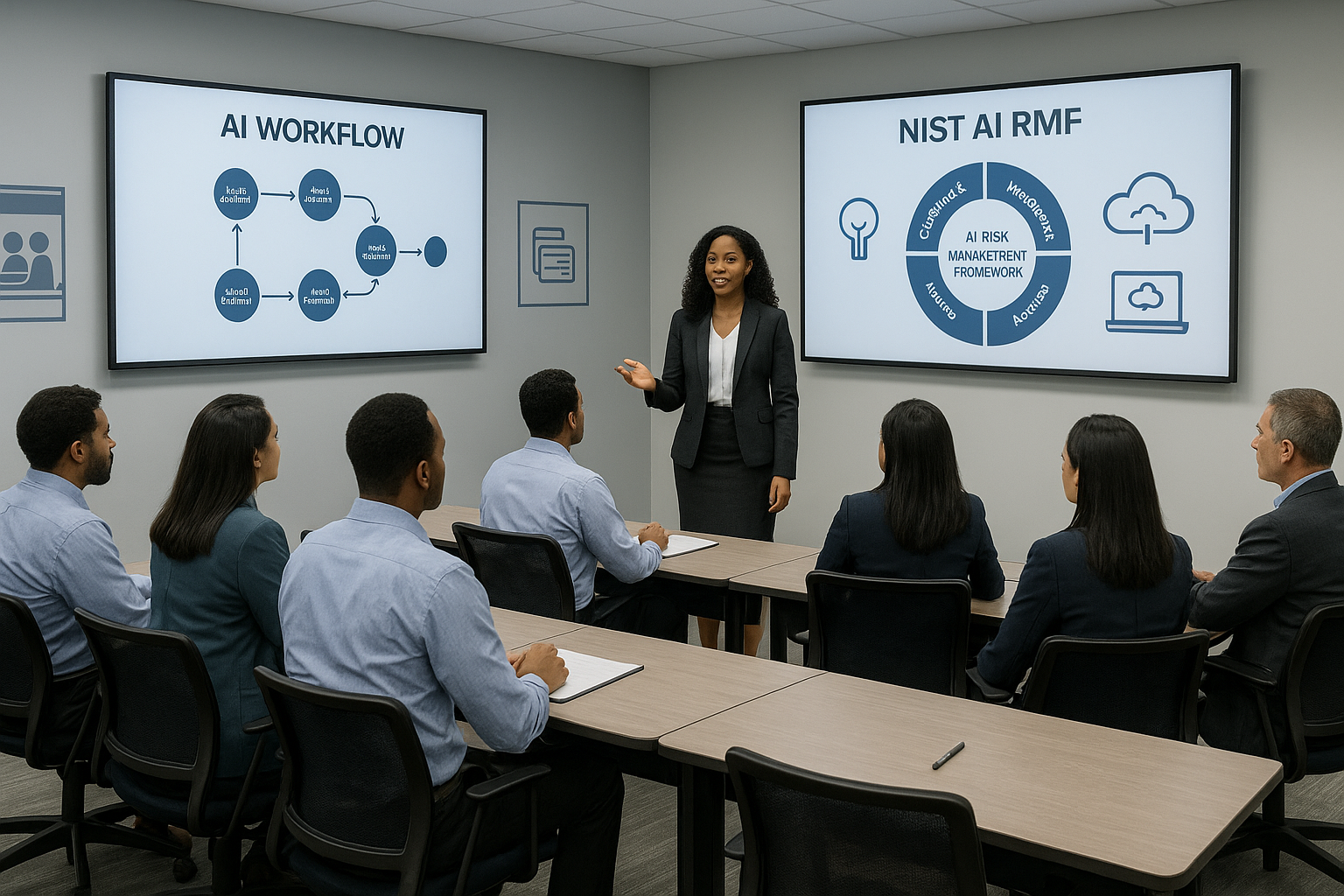
Policies only matter when they are operationalized. Map training content to widely accepted frameworks like NIST AI RMF and ISO/IEC 42001 so your governance language aligns with industry standards. Translate high‑level guardrails into day‑to‑day rules: how to handle PII in prompts, what constitutes an acceptable confidence threshold, and how to maintain human‑in‑the‑loop for adverse action. Establish a clear RACI for model ownership, approvals, and ongoing monitoring so everyone understands who signs off on a scoring model versus who monitors drift. Embedding governance into workflows reduces examiner friction and makes AI tools safer for customer‑facing use cases such as KYC automation and AML automation.

Illustration of a secure sandbox for AI experiments with server racks, shield icon for privacy, and a lock symbol; labeled 'no real customer data'
Secure sandboxes enable hands-on MLOps and LLM safety practice without exposing real customer data.

Skills Baseline and Assessment

Begin with an honest inventory of current capabilities. A skills taxonomy tied to job families clarifies what proficiency looks like for executives, risk professionals, data engineers, and contact center staff. Use diagnostic surveys and practical assessments — prompt tasks for copilot use, feature engineering exercises for data teams — to establish a baseline. Assessment results should feed directly into personalized learning paths so that scarce training resources focus on gaps that matter to compliance and operations. This targeted approach is more defensible to auditors than one‑size‑fits‑all training rolls.

Training Modalities That Work in Banking

Regulated environments require training formats that balance realism with control. Secure sandboxes let technical teams build and test models without exposing real customer data, enabling rapid upskilling in MLOps and LLM safety banking practices. Scenario‑based workshops are ideal for compliance and frontline teams: run through an adverse action notice generation or a fair lending review to surface documentation needs and escalation points. For branch and operations staff, microlearning modules — 5–10 minute lessons delivered between shifts — drive steady proficiency without disrupting service. The academy should combine synchronous workshops, asynchronous modules, and hands‑on labs to support different learning preferences while preserving audit trails of completion and competency.

Linking Training to Quick‑Win Automation

To sustain momentum, pair learning with tangible automations that deliver measurable benefits. Practical areas where AI training for banks can show early ROI include KYC document validation and entity resolution, where model‑assisted extraction and matching compress onboarding time. AML automation can assist investigators by drafting Suspicious Activity Report narratives for human review, reducing analyst hours and improving consistency. Underwriting copilots that summarize borrower profiles and highlight exceptions can reduce decision cycle time while keeping humans in the loop. These quick wins demonstrate how financial services AI literacy translates into operational improvements that boards can recognize and regulators can audit.

Measurement and Reporting to Audit and the Board

Design metrics that satisfy both business leaders and examiners. Capability metrics should include course completion, proficiency uplift, and certification rates. Operational metrics must speak to outcomes: average handling time, false positive rates for transaction monitoring, and model approval lead time. Governance metrics should capture documentation completeness, monitoring cadence adherence, and the speed at which audit findings are closed. Presenting a dashboard that links training progress to operational impact transforms the academy from a training expense into a risk‑mitigating investment with measurable results.

Dashboard mockup of training metrics and governance KPIs for the board: course completion, model approval lead time, false positive rates
Board-ready dashboard showing training progress alongside governance and operational KPIs.

Roadmap and Budgeting

Phase the rollout over 90/180/365 days to manage risk and scale sustainably. Start with one or two business units to validate curriculum and governance touchpoints, then expand through a federated Center of Excellence to maintain standards while enabling local innovation. Budget ranges will vary, but plan for content development, platform licensing, secure sandbox infrastructure, and coaching. Sourcing can be blended: leverage internal subject matter experts for domain content, partners for regulatory alignment and pedagogy, and vendor academies for product‑specific training. A phased budget and roadmap keep stakeholder expectations aligned and control costs.

How We Can Help

Organizations that lack in‑house capacity can accelerate by engaging partners who combine AI strategy with regulatory experience. Services that add immediate value include an AI strategy and risk alignment workshop, process automation enablement focused on KYC automation and AML automation, and developer enablement for MLOps toolchain setup and secure sandboxes. A partner‑led pilot of training content and governance playbooks can create reusable artifacts — from role‑based curricula to board reporting dashboards — that reduce time to value and ensure bank CIO AI strategy objectives are met without compromising compliance. Contact us to discuss a tailored pilot and roadmap.

Building a regulator‑ready AI academy requires more than courses: it demands curriculum woven into governance, hands‑on practice in controlled environments, measurable links to business outcomes, and ongoing assessment that keeps pace with both technological change and regulatory expectations. For CIOs in mid‑market banks, this dual focus on innovation and control is the difference between transforming operations and inheriting a compliance headache. The blueprint outlined here gives you a practical pathway to deliver AI training for banks that is both effective and defensible.

From Pilots to Practice: Scaling an AI Literacy Program Across Hospital Operations for CIOs (Health Care)

When a hospital runs its first experiments with generative AI, enthusiasm often peaks quickly: a promising copilot shortens a note, an automation drafts a prior authorization letter, or a scheduler’s inbox gets pared down. But for many health systems that momentum stalls. Pilots return useful signals but few scale to become reliable, HIPAA-compliant capabilities embedded across operations. For CIOs, the missing ingredient is not just technology—it is hospital AI literacy and a program that turns local wins into system-wide practice.

A training session in a hospital conference room with clinicians and administrators learning AI tools on laptops; diverse group, professional setting, subtle healthcare branding

The Scaling Gap in Healthcare AI

The gap between pilot success and enterprise adoption is rarely technical alone. Fragmented workflows across departments mean an approach that works in one clinic can break in another. Data privacy risk and anxieties around PHI amplify resistance: clinical staff rightly fear optional prompts that leak sensitive information, and legal teams push back without clear guardrails. Consistent training, standardized policies, and scalable guardrails are what unlock these pilots. A practical healthcare AI training program closes that gap by aligning clinicians, administrators, and IT around common expectations for safe, measurable use.

Role-Based Pathways: Clinical, Administrative, IT/Data

A single curriculum seldom fits the people who touch AI in a hospital. Design role-based pathways so learning maps to daily work. For clinicians, emphasize safe use of copilot tools, how to verify evidence and maintain traceability, and how to spot and mitigate bias. These healthcare AI training modules should teach clinicians when to accept automation and when to insist on human review. Administrative teams benefit from concrete workflows: how AI can streamline scheduling, revenue cycle, and patient communications without exposing PHI. For IT and data teams, the focus shifts to de-identification strategies, EHR integration AI patterns, and prompt safety engineering so that models are deployed with predictable behavior. When each group has relevant, practical training, hospital AI literacy rises in step with operational needs.

An IT engineer diagramming FHIR API integrations on a whiteboard with model cards pinned nearby; modern office, focused collaboration

Safety and Compliance by Design

Training must bake HIPAA and consent controls into day-to-day workflows. That starts with clear do’s and don’ts for handling PHI inside prompts and UIs: what data can be sent to a model, when to de-identify, and how to store outputs. Human-in-the-loop safeguards are critical for clinical decisions—AI should assist, not replace, clinician judgment. Model cards and documentation standards are also essential artifacts; they capture intended uses, known limitations, and provenance so governance teams can assess risk. This combination of education and artifact-driven governance produces a HIPAA compliant AI posture that clinicians and compliance officers can accept.

Embedding AI in EHR Workflows

Adoption accelerates when AI feels like part of the EHR rather than a bolt-on experiment. Make training practical by using EHR-integrated scenarios: note summarization with editable outputs, in-basket triage that prioritizes messages for clinician review, and audit-friendly change logs. For IT teams, teach the basics of FHIR APIs and eventing so they understand how an AI service can subscribe to relevant triggers without creating undue latency or security gaps. Include change control and validation steps in the curriculum so deployments include test cases, clinician sign-off, and rollback plans. When people learn AI in the context of EHR workflows they perform daily, the path from training to operationalization shortens.

Close-up of an EHR screen with a pop-up AI copilot assisting with a discharge summary; clear UI, realistic medical data blurred for privacy

Operational Use Cases to Anchor Learning

Clinical documentation automation is one of the clearest hooks for education: trainees can see time saved per note and improved consistency. Anchor courses around specific operational use cases to keep learning tied to measurable outcomes. For example, prior authorization document extraction and drafting exercises show how AI can reduce turnaround and denials when paired with human review and templates. Discharge instructions personalization units teach clinicians how to generate patient-facing text that meets health literacy requirements while preserving clinical oversight. Capacity management modules link bed management forecasting and staffing models to everyday decisions, helping operations teams anticipate surges and redeploy resources. These use cases make hospital AI literacy tangible and directly connected to ROI.

Measurement and Clinician Trust

Trust is earned through transparent metrics and ongoing engagement. Track outcome metrics like time saved per note and reductions in authorization turnaround, but don’t stop there. Quality metrics such as hallucination rate tracking and override logs expose where models fail and where additional guardrails or retraining are required. Clinician champions—early adopters who contribute to training content and share examples—are invaluable for credibility. Regular feedback loops where clinicians can flag errors, suggest model improvements, and see responses from the AI governance team keep the program responsive and credible.

Program Operations and Scaling Model

Sustaining momentum requires an organizational model that can evolve with technology. A federated Center of Excellence (CoE) that combines clinical leaders, IT, legal, and data science balances central standards with local adaptability. Cadenced policy refreshes and model reviews ensure the program stays current as commercial models and regulatory guidance shift. Consider credentialing options and alignment with continuing medical education where applicable—formal recognition reinforces participation and accountability. Over time, the academy should move from one-off training to an ongoing learning practice embedded into hiring, performance plans, and credential maintenance.

How We Can Help

CIOs often need partners who understand both the technical and cultural dimensions of scaling AI. Our services include building an AI governance healthcare operating model, designing healthcare AI training curricula tailored by role, and delivering healthcare automation accelerators that pair RPA with LLM capabilities for tasks like clinical documentation automation and prior authorization drafting. We also provide developer enablement for EHR integration AI, helping engineering teams implement safe FHIR-based eventing and create model cards and validation suites. These services are meant to accelerate a CIO healthcare AI strategy that is practical, auditable, and focused on operational wins.

Scaling AI across a hospital requires more than pilots and proofs; it requires an academy that teaches people to use AI safely and a governance model that ensures those practices endure. By investing in role-based healthcare AI training, embedding HIPAA compliant AI patterns into EHR workflows, and anchoring learning to high-value operational use cases, CIOs can move from experimental pilots to enterprise practice—delivering measurable improvements in documentation, authorizations, and capacity management while keeping clinicians and patients safe.

Public Sector AI Literacy That Sticks: Building an Agency‑Wide Program for CIOs and Program Managers

When citizens expect faster benefits decisions, timely FOIA responses, and reliably accessible services, agency leaders face a stark choice: invest in tools or fall further behind. For most federal, state, and local agencies, neither unlimited budgets nor rapid hiring are realistic options. What is realistic, however, is building a public sector AI literacy program that turns policy into practice, embeds responsible AI into daily work, and delivers measurable improvements in citizen services. This kind of government AI training is not about flashy pilots; it is about teaching the people who run programs and manage systems how to use AI safely and effectively so automation yields real wins for constituents.

Why Government Needs AI Literacy Now

Across agencies, backlogs in benefits adjudication, casework queues, and records requests are straining staff and eroding public trust. At the same time, executive orders and legislation are tightening expectations around risk management, transparency, and accountability. Agency CIOs and program managers hear the directive: adopt AI tools thoughtfully, align to frameworks like the NIST AI RMF, and demonstrate controls that protect privacy and fairness. Yet most workforces face hiring constraints, and the people who decide to adopt automation are often the same caseworkers and line supervisors who will rely on it day-to-day. A structured public sector AI literacy initiative helps those employees understand trade-offs and opportunities, reduces procurement friction, and shortens the distance from pilot to scaled service improvements.

A Policy‑Aligned Curriculum Framework

Designing an agency curriculum around recognizable policy scaffolds makes training relevant to decision makers and auditors. Using the NIST AI RMF as the course spine gives trainees a vocabulary—Govern, Map, Measure, Manage—that connects learning outcomes directly to compliance and risk reporting. Each training module should translate high-level functions into practical tasks: mapping data lineage so privacy officers can explain residency constraints, measuring model performance in ways that align to service-level KPIs, and managing lifecycle controls so ATO processes see clear evidence of monitoring and remediation. Equally important are training topics on transparency and documentation: how to produce public model cards, create plain-language FAQs for constituents, and capture design choices so audits and FOIA responses are straightforward. Accessibility and inclusive design must also be integral; public sector AI literacy includes how to test interfaces for assistive technologies and ensure any automation improves equity, not just efficiency.

Procurement, Security, and ATO‑Friendly Delivery

Training that looks great in concept can get stuck in procurement or security review if it neglects delivery models. An ATO‑friendly government AI training program emphasizes low-code platforms and vetted government cloud options to keep vendor complexity manageable. When participants need hands-on labs, sandboxing with synthetic or de‑identified data allows real practice without exposing sensitive information, and it greatly simplifies Authority to Operate conversations. FedRAMP-authorized hosting and clear data residency policies should be explicit in course materials so IT reviewers see alignment from day one. This practical framing helps CIOs recommend procurement vehicles that the agency can actually approve and supports program managers in making case-level decisions about tools and vendors.

Role‑Specific Learning Journeys

Not every learner needs the same depth or the same examples. Tailoring journeys to Program Managers, caseworkers, IT staff, and communications teams keeps engagement high and accelerates adoption. Program managers learn how to translate AI capability into value cases and define KPIs that tie directly to citizen outcomes. Caseworkers benefit from hands-on practice with document automation and conversational assistants designed to preserve human oversight. IT professionals need deeper walkthroughs of integration patterns, APIs, monitoring strategies, and how automated components fit into existing enterprise architectures. Communications teams require coaching on responsible messaging, drafting public-facing explanations, and preparing FAQs that balance transparency with security. When each audience sees realistic, role-specific workflows, the organization gains a shared language and a faster path to operationalizing government automation.

Automation‑First Wins to Build Momentum

Effective government AI training anchors learning in visible improvements rather than abstract machine-learning concepts. Start with automation-first scenarios that yield quick, repeatable wins: document intake and classification that cuts manual routing time, constituent correspondence drafting with clear human review steps, and queue triage plus automated appointment scheduling that reduces no-shows and speeds service. By coupling these hands-on examples with governance checklists and performance metrics, agencies can demonstrate early backlog reduction and improvements in cycle time. These practical outcomes build trust among staff and political leaders, and they justify further investment in broader training and more ambitious automation projects.

Governance and Transparency in Practice

Training must move governance from policy statements into daily practice. Human-in-the-loop rules and escalation paths should be part of every lab and scenario, not a separate module. Trainees need to practice writing public model cards, assembling audit logs that capture who reviewed what decisions and when, and generating performance reports that feed governance committees. Explaining model behavior in plain language is a skill as important as understanding precision and recall. When staff routinely document choices and provide readable artifacts for the public, agencies fulfill responsible AI government expectations and make oversight extensible rather than ad hoc.

Measurement and Sustainability

A training program is only as good as its ability to demonstrate impact and sustain learning. Measure service outcomes such as cycle time, backlog reduction, and accuracy on automated tasks, and pair those with capability indicators like certification rates and demonstrated proficiency gains. Funding follow-on phases is easier when the program includes train-the-trainer models and community-of-practice structures that allow knowledge to propagate without constant external support. Over time, a sustainable public sector AI literacy initiative becomes a lever for continuous improvement rather than a one-time compliance exercise.

How We Can Help

Helping agencies move from pilot experiments to agency-wide adoption is what we do. We run AI strategy workshops aligned to policy requirements, tailor NIST AI RMF training to operational roles, and develop automation accelerators focused on document-heavy processes. For technical teams we provide developer enablement and secure sandbox provisioning using synthetic data and FedRAMP-aligned environments so learning activities are ATO-friendly. If your agency needs a pragmatic roadmap that ties government automation to citizen services outcomes—while keeping an eye on procurement, security, and public trust—we can partner to design and deliver a program that sticks. Contact us to discuss a tailored AI literacy program for your agency.

Public sector AI literacy is not an optional skill anymore; it is an operational necessity for agencies that want to serve constituents efficiently and responsibly. By grounding training in policy, tailoring learning journeys to roles, and demonstrating early automation wins, agency CIOs and program managers can unlock lasting improvements in citizen services without getting lost in red tape.

Train the Factory: Role‑Based AI Upskilling for Smart Manufacturing CTOs and Plant Leaders

Factories have long been places where small gains compound into competitive advantage. Today that same principle applies to artificial intelligence: when plant leaders treat AI literacy as part of continuous improvement, the effects show up in yield, uptime, and worker safety. But unlike a tooling upgrade, smart factory transformation depends on people across operations, maintenance, IT, and quality being able to act on AI signals. This article lays out a role‑based upskilling approach—focused on manufacturing AI training and edge AI upskilling—that aligns with shop‑floor realities and delivers measurable OEE improvement AI results.

Why AI Literacy Is the Next Lean

Manufacturers are operating under margin pressure, labor shortages, and rising variability from complex supply chains. Lean practices taught us to remove waste; now AI is a lever to reduce variability and anticipate failures, not just react to them. A targeted manufacturing AI training program shows technicians and supervisors how to use predictive alerts to prevent downtime and how computer vision quality control can catch defects before they accumulate. The practical payoff is not theoretical: improved first pass yield and fewer emergency maintenance incidents translate directly into margin protection.

AI also intersects with safety and change management. When an alert flags an abnormal vibration signature or a vision system flags a missing fastener, operators need clear escalation paths and safe work procedures. Training that connects model outputs to standard operating procedures reduces ambiguity and keeps teams aligned. Thoughtful role‑based upskilling turns friction around new technology into an opportunity to reinforce safety and process discipline.

Role‑Based Skills Matrix for OT, IT, and Operations

Not everyone on the shop floor needs to become a data scientist, but everyone needs a practical set of skills tied to their role. For maintenance technicians, manufacturing AI training focuses on sensor basics—how vibration and temperature feed predictive maintenance training pipelines, what anomaly detection scores mean, and how to perform basic sensor health checks. Quality engineers need hands‑on practice with computer vision workflows: collecting representative images, defining defect taxonomies, and monitoring model drift during production shifts.

Close-up of a maintenance technician inspecting a vibration sensor on a motor with a tablet showing anomaly detection scores; high detail, industrial setting.
Maintenance technician inspecting a vibration sensor with on‑device anomaly scores.

Line supervisors benefit from learning how to interpret AI signals and how to include them in daily production standups. Training here is about decision rules and escalation: when to stop a line, whom to call, and how to document interventions. IT and OT teams require deeper technical skills that bridge data pipelines and deployment: connecting PLCs and historians to edge gateways, packaging models for constrained devices, and ensuring secure OTA updates. This alignment of responsibilities is the heart of OT IT convergence AI in a practical sense.

Edge AI and Data Foundations

Edge AI upskilling is not just about model inference; it’s about understanding the constraints and patterns of the plant environment. Technicians and engineers need to know how data flows from PLCs, MES, and historians into AI pipelines and what gets lost when sampling rates change or when a network hiccup occurs. Training should include hands‑on exercises with edge gateways and model packaging so teams understand how a model behaves in low‑latency or offline modes and what fallback strategies look like when connectivity fails.

Edge gateway device mounted in a control cabinet with cables to PLCs and a schematic overlay showing data flow to cloud MLOps; technical, schematic style.
Edge gateway mounted in a control cabinet illustrating data flow to cloud MLOps.

Part of the curriculum should emphasize data hygiene—timestamp synchronization, consistent tagging, and lightweight feature checks at the edge. When teams can validate that data entering a model is trustworthy, model outputs become actionable. Edge MLOps practices taught at the plant level—such as simple versioning and rollback procedures—keep deployments reliable and auditable.

Computer Vision for Quality Control

Computer vision quality control succeeds when people closest to the product own the data. Training for vision systems should begin with practical data collection: how to capture golden samples, how to create balanced datasets across shift and lighting conditions, and how to structure a defect taxonomy that operators can use. Quality engineers need to learn labeling workflows and how to evaluate model performance against real production variations.

A quality engineer standing beside a vision inspection station reviewing defect images on a monitor; label sheets and golden sample visible; clean lab-like production area.
Quality engineer reviewing vision inspection outputs and golden samples.

Equally important is establishing a cadence for retraining. Vision models drift when tooling, materials, or lighting change; therefore the training program must include guidance for monitoring precision‑recall metrics on the line, setting thresholds for human review, and scheduling retraining cycles. Human‑in‑the‑loop processes preserve operator trust: when a model is uncertain, the system should defer to an inspector and use that interaction to improve the dataset.

Predictive Maintenance and Digital Twins

Predictive maintenance training translates sensor signals into maintenance actions. Teams need a shared vocabulary for features—vibration bands, RMS values, bearing temperature trends—and for alerts such as threshold breaches versus pattern anomalies. Training that focuses on remaining useful life modeling helps technicians understand probabilistic outcomes and prioritize work orders accordingly.

Digital twins add a practical layer for process tuning and what‑if analysis. When plant engineers can simulate different maintenance intervals or production speeds against a digital twin, they make better tradeoffs between throughput and equipment longevity. Upskilling around these tools helps operations move from reactive firefighting to prescriptive action, which is central to OEE improvement AI strategies.

Change Management on the Shop Floor

New systems fail fast if the people who touch them aren’t involved. Operator training needs to be hands‑on and short, focused on the immediate actions required when an AI alert appears. SOPs must be updated to reflect new responsibilities and to maintain compliance with safety protocols. Engaging union representatives and safety committees early helps surface concerns and builds consensus about acceptable workflows and escalation rules.

Visual work aids, quick reference guides, and on‑machine prompts reduce cognitive load in busy shifts. When line crews can see exactly what a vision model flagged and why, they are more likely to accept the system and to provide the contextual feedback that improves models over time. Consistent communication and feedback loops are the soft infrastructure of any successful upskilling program.

Measuring ROI and Scaling Across Sites

To justify investment in manufacturing AI training and edge AI upskilling, organizations need to measure them against operational KPIs. Track improvements in OEE, scrap rate, unplanned downtime, and first pass yield to understand the impact of training on daily performance. Link alerts and remediation actions to work orders so you can quantify time saved and failures avoided.

Once a site demonstrates repeatable gains, create a site playbook that captures role responsibilities, model governance, retraining schedules, and escalation matrices. Governance ensures that model updates and data pipelines follow consistent quality checks as they replicate across plants. Benchmarking between sites helps identify process differences and accelerates adoption of best practices across the network.

How We Can Help

Bringing this approach to life requires a blend of strategy, enablement, and technical delivery. We help manufacturing leaders build an AI strategy and factory roadmap that prioritizes the highest‑value use cases and ties training to measurable KPIs. Our teams deliver automation development—from vision inspection cells to predictive maintenance analytics—while enabling developers and plant staff with edge MLOps and data ops practices that fit shop‑floor constraints.

Training programs we design are role‑based and hands‑on, combining classroom sessions with on‑machine exercises and clear playbooks for governance and scaling. The result is a workforce that understands not just what the models predict, but how to act on those predictions to improve OEE, quality, and safety. For CTOs and plant leaders, that alignment is what turns technology investment into lasting operational advantage. Contact us to discuss a site‑specific upskilling roadmap.

AI Literacy for Retail Growth: Training Merchandising and Marketing Leaders to Win with Personalization

Why AI Literacy Is a Growth Lever in Retail

Every retail leader I talk to describes the same tension: customer acquisition costs are rising while shoppers expect more relevant experiences across channels. That pressure makes AI not just a point solution but a growth lever. When merchandising, marketing, and data teams become fluent in retail AI training, the organization moves faster—creating richer product pages, smarter recommendations, and campaigns that convert. The link between training and revenue is simple: better AI use leads to higher conversion rates, increased average order value (AOV), and faster time-to-publish for content that drives sales.

AI’s role spans content scale, product attribution, and targeting. Brand teams can generate thousands of localized product descriptions with consistent tone. Merchandisers can enrich attributes to improve search relevance. Data teams can integrate CDP AI integration points to feed personalized signals into real-time experiences. All of this matters because omnichannel shoppers expect seamless personalization while privacy and consent management add operational complexity.

Close-up of a product detail page being auto-generated on a laptop screen with copy suggestions and attribute enrichment UI; UX mockup style, clean interface.
Example UI: auto-generated product detail page with copy suggestions and attribute enrichment.

Role-Based Learning for Merch, Marketing, and Data

Training that treats everyone the same produces mixed results. A role-based approach turns learning into practical, day-to-day decision-making. For merchandising teams, courses should focus on attribute enrichment, pricing signals, and assortment logic. When merchandisers understand how models interpret attributes, they can make small changes to product data that yield outsized gains in relevance and conversion.

Marketing leaders need hands-on personalization training that covers prompt engineering for brand-safe copy, audience insights, and creative testing workflows. The goal is to empower marketers to request model outputs that adhere to brand voice and legal constraints while iterating quickly on creative variants. For data and IT teams, training concentrates on CDP AI integration, building feature stores, and setting up robust testing frameworks. That enables reliable data flows from consented customer profiles into recommendation systems and campaign segmentation.

A flow diagram showing CDP integration to recommendation engine and content ops; professional infographic style, retail icons and data pipelines.
Integration diagram: CDP feeding features into recommendation and content operations.

Brand Safety and Governance

As generative models are woven into content operations, governance moves from a checklist to an active practice. Brand-safe generative AI requires clear guardrails around tone, product claims, and mandatory disclaimers. Training programs should include practical exercises where marketers and legal owners codify unacceptable claims and map them to rule-based filters or model prompts.

Human review workflows and approval gates must be designed into the content pipeline so automation accelerates output without sacrificing brand integrity. Privacy and consent belong in these workflows too: personalization training needs to cover data minimization, consent signals, and how to handle suppression lists so personalization remains compliant and customer-trusted.

Experimentation Discipline

Training becomes valuable only when teams know how to test. Teaching A/B testing fundamentals is necessary, but retail teams also need instruction on multi-armed bandits for content and recommendations, and when to move from exploratory tests to scaled experiments. A disciplined experimentation practice ties each test to north-star metrics—conversion rate, AOV, or retention—while monitoring guardrail metrics like margin impact and churn.

Campaign and model versioning should be standard operating procedure. When merchandisers and data scientists learn to version models and content, they can iterate safely and roll back changes without business disruption. This is where retail CIO CMO AI strategy shifts from theory to repeatable practice: experiments create a continuous feedback loop between learning and revenue impact.

Automation Anchors for Early Wins

Early training should point teams to automation anchors—practical use cases that deliver quick, measurable returns. Catalog automation for attribute enrichment is one such anchor: automated suggestions vetted by human QA improve search, filter relevance, and reduce manual tagging time. Similarly, copy generation for product detail pages (PDP) and email templates, driven by brand prompts, accelerates content velocity while maintaining voice and compliance.

Recommendation tuning is another anchor. Training should show how to apply simple, interpretable adjustments to category and PDP page recommendations—like blending popularity with margin or inventory signals—so merchandisers can see immediate lift in AOV and conversion without requiring complex model builds.

Measurement and Business Cases

Retail leaders want to see outcomes in business terms. A robust retail AI training program teaches teams to measure KPIs that matter: conversion rate lift, AOV, time-to-publish, and content reuse. It also emphasizes incrementality testing to avoid mistaking correlation for causation, and it surfaces common attribution pitfalls in multi-touch, omnichannel environments.

Training should include business case templates by use case—catalog automation, personalized email, or on-site recommendations—so teams can estimate payback periods and make decisions that align with finance and merchandising objectives. When a merchandiser or marketer can quantify the expected conversion lift from improved attribute completeness, the investment in training and automation becomes a clear priority.

Operating Model to Scale

Sustained adoption depends on an operating model that balances central guidance with distributed ownership. A center-led pattern with brand squads enables consistent standards while empowering teams to adapt models and prompts for local needs. Reusable prompt libraries and model cards reduce onboarding friction and preserve institutional knowledge, while vendor ecosystem governance ensures external tools adhere to brand and privacy requirements.

Developer enablement is part of this operating model: simple APIs, model inference endpoints, and clear documentation speed integration. The goal of an operating model is to move from one-off wins to predictable, seasonal scale so AI becomes part of how merchandising, marketing, and data teams operate every day.

How We Can Help

Retail CIOs and CMOs often accelerate outcomes by working with partners who translate strategy into education and execution. Services that complement in-house efforts include AI strategy for personalization and content operations, automation accelerators for catalog and CRM, and developer enablement for data pipelines and MLOps supporting recommendations. These engagements are designed to be hands-on: building role-based curriculums, deploying catalog automation pilots with QA workflows, and establishing measurement frameworks that tie training to conversion lift and AOV.

Investing in retail AI training is an investment in speed and relevance. When merchandising AI, personalization training, and CDP AI integration become part of team fluency, retailers unlock the ability to deliver timely, brand-safe experiences that scale. That combination—people fluent in AI, governed automation, and disciplined experimentation—is what turns technology into sustained growth. Contact us to discuss how we can design a role-based curriculum and pilot the automation anchors that matter most for your business.

Compliance-First Prompting in Financial Services: A CIO/CRO Playbook for Scaling LLMs Safely

When a bank’s chief information officer sits down with the chief risk officer to talk about rolling LLMs into underwriting, fraud operations, or advisor tools, the conversation rarely starts with glossy product demos. It starts with three questions: can the model be trusted, can it be explained to regulators, and will it actually improve operational metrics? For leaders in financial services, those questions reveal why financial services AI prompting must be compliance-first. Generic prompts may show promise in a demo, but they fail to meet the rigor of SEC, FINRA, or OCC expectations when scaled.

Why industry-specific prompting matters in finance

Regulation in banking and insurance is not an optional checklist; it shapes product design, data handling, and the audit trail every system must produce. Model explainability expectations demand that outputs be traceable to authoritative sources and business logic. That is why a compliance-first LLM approach starts by encoding domain precision—terminology, product nuances, legal language—into the prompt and the retrieval layer. When a prompt references ambiguous terms or omits policy context, downstream decisions become inconsistent and audit-deficient. Conversely, when prompts are designed with regulatory controls and domain ontologies, ROI becomes measurable: handling time drops, decision consistency rises, and the model’s recommendations are defensible during regulatory scrutiny.

High-value use cases where prompting moves the needle

Prompts are not an abstract engineering exercise; they are how an LLM is steered to create business value. An advisor copilot equipped with KYC/AML-aware prompting can provide compliant, context-sensitive guidance to relationship managers while surfacing required disclosures and escalation flags. In claims triage, prompts that incorporate policy clauses and coverage thresholds enable rapid policy-aware summarization that speeds routing and reduces manual interpretation. Fraud operations benefit from prompts that ask the model to produce explainable alert rationales and next-best actions, helping investigators prioritize cases. For risk reporting, constraints baked into prompts produce structured outputs mapped directly to Basel or IFRS taxonomies, simplifying ingestion into governance dashboards. Each use case demands a different prompt pattern, but all share the same requirement: the prompt must encode compliance requirements and map back to auditable sources.

Illustration of an AI copilot assisting a financial advisor with KYC/AML highlights and policy disclaimers on-screen. Clean UI mockup style.
AI copilot mockup showing KYC/AML highlights and on-screen policy prompts for advisors.

Designing the financial domain context: RAG + ontologies

Grounding an LLM with retrieval-augmented generation (RAG finance implementations) changes the game. Secure RAG pipelines link the model to policy documents, product catalogs, and procedure manuals stored in access-controlled repositories. When a prompt triggers a retrieval, the selected passages must be ranked and tagged with provenance metadata so that every assertion the model makes can be traced to a specific document and line. Financial ontologies like FIBO provide a taxonomy to standardize entities and relationships—customers, instruments, policy items—so that prompts and retrieved passages speak the same language. This metadata-driven retrieval and passage ranking substantially raises faithfulness, helping auditors and regulators understand how a model arrived at a recommendation.

Diagram of RAG pipeline in finance: secure document store, retriever, LLM with ontology overlay, and audit logs. Flat vector style, corporate colors.
RAG pipeline diagram showing secure stores, retrieval, ontology overlay, and audit logging for traceability.

Prompt patterns for compliance and accuracy

Practical prompting patterns for financial services follow a hierarchy: system instructions that embed business rules, developer-level guidance that constrains tone and format, and user-level prompts that capture intent. Using JSON schema-constrained outputs ensures responses are machine-readable and suitable for downstream automation. Few-shot exemplars drawn from approved content teach the model required phrasing and mandatory disclaimers without exposing internal reasoning. When calculations, identity lookups, or deterministic checks are needed, tool or function-calling is the right pattern: the LLM asks the system for the computed result or the KYC record rather than inventing values. These patterns reduce hallucination risk and preserve a separation between probabilistic language generation and deterministic business logic.

Guardrails, red-teaming, and auditability

Operational guardrails are non-negotiable. PII filtering, toxicity and bias checks, and retrieval provenance logging form the first line of defense. Defending against prompt injection requires allow/block lists, sanitized retrieval contexts, and prompts that insist on citing sources. Policy-as-code embeds regulatory clauses into the prompt set so the model is conditioned on the constraints it must respect. Versioning prompts and storing responses—complete with the used model, retrieval IDs, and prompt version—creates an auditable trail for model risk governance. Regular red-teaming exercises validate that guardrails hold under adversarial interaction and evolving threat models.

Evaluation: from offline tests to production monitoring

Evaluation must bridge the laboratory and the call center. Offline golden sets enable faithfulness and correctness benchmarks: synthetic and real annotated examples that represent edge cases and regulatory requirements. Key metrics include hallucination rate, leakage incidents, and policy-violation counts, all tracked over time. In production, human-in-the-loop QA workflows flag model outputs for review and feed corrections back into continuous evaluation. Cost and performance tuning—batching retrievals, caching frequent passages, and model routing based on query criticality—balance accuracy with economics. A mature evaluation pipeline makes compliance an operational metric, not just a legal resilience story.

Integration with process automation and core systems

LLM outputs must translate to action. When a compliant prompt yields a structured decision—claims priority, fraud disposition, or advisor script—the result should drive workflow engines and RPA bots to complete the task or handoff to an exception queue. APIs into policy administration systems, CRM platforms, and risk engines ensure the model’s outputs are reconciled with authoritative records. Event-driven triggers and clear exception handling routes keep humans in control for high-risk decisions, while routine cases flow through automated processes.

Build vs. buy: the enterprise prompting stack

Choosing between building and buying hinges on control, time to value, and governance needs. Prompt management systems, LLMOps, and secrets governance are baseline requirements for regulated institutions. Fine-tuning a model makes sense when you require extensive domain internalization, but prompt engineering plus RAG often delivers faster compliance-first outcomes with less regulatory friction. Vendor evaluation should emphasize data handling, audit logs, model provenance, and the ability to integrate with existing governance frameworks. For banks and insurers, selecting vendors and platforms that align with AI governance banking expectations is critical to de-risk adoption.

How we help: strategy, automation, and development services

For CIOs and CROs scaling AI, navigating the intersection of technology, policy, and operations is the essential leadership work. Our services combine compliance-first AI strategy, prompt library creation, secure RAG pipelines, and guardrails engineering to accelerate safe deployment. We deliver AI evaluation harnesses and LLMOps integration so monitoring, versioning, and audits become part of the operational fabric. Finally, our change-management playbook helps translate pilots into enterprise-grade process automation in insurance and banking, with vendor selection criteria and a pilot-to-scale roadmap that aligns with risk and regulatory stakeholders.

Adopting a compliance-first LLM approach does not mean slowing innovation; it means designing prompts, retrieval layers, and controls so that AI becomes an auditable, value-creating part of the institution. For leaders intent on scaling responsibly, the playbook is clear: ground models in authoritative context, engineer prompts for traceability, bake in guardrails, and measure compliance as a first-class operational KPI. Contact us to discuss how to operationalize a compliance-first LLM strategy for your organization.