

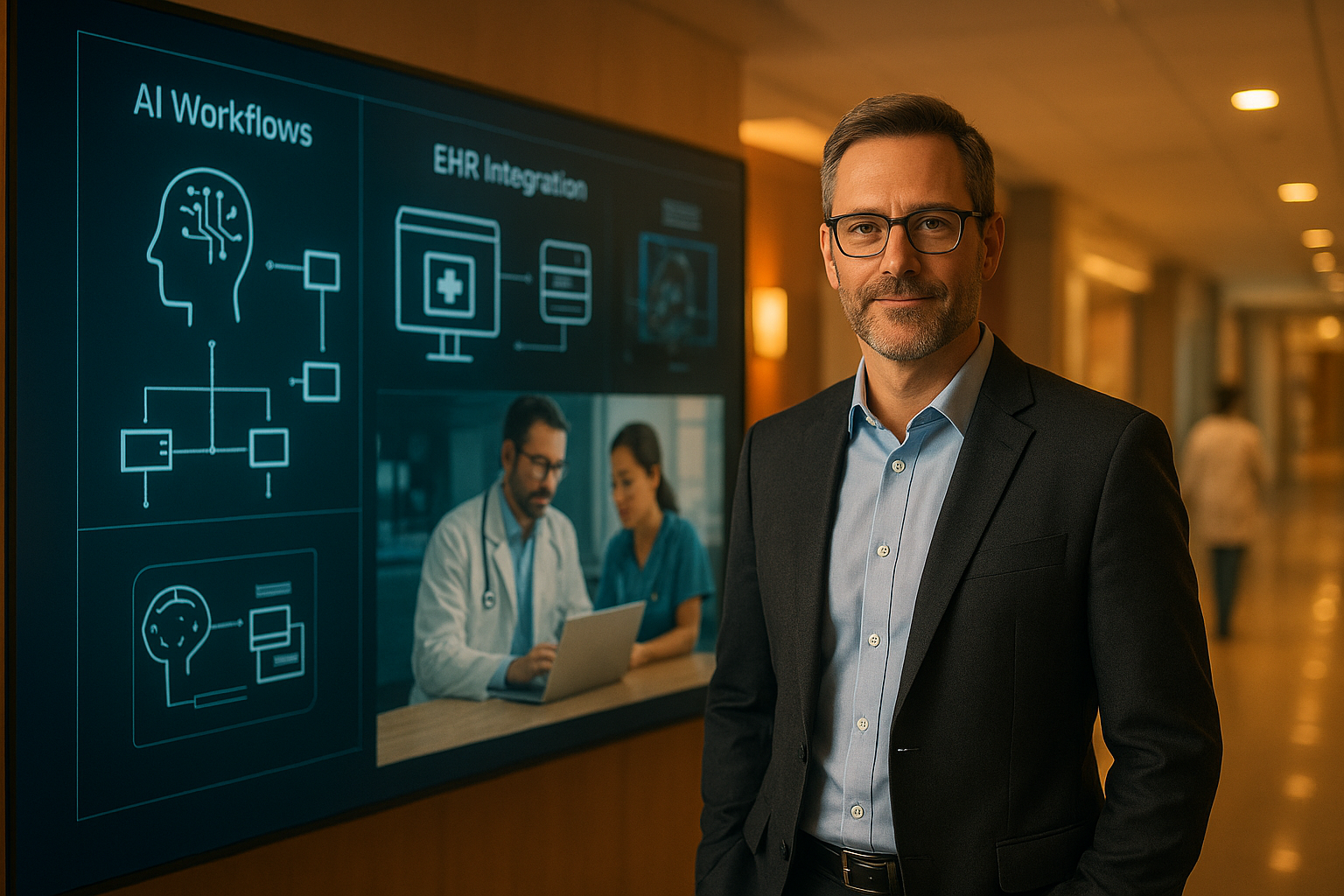

When a hospital runs its first experiments with generative AI, enthusiasm often peaks quickly: a promising copilot shortens a note, an automation drafts a prior authorization letter, or a scheduler’s inbox gets pared down. But for many health systems that momentum stalls. Pilots return useful signals but few scale to become reliable, HIPAA-compliant capabilities embedded across operations. For CIOs, the missing ingredient is not just technology—it is hospital AI literacy and a program that turns local wins into system-wide practice.

The Scaling Gap in Healthcare AI
The gap between pilot success and enterprise adoption is rarely technical alone. Fragmented workflows across departments mean an approach that works in one clinic can break in another. Data privacy risk and anxieties around PHI amplify resistance: clinical staff rightly fear optional prompts that leak sensitive information, and legal teams push back without clear guardrails. Consistent training, standardized policies, and scalable guardrails are what unlock these pilots. A practical healthcare AI training program closes that gap by aligning clinicians, administrators, and IT around common expectations for safe, measurable use.
Role-Based Pathways: Clinical, Administrative, IT/Data
A single curriculum seldom fits the people who touch AI in a hospital. Design role-based pathways so learning maps to daily work. For clinicians, emphasize safe use of copilot tools, how to verify evidence and maintain traceability, and how to spot and mitigate bias. These healthcare AI training modules should teach clinicians when to accept automation and when to insist on human review. Administrative teams benefit from concrete workflows: how AI can streamline scheduling, revenue cycle, and patient communications without exposing PHI. For IT and data teams, the focus shifts to de-identification strategies, EHR integration AI patterns, and prompt safety engineering so that models are deployed with predictable behavior. When each group has relevant, practical training, hospital AI literacy rises in step with operational needs.

Safety and Compliance by Design
Training must bake HIPAA and consent controls into day-to-day workflows. That starts with clear do’s and don’ts for handling PHI inside prompts and UIs: what data can be sent to a model, when to de-identify, and how to store outputs. Human-in-the-loop safeguards are critical for clinical decisions—AI should assist, not replace, clinician judgment. Model cards and documentation standards are also essential artifacts; they capture intended uses, known limitations, and provenance so governance teams can assess risk. This combination of education and artifact-driven governance produces a HIPAA compliant AI posture that clinicians and compliance officers can accept.
Embedding AI in EHR Workflows
Adoption accelerates when AI feels like part of the EHR rather than a bolt-on experiment. Make training practical by using EHR-integrated scenarios: note summarization with editable outputs, in-basket triage that prioritizes messages for clinician review, and audit-friendly change logs. For IT teams, teach the basics of FHIR APIs and eventing so they understand how an AI service can subscribe to relevant triggers without creating undue latency or security gaps. Include change control and validation steps in the curriculum so deployments include test cases, clinician sign-off, and rollback plans. When people learn AI in the context of EHR workflows they perform daily, the path from training to operationalization shortens.

Operational Use Cases to Anchor Learning
Clinical documentation automation is one of the clearest hooks for education: trainees can see time saved per note and improved consistency. Anchor courses around specific operational use cases to keep learning tied to measurable outcomes. For example, prior authorization document extraction and drafting exercises show how AI can reduce turnaround and denials when paired with human review and templates. Discharge instructions personalization units teach clinicians how to generate patient-facing text that meets health literacy requirements while preserving clinical oversight. Capacity management modules link bed management forecasting and staffing models to everyday decisions, helping operations teams anticipate surges and redeploy resources. These use cases make hospital AI literacy tangible and directly connected to ROI.
Measurement and Clinician Trust
Trust is earned through transparent metrics and ongoing engagement. Track outcome metrics like time saved per note and reductions in authorization turnaround, but don’t stop there. Quality metrics such as hallucination rate tracking and override logs expose where models fail and where additional guardrails or retraining are required. Clinician champions—early adopters who contribute to training content and share examples—are invaluable for credibility. Regular feedback loops where clinicians can flag errors, suggest model improvements, and see responses from the AI governance team keep the program responsive and credible.
Program Operations and Scaling Model
Sustaining momentum requires an organizational model that can evolve with technology. A federated Center of Excellence (CoE) that combines clinical leaders, IT, legal, and data science balances central standards with local adaptability. Cadenced policy refreshes and model reviews ensure the program stays current as commercial models and regulatory guidance shift. Consider credentialing options and alignment with continuing medical education where applicable—formal recognition reinforces participation and accountability. Over time, the academy should move from one-off training to an ongoing learning practice embedded into hiring, performance plans, and credential maintenance.
How We Can Help
CIOs often need partners who understand both the technical and cultural dimensions of scaling AI. Our services include building an AI governance healthcare operating model, designing healthcare AI training curricula tailored by role, and delivering healthcare automation accelerators that pair RPA with LLM capabilities for tasks like clinical documentation automation and prior authorization drafting. We also provide developer enablement for EHR integration AI, helping engineering teams implement safe FHIR-based eventing and create model cards and validation suites. These services are meant to accelerate a CIO healthcare AI strategy that is practical, auditable, and focused on operational wins.
Scaling AI across a hospital requires more than pilots and proofs; it requires an academy that teaches people to use AI safely and a governance model that ensures those practices endure. By investing in role-based healthcare AI training, embedding HIPAA compliant AI patterns into EHR workflows, and anchoring learning to high-value operational use cases, CIOs can move from experimental pilots to enterprise practice—delivering measurable improvements in documentation, authorizations, and capacity management while keeping clinicians and patients safe.


Sign Up For Updates.