

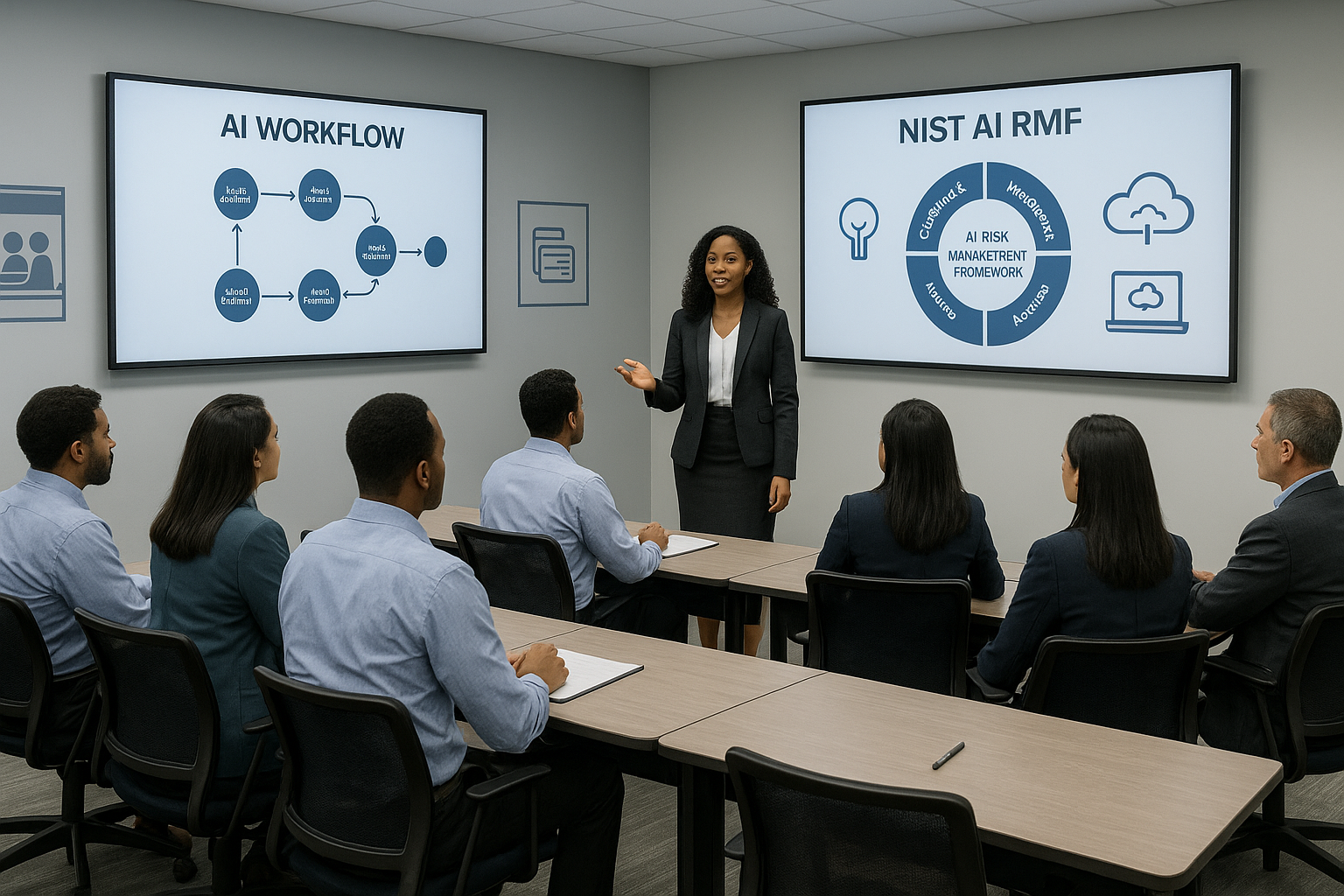

When citizens expect faster benefits decisions, timely FOIA responses, and reliably accessible services, agency leaders face a stark choice: invest in tools or fall further behind. For most federal, state, and local agencies, neither unlimited budgets nor rapid hiring are realistic options. What is realistic, however, is building a public sector AI literacy program that turns policy into practice, embeds responsible AI into daily work, and delivers measurable improvements in citizen services. This kind of government AI training is not about flashy pilots; it is about teaching the people who run programs and manage systems how to use AI safely and effectively so automation yields real wins for constituents.
Why Government Needs AI Literacy Now
Across agencies, backlogs in benefits adjudication, casework queues, and records requests are straining staff and eroding public trust. At the same time, executive orders and legislation are tightening expectations around risk management, transparency, and accountability. Agency CIOs and program managers hear the directive: adopt AI tools thoughtfully, align to frameworks like the NIST AI RMF, and demonstrate controls that protect privacy and fairness. Yet most workforces face hiring constraints, and the people who decide to adopt automation are often the same caseworkers and line supervisors who will rely on it day-to-day. A structured public sector AI literacy initiative helps those employees understand trade-offs and opportunities, reduces procurement friction, and shortens the distance from pilot to scaled service improvements.
A Policy‑Aligned Curriculum Framework
Designing an agency curriculum around recognizable policy scaffolds makes training relevant to decision makers and auditors. Using the NIST AI RMF as the course spine gives trainees a vocabulary—Govern, Map, Measure, Manage—that connects learning outcomes directly to compliance and risk reporting. Each training module should translate high-level functions into practical tasks: mapping data lineage so privacy officers can explain residency constraints, measuring model performance in ways that align to service-level KPIs, and managing lifecycle controls so ATO processes see clear evidence of monitoring and remediation. Equally important are training topics on transparency and documentation: how to produce public model cards, create plain-language FAQs for constituents, and capture design choices so audits and FOIA responses are straightforward. Accessibility and inclusive design must also be integral; public sector AI literacy includes how to test interfaces for assistive technologies and ensure any automation improves equity, not just efficiency.

Procurement, Security, and ATO‑Friendly Delivery
Training that looks great in concept can get stuck in procurement or security review if it neglects delivery models. An ATO‑friendly government AI training program emphasizes low-code platforms and vetted government cloud options to keep vendor complexity manageable. When participants need hands-on labs, sandboxing with synthetic or de‑identified data allows real practice without exposing sensitive information, and it greatly simplifies Authority to Operate conversations. FedRAMP-authorized hosting and clear data residency policies should be explicit in course materials so IT reviewers see alignment from day one. This practical framing helps CIOs recommend procurement vehicles that the agency can actually approve and supports program managers in making case-level decisions about tools and vendors.

Role‑Specific Learning Journeys
Not every learner needs the same depth or the same examples. Tailoring journeys to Program Managers, caseworkers, IT staff, and communications teams keeps engagement high and accelerates adoption. Program managers learn how to translate AI capability into value cases and define KPIs that tie directly to citizen outcomes. Caseworkers benefit from hands-on practice with document automation and conversational assistants designed to preserve human oversight. IT professionals need deeper walkthroughs of integration patterns, APIs, monitoring strategies, and how automated components fit into existing enterprise architectures. Communications teams require coaching on responsible messaging, drafting public-facing explanations, and preparing FAQs that balance transparency with security. When each audience sees realistic, role-specific workflows, the organization gains a shared language and a faster path to operationalizing government automation.
Automation‑First Wins to Build Momentum
Effective government AI training anchors learning in visible improvements rather than abstract machine-learning concepts. Start with automation-first scenarios that yield quick, repeatable wins: document intake and classification that cuts manual routing time, constituent correspondence drafting with clear human review steps, and queue triage plus automated appointment scheduling that reduces no-shows and speeds service. By coupling these hands-on examples with governance checklists and performance metrics, agencies can demonstrate early backlog reduction and improvements in cycle time. These practical outcomes build trust among staff and political leaders, and they justify further investment in broader training and more ambitious automation projects.
Governance and Transparency in Practice
Training must move governance from policy statements into daily practice. Human-in-the-loop rules and escalation paths should be part of every lab and scenario, not a separate module. Trainees need to practice writing public model cards, assembling audit logs that capture who reviewed what decisions and when, and generating performance reports that feed governance committees. Explaining model behavior in plain language is a skill as important as understanding precision and recall. When staff routinely document choices and provide readable artifacts for the public, agencies fulfill responsible AI government expectations and make oversight extensible rather than ad hoc.
Measurement and Sustainability
A training program is only as good as its ability to demonstrate impact and sustain learning. Measure service outcomes such as cycle time, backlog reduction, and accuracy on automated tasks, and pair those with capability indicators like certification rates and demonstrated proficiency gains. Funding follow-on phases is easier when the program includes train-the-trainer models and community-of-practice structures that allow knowledge to propagate without constant external support. Over time, a sustainable public sector AI literacy initiative becomes a lever for continuous improvement rather than a one-time compliance exercise.
How We Can Help
Helping agencies move from pilot experiments to agency-wide adoption is what we do. We run AI strategy workshops aligned to policy requirements, tailor NIST AI RMF training to operational roles, and develop automation accelerators focused on document-heavy processes. For technical teams we provide developer enablement and secure sandbox provisioning using synthetic data and FedRAMP-aligned environments so learning activities are ATO-friendly. If your agency needs a pragmatic roadmap that ties government automation to citizen services outcomes—while keeping an eye on procurement, security, and public trust—we can partner to design and deliver a program that sticks. Contact us to discuss a tailored AI literacy program for your agency.
Public sector AI literacy is not an optional skill anymore; it is an operational necessity for agencies that want to serve constituents efficiently and responsibly. By grounding training in policy, tailoring learning journeys to roles, and demonstrating early automation wins, agency CIOs and program managers can unlock lasting improvements in citizen services without getting lost in red tape.


Sign Up For Updates.