

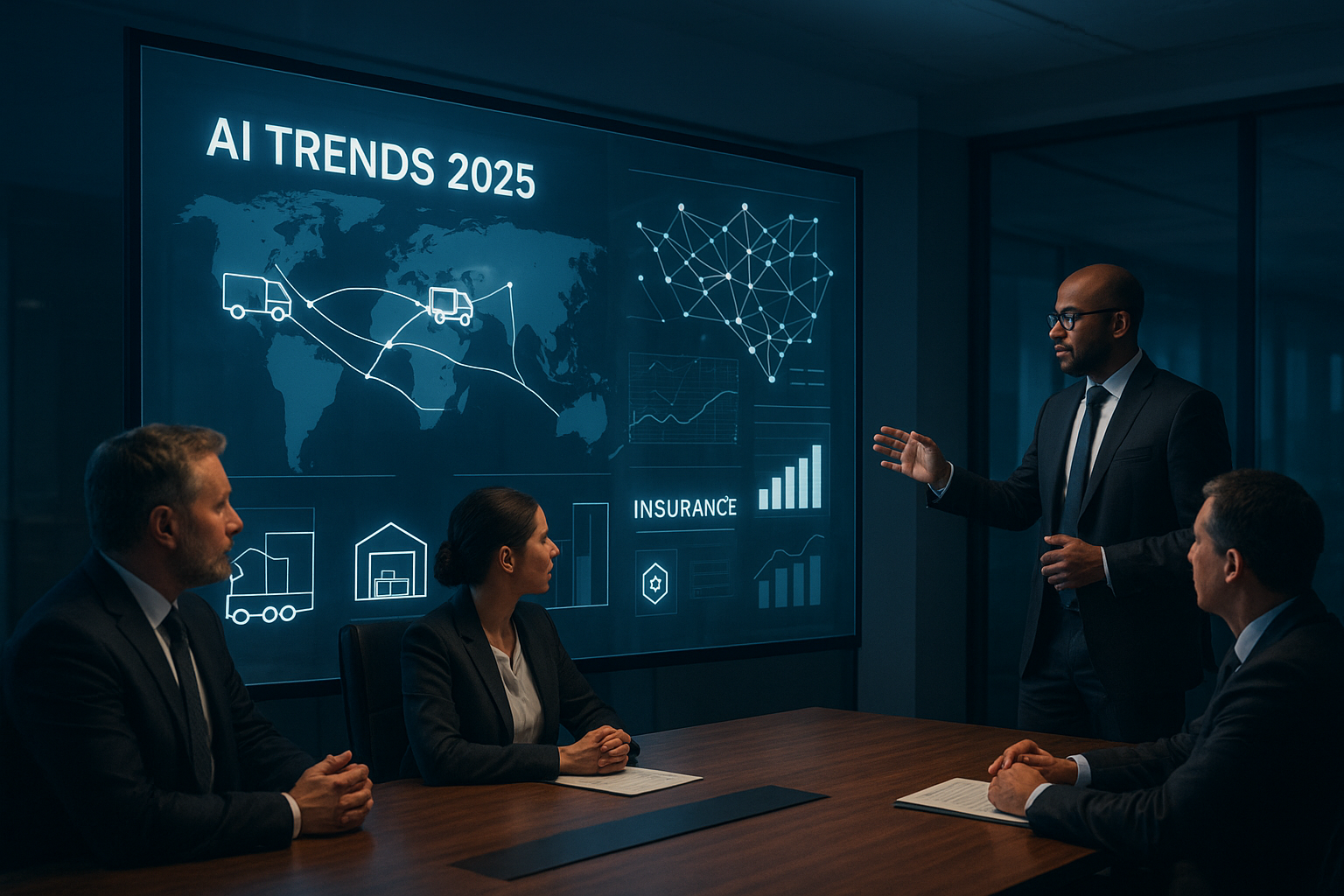

Week 1 — AI Trends 2025 and Strategic Planning for Enterprises
Executives entering 2025 face a familiar tension: the promise of AI trends 2025 enterprise-grade capabilities and the practical constraints of existing operations. For COOs in transportation and logistics, that means converting generative copilots, predictive planning, and computer vision into reliable improvements in on-time performance and cost per mile. For CIOs in insurance, the ask is bolder: scale an insurance AI operating model that supports underwriting automation, smarter FNOL workflows, and fraud detection without introducing unmanageable model risk. This two-part brief lays out starting-roadmap guidance for logistics leaders and a scaling playbook for insurance technologists.
Part 1 — Logistics 2025: A COO’s Guide to Starting with AI (Starting Out)
When a logistics COO first evaluates AI, the right frame is pragmatic sequencing. The most immediate wins will not come from sweeping, network-wide optimization but from tactical improvements that reduce exceptions and free capacity. Begin by mapping customer-impact events — missed windows, damaged freight, invoice disputes — and match those to the 2025 trends that matter: genAI copilots for dispatcher assistance, predictive planning for demand smoothing, and computer vision for damage detection at docks and in yards.

A practical logistics AI roadmap favors use case sequencing: prioritize quick wins such as route optimization AI pilots on constrained corridors, followed by demand forecasting in high-variance lanes, and then back-office automation for documents and exceptions. Route optimization AI can reduce empty miles and improve ETAs when integrated with telematics and order data; however, the most resilient gains come from coupling optimization with human-in-the-loop dispatching so drivers and planners retain control when rules or service priorities change.
Data prerequisites surface quickly. You will need synchronized orders, telematics, warehouse events, and the document flows that accompany shipments. Latency matters: real-time decision-making for route adjustments requires streaming telematics, while batch demand planning can tolerate daily aggregation. For many organizations, the first technical project is implementing a lightweight event bus and standardizing message schemas so a new route optimization AI service can subscribe to live updates without ripping out the TMS.
Automation targets in the near term are often mundane but high-value. Document processing for bills of lading and invoices eliminates bottlenecks in billing and carrier settlement. Exception triage that routes late deliveries or damaged-item reports to the right human queue reduces cycle time. Customer communication automation driven by generative copilots reduces inquiry volume while keeping customers informed with ETA updates. Consider AI process automation services that can be delivered as modular APIs, enabling rapid integration with your TMS and WMS.
The build versus buy decision is rarely binary. Off-the-shelf TMS/WMS extensions can provide rapid access to route optimization AI and predictive planning. Custom AI development for enterprises becomes compelling when you need microservices tailored to proprietary routing constraints, specialized cost models, or unique integration requirements across carriers. A hybrid approach — extend the TMS for baseline capabilities while developing custom microservices for core differentiators — tends to balance time-to-value with strategic control.
Model ROI must be grounded in operational KPIs: on-time rate, cost per mile, dock-to-stock time, and exception rate. Create a simple financial model that ties a percent improvement in on-time deliveries to revenue retention and reduced expedited costs. Beware the risk of model drift: seasonality, route changes, and carrier behavior will degrade model accuracy. A disciplined human-in-the-loop approach to dispatch and a plan for continuous retraining and validation will protect service levels as you scale.
Part 2 — Insurance CIO Playbook: Turning 2025 AI Trends into an AI-First Operating Model (Scaling)

For insurers, the transition from point solutions to an insurance AI operating model is a governance and platform story as much as it is a modeling one. The strategic themes for 2025 are clear: straight-through processing where risk permits, personalized pricing enabled by fine-grained risk signals, and intelligent claims workflows that reduce cycle time while preserving fairness. Scaling these themes requires a unified data fabric and a catalogue of reusable AI services.
A unified data fabric must harmonize policy records, claims histories, third-party data feeds, document images, and voice/text interactions. Without consistent identifiers and lineage, model performance will vary across lines of business. Invest early in master data management, message schemas, and an ingestion pipeline that tags data with provenance and timeliness. This fabric becomes the backbone for underwriting automation and claims AI and FNOL processes that depend on rapid, reliable access to policy and incident context.
At the service layer, design reusable AI assets: document IQ that extracts structured fields from PDFs and photos, entity extraction for third-party reports, risk scoring services that normalize exposures across products, and fraud detection modules that flag anomalies. These components accelerate deployments and reduce model sprawl. Standardizing APIs and response formats allows underwriting applications, call centers, and claims systems to share the same intelligence, simplifying governance and auditability.
Controls are non-negotiable as models influence pricing and customer outcomes. Implement fairness checks, explainability tools, and adverse action notice workflows so decisions tied to underwriting automation can be defended and audited. Maintain immutable audit logs for model inputs, predictions, and human overrides. These controls not only satisfy regulators and auditors but also reduce operational risk when models are retrained or updated.
MLOps practices should be organized by line of business. A central model catalog with metadata—owner, training data windows, performance metrics, retraining SLA—allows the CIO’s office to track model health. Retraining SLAs should be explicit: e.g., models for weather-sensitive property risk require shorter retraining cycles than long-tail commercial lines. Segmentation in MLOps prevents cascading failures and ensures the right teams own lifecycle responsibilities.
Partnerships and where to bring in external expertise is another strategic choice. For complex integrations into claims platforms or policy administration systems, partnering with AI process automation services and custom AI development for enterprises accelerates delivery while transferring knowledge. External teams can help integrate explainability libraries, instrument model monitoring, and implement deployment pipelines that meet enterprise security standards.
Finally, operational KPIs must translate model outputs into business impact: track loss ratio movement attributable to underwriting automation, claim cycle time improvements from FNOL automation, fraud leakage reduction, and customer NPS. Build executive dashboards that show these indicators alongside model performance metrics so business leaders can connect AI investments to financial and customer outcomes. This visibility sustains momentum and prioritizes the next set of investments across underwriting, claims, and servicing.
Both the logistics COO and the insurance CIO face a similar arc in 2025: start with targeted, high-impact pilots that validate data and integration patterns, then invest in platform and governance to scale. Whether your organization needs a logistics AI roadmap focused on route optimization AI and document automation, or an insurance AI operating model that enables underwriting automation and smarter claims AI and FNOL, the pattern is the same: prioritize reusable services, enforce controls, and measure impact in operational KPIs. That disciplined path turns the promise of AI trends 2025 enterprise into durable business value.


Sign Up For Updates.