

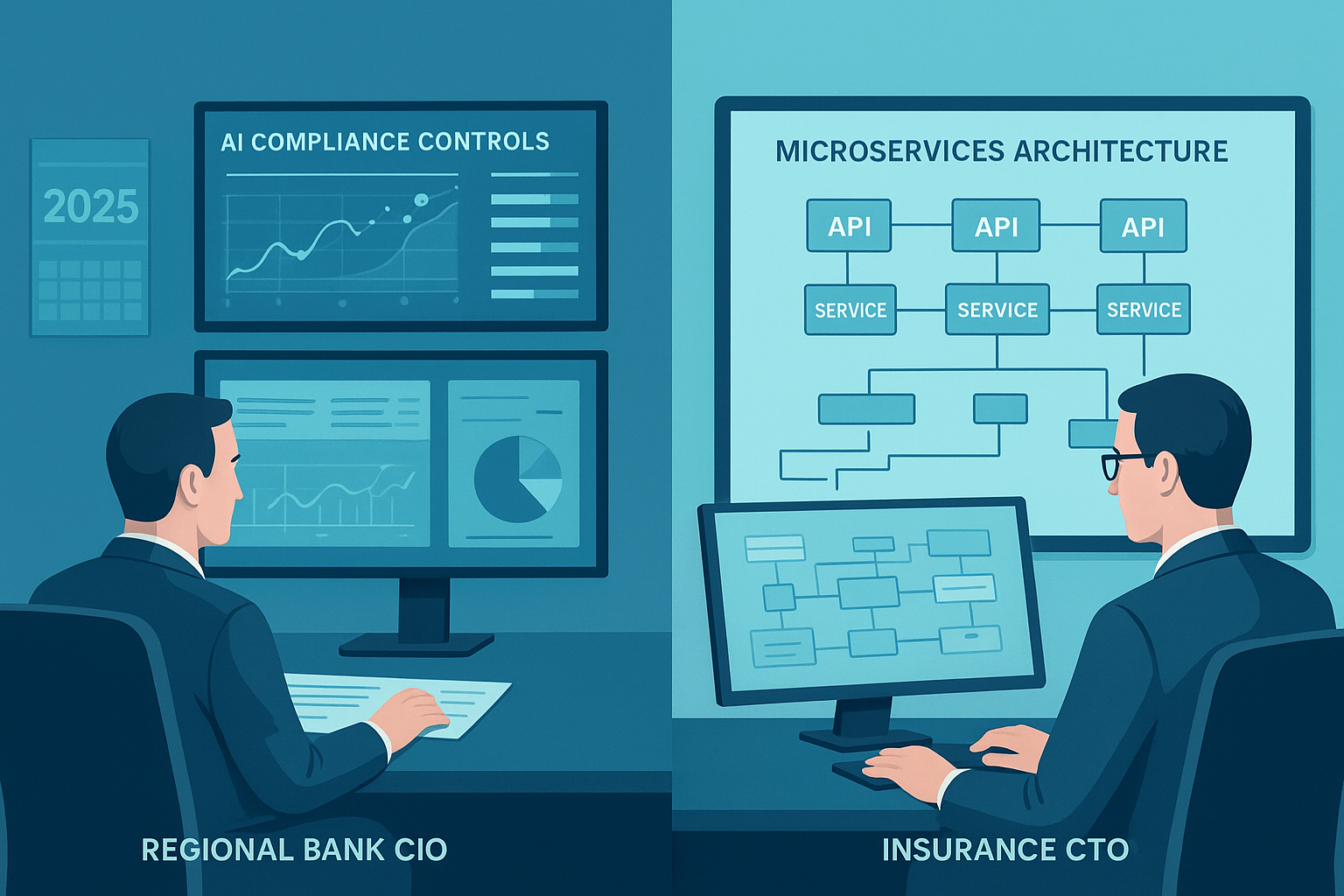

Part I: A 90-Day AI Compliance-and-Value Plan for Regional Banks (CIOs — Starting Out)

As 2025 closed, many mid-market banks saw two parallel realities: clearer regulatory expectations around generative AI and practical technical advances that made rapid, useful deployments possible. This financial services AI 2025 review matters because it pulled ambiguous vendor promises into tangible controls — enterprise LLMs behind the firewall, standardized prompt logging, and rapid adoption of retrieval-augmented generation for knowledge work. For a regional bank CIO facing pressure to show ROI while managing risk, the task is not to chase every shiny use case but to execute a tight, compliance-first 90-day plan that delivers measurable outcomes.
Start by translating the banking AI roadmap 2026 into three concrete themes: capture value quickly with onboarding and compliance tasks, reduce operational risk with human-in-the-loop controls, and prepare an enterprise-grade foundation for future expansion. In week one, convene operations, compliance, and IT for a data readiness sprint. Inventory customer documents and key feeds, define quality thresholds for OCR and data extraction, and map lineage for any PII or PHI. Early wins depend on clean inputs: a poor data baseline will kill time-to-value and attract regulatory scrutiny.
Deployment should focus on use cases that pair well with RAG in finance. For example, a retrieval layer that indexes customer KYC documentation and sanctions lists can power smarter adverse-media enrichment and faster compliance report drafting. Combine that with intelligent automation banking patterns — integrate IDP (intelligent document processing) for onboarding forms, business rules for decision gates, and RPA to close out straight-through processing paths. Keep workflows shallow at first: route borderline cases to humans, log prompts and responses, and maintain full audit trails for approvals.
Governance needs to be pragmatic and visible. Define model risk tiers so that high-impact flows (e.g., sanctions screening) require explicit human sign-off and enhanced logging. Implement prompt controls and content filters, and ensure every LLM interaction emits metadata for later review. This is the skeleton of responsible AI compliance, and it will also support regulatory requests without stalling delivery.
On build vs. buy: prioritize vendor due diligence around security posture, data residency, and extensibility. Cost-to-serve calculations should include token costs, integration effort, and ongoing monitoring. If you choose to buy, insist on a transparent MLOps financial services playbook from the vendor: how they model drift, maintain embeddings, and manage model upgrades. If you build, focus on using managed components for vector stores and model serving to accelerate time-to-market.
Finally, quantify ROI in business terms: time-to-decision improvements, reduction in false positives in fraud alerts, and lower cost-per-case for onboarding. Set 30/60/90-day milestones that are operational and behavioral — in 30 days, have a running sandbox with realistic data; in 60 days, pilot a production flow for one region; in 90 days, measure cost-per-case and compliance outcomes and iterate. Train operations and compliance users continuously: the best automation still depends on people who understand how to override, audit, and improve models.
Part II: From Pilots to Portfolio—Scaling AI in Insurance Claims and Underwriting (CTOs — Scaling)

2025 proved that insurance AI scaling is no longer theoretical. Claims triage using NLP at FNOL, document AI that digests medical bills, and RAG-powered underwriting knowledge search moved from pilots to repeatable capabilities. The strategic question for CTOs is how to turn those point successes into a governed, efficient platform that reduces loss and expense ratios while satisfying regulators and auditors.
The foundational move is to define a reference architecture that supports reuse. At the center should be a feature store for production-ready signals, a vector database for embeddings used in RAG in finance scenarios, and a model registry linked to CI/CD pipelines. Add a prompt hub for standardized prompt templates, and sit all of this on event-driven microservices so claims intake, triage, and payment triggers can be composed and scaled independently. This architecture enables claims automation AI to be applied across lines of business without rebuilding basic connectors.
Operationalizing the flow requires a hyperautomation blueprint: ingest FNOL with LLM-assisted intake, classify and route documents via document AI, summarize clinical and billing documents, and feed structured signals into decision support models. Payment triggers and straight-through processing should be gated by explainability outputs and drift detectors to maintain regulatory confidence. Reusable data products matter: a policy knowledge graph, shared embedding catalogs, and risk-scoring primitives reduce duplication and speed new use-case launches.
Governance at scale must be technical and organizational. Implement continuous bias testing, red-teaming for adversarial inputs, and automated drift detection with rollback paths. MLOps financial services practices should include versioned datasets, lineage tracking, and runbooks that map model changes to business KPIs like indemnity outcomes and SLOs for claim cycle time.
FinOps is another lever: workloads need right-sizing so token usage, throughput, and caching are optimized. Balance caching and guardrails against quality trade-offs — a cached answer may be cheaper but could introduce stale knowledge in underwriting decisions. Make cost-visible to product owners and encourage design patterns that reduce repetitive queries to large models by leveraging embeddings and smaller specialist models when appropriate.
Talent and the operating model determine whether the platform succeeds. A hybrid approach — central CoE for core services with federated product teams owning domain models — often works best. Productize AI services with SLAs so lines of business can consume them without deep ML expertise. Finally, measure business outcomes aggressively: straight-through-processing rates, reduction in cycle time, improvements in customer experience scores, and measurable downward pressure on combined ratios are the KPIs that will secure continued investment.
As mid-market financial institutions plan their 2026 investments, remember that the promise of 2025 becomes sustainable through disciplined execution: a compliance-first, ROI-focused entry for regional banks and a scalable, governed platform for insurers. Both paths require the same fundamentals — data maturity, clear governance, and architecture designed for reuse — but they differ in immediate priorities. For CIOs, prioritize controlled value capture and auditability. For CTOs, turn pilots into a portfolio that drives better claims and underwriting economics while meeting the new expectations of responsible AI compliance.


Sign Up For Updates.