

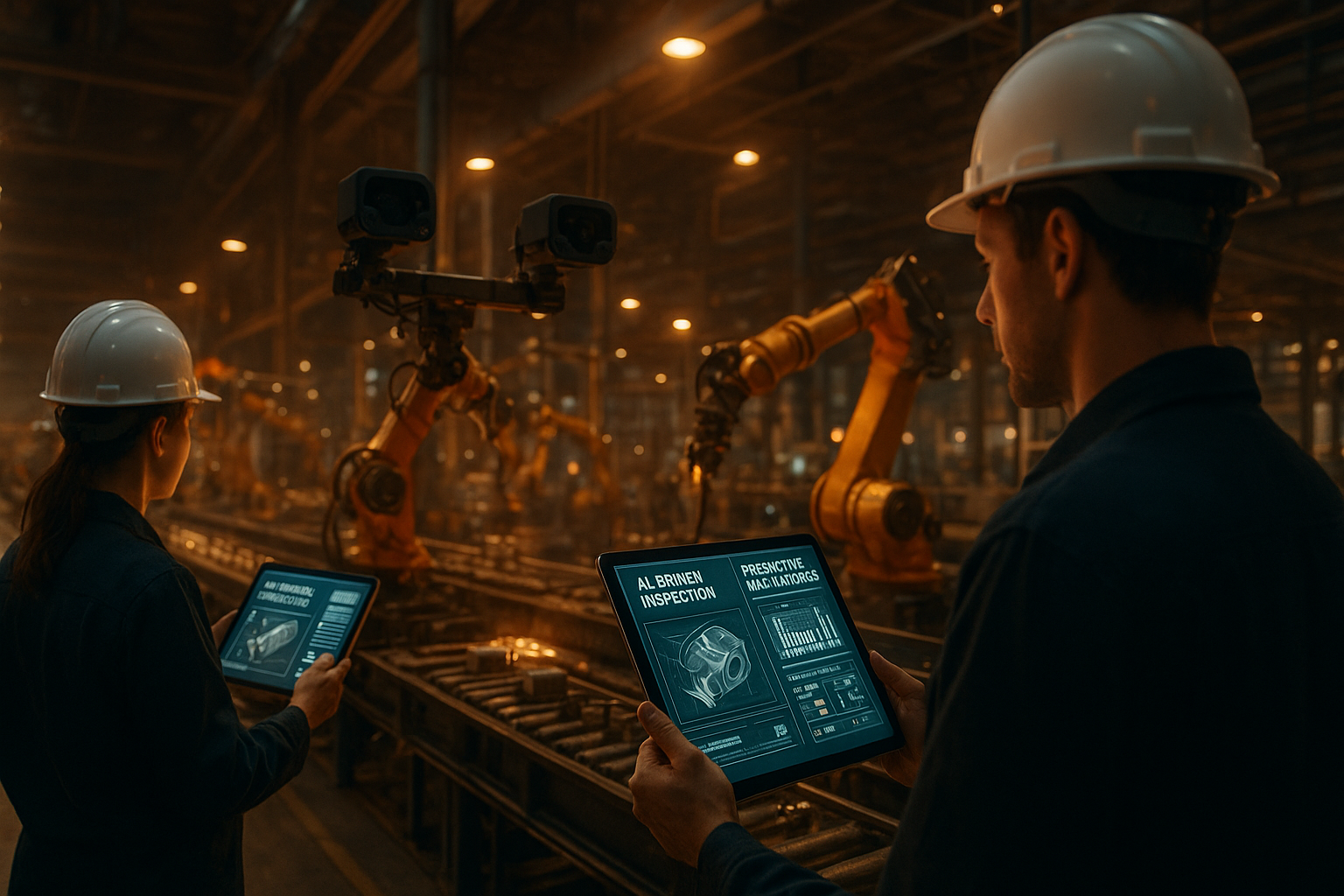

AI Year in Review 2025 in Manufacturing: Edge Intelligence, Vision QA, and Predictive Maintenance — Scaling Smarter Plants in 2026
Walking the plant floor at the end of 2025 felt different. Cameras that would once have cost a small fortune were now routine tools on every line; tiny, optimized neural networks were catching defects that eluded human eyes; and vibration sensors paired with lightweight models were predicting bearing failures days before a line would stall. This manufacturing AI 2025 review is not just a catalog of shiny new tools — it shows how teams translated those tools into measurable improvements in yield, throughput, and uptime. For teams planning next year, the question is how to convert those wins into predictable, repeatable programs. The next sections map a pragmatic path: rapid plant-level wins for plant managers, and the systems-level discipline CTOs need to scale across multiple sites.
Part: Quick Wins with Vision QA and PdM Starter Kits (For Plant Managers — Starting Out)
For plant managers who must deliver results on the next production quarter, 2025 proved one thing: you can get meaningful OEE improvement AI outcomes fast if you focus. Vision quality inspection AI and predictive maintenance AI moved from experimental to operational because of three converging developments — affordable edge cameras, robust small models for defect detection, and better sensor fusion stacks. That means a one-quarter lift in first-pass yield is realistic when projects are scoped tightly.
Begin with use-case selection. Pick a high-frequency failure mode: visual defect detection on a finished assembly, parts counting during packaging, or an anomaly detection target on a critical pump. Narrow scope reduces the labeling burden and lets you create a golden dataset in weeks, not months. Practical data work includes camera placement to capture the key view, consistent lighting to reduce false positives, and focused sample labeling (include the worst failures first). Early collaboration between operators, quality engineers, and OT technicians ensures camera mounts and cable runs don’t interfere with standard work and that visual criteria reflect human inspection standards.

Automation integration accelerates value. Connect inference outputs to simple PLC triggers so a detected defect can stop a short segment of the line, tag the affected batch, and feed an RPA task that logs a quality report. Those feedback loops make AI outcomes visible to operators and create a traceable record for continuous improvement. Safety and change management matter just as much as model accuracy; engage unions and operators early, update standard work, and publish transparent pass/fail rules so acceptance isn’t a black box.
Do the math openly. ROI for vision and PdM starter kits typically comes from scrap reduction, rework time saved, and downtime avoided. If a vision model reduces scrap by five percent on a line doing 10,000 units per week, that reduction—times material cost and labor savings—paints a clear payback schedule. For predictive maintenance, even a modest MTBF improvement shifts emergency repairs to scheduled maintenance, trimming MTTR and avoiding the high cost of unplanned stops.
A pilot plan should be short and surgical: define scope, collect a golden dataset, set acceptance criteria (precision/recall thresholds that match operator risk tolerance), and train operators on interpreting model outputs. Move from pilot to line-wide deployment by packaging models with simple deployment playbooks — model artifacts, inference container settings, camera calibration notes, and a two-week maintenance schedule for re-calibration or incremental retraining. These building blocks let a successful pilot expand without reinventing the deployment steps on every line.
Part: Rolling Out Edge AI Across Multi-Site Operations (For CTOs — Scaling)
If plant managers convert pilots into line-level wins, the CTO’s job is to compound those wins across sites. In 2025 the biggest barrier to scale was not model accuracy but the lack of repeatable operations: inconsistent stacks, fragile update processes, and insecure OT connections. Edge AI in factories needs an enterprise reference stack to change that reality — edge gateways that host containerized inference, a model registry for versioning, centralized telemetry for drift detection, and remote orchestration that can push updates safely to thousands of inference nodes.

Manufacturing MLOps at the edge looks different from cloud-centric MLOps. You need rigorous model versioning, A/B testing on the line, and canary rollouts that limit exposure when a new vision quality inspection AI model is introduced. Drift monitoring must run close to the source, flagging changes in input distributions so teams can decide whether to retrain or adjust thresholds. A centralized defect library and feature store accelerate new deployments by reusing labeled examples and standardized features across sites, turning local learning into enterprise data products.
Digital twins and simulation became practical enablers in 2025: you can simulate line changes and test new control strategies without stopping production. That reduces the risk of yield loss when rolling out new computer vision inspections or modified PdM thresholds. Combine simulation with staged rollouts — test in a digital twin, deploy to a pilot line, run a canary on a single shift, then expand — and you get predictable outcomes faster.
Security is non-negotiable. OT cybersecurity AI can help by monitoring for anomalous network traffic patterns and unauthorized firmware changes, but architecture matters: adopt zero-trust networks, segment inference nodes from critical control systems, and use signed, auditable update pipelines for models and software. Secure update mechanisms let you push patched models or bug fixes without risking plant operations.
Successful multi-site rollouts depend on a clear partner and vendor ecosystem. Define who owns cameras, who manages the edge gateways, and who provides the model lifecycle tooling. System integrators often orchestrate the initial hardware and integration, cloud providers supply centralized model registries and telemetry, and camera vendors support calibration. Clear SLAs and responsibilities avoid the finger-pointing that kills momentum.
Finally, workforce enablement must be part of the scaling plan. Upskill maintenance techs and quality engineers as citizen AI operators who can re-calibrate cameras, validate retraining datasets, and run basic model health checks. Track enterprise KPIs that matter to leadership: OEE improvement AI targets, MTBF/MTTR trends from predictive maintenance AI, and throughput gains per site. With those metrics tied to clear ownership and an MLOps backbone, a multi-site AI rollout turns into a compounding business capability rather than a set of siloed experiments.
The arc from 2025’s tactical wins to a 2026 program is straightforward in concept: lock down quick, high-impact plant projects, then standardize the stack, security, and operational practices that let those projects scale. When vision quality inspection AI and predictive maintenance AI are treated as productized services — with versioning, telemetry, and retraining pipelines — the result is not just better models, but measurable enterprise improvements in yield, uptime, and predictable growth across sites.


Sign Up For Updates.