


Throughput, Safety, and Visibility: The Modern Ops Trilemma
As a COO responsible for maritime terminals, inland yards, or airport ramps, you live with a constant tension: throughput targets push operations to move more containers, pallets, and aircraft faster, while safety and regulatory requirements insist on slower, more controlled behavior—and visibility across partners is often fragmented. Dwell penalties and congestion costs appear on monthly P&Ls, yet a single safety incident can trigger regulatory reviews and reputation damage that far outweigh incremental efficiency gains. Bringing computer vision and digital twin technologies together creates a path to resolve that trilemma: improving throughput, bolstering safety, and delivering consistent visibility for stakeholders.

Computer Vision at the Edge: What It Can See Reliably
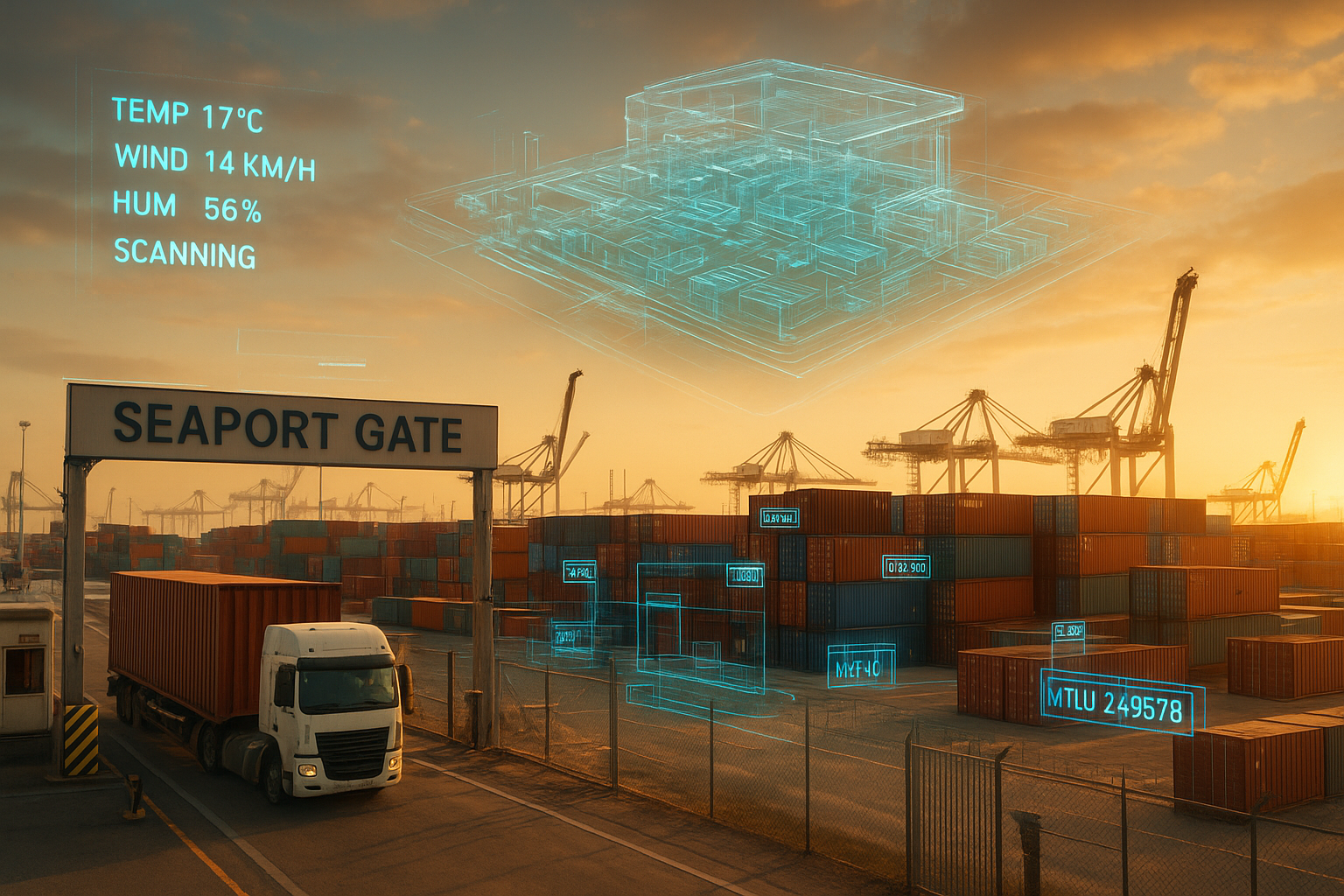
In outdoor, harsh environments the right combination of rugged cameras, edge compute, and models trained for variability delivers dependable results. Common, high-value use cases include gate OCR for container and ULD IDs, license plates, and trailer markings—what many teams refer to as container OCR AI. Reliable optical recognition at gates eliminates manual tag-in delays and reduces reconciliation errors that drive dwell time. Beyond text recognition, yard management computer vision can assess dock and ramp occupancy, estimate queue length, and detect PPE compliance or hazardous behaviour among personnel.

Computer vision models also excel at condition assessment: detecting trailer or container damage, punctures, or misplaced cargo that would otherwise be discovered only after costly delays. Because many of these detections must operate even with limited connectivity, edge AI in transportation—deploying inference at local gateways with GPU or TPU acceleration—becomes essential. Edge inference lowers latency for time-sensitive alerts while buffering streams for central analysis, making vision-based safety and throughput features practical at scale.

Digital Twins for Planning and ‘What‑If’
Once you have reliable telemetry from computer vision, the next step is to project outcomes. Digital twin logistics brings a real-time mirror of gates, lanes, cranes, and vehicles into a simulation environment where policies can be stress-tested without touching live operations. Discrete-event simulation reproduces queuing at gates, lane conflicts, and crane interactions, allowing planners to run policy experiments: tighter appointment windows, priority lanes for high-value customers, or different sequencing rules for truck arrivals.
These controlled experiments let teams quantify trade-offs before implementation. More advanced programs incorporate reinforcement learning agents to recommend dynamic slotting policies, though many organizations find immediate value in scenario-based simulations that tune appointment rules and staffing levels. Using operations simulation logistics to iterate on policies reduces the risk of negative operational impacts while providing defensible, data-backed decisions for boardrooms and regulator conversations.
Closed-Loop Orchestration and Automation
Vision and simulation generate insights, but real impact comes from closing the loop: translating those insights into automated orchestration and human-guided execution. Integration into YMS, TOS, or GH systems is the practical glue—pushing automatic lane reassignments, dispatch instructions, and updated appointment slots back into operational workflows. Real-time location systems (RTLS) and dispatch logic can use vision-derived occupancy and queue metrics to re-route incoming trucks or reprioritize cranes, reducing idle time and smoothing throughput peaks.
Automation also supports human-in-the-loop controls. When the system recommends a lane change or an exception, operators receive an alert with an SOP playbook and the key data behind the recommendation: camera snapshots, queue projections, and runway/ramp constraints. This keeps the operator in control while enabling faster, more consistent decisions across shifts and sites.
Architecture & MLOps for CV + Simulation
Deploying these capabilities at industrial scale requires an architecture that supports both robustness and maintainability. Edge gateways should incorporate GPU acceleration and local buffering to handle intermittent connectivity; they must also support secure model deployment and rollback. A disciplined MLOps pipeline tracks model performance in production, flags drift when environmental conditions change, and automates safe rollbacks to earlier model versions when confidence drops.
Data governance is equally important. Define privacy zones (virtual areas in camera views where no recording or PII extraction occurs), retention policies, and secure transfer channels for recorded events used in incident forensics. For rare event detection—such as a dangerous vehicle maneuver or catastrophic container failure—synthetic data augmentation helps close gaps in training data without exposing employees to risk during labeling, improving model recall for low-frequency but high-impact events.
Safety, Compliance, and Stakeholder Trust
Designing for safety and compliance from day one builds trust with regulators, labor partners, and customers. Visible signage, clear policies about recording and data use, and privacy zones are not optional niceties but operational necessities. Computer vision systems should generate auditable trails: time-stamped evidence for incident investigation, model confidence scores for any automated action, and immutable logs showing what data was shared externally under cross-tenant agreements.
Transparency matters: when terminals share data with carriers, third-party logistics providers, or airport authorities, contractual agreements should define the scope of sharing, retention windows, and anonymization requirements. A robust approach protects sensitive information while enabling the collaboration necessary to reduce systemic congestion across the supply chain.
Business Case and Phased Rollout
For COOs, the technology conversation always narrows to KPIs. Measure success using dwell time, turn time, asset utilization, and incident rates, and prioritize zones with high variance in those metrics—typically gates and ramps with unpredictable peaks. Start with a focused pilot on a handful of gates or a single ramp, instrumenting them with container OCR AI and occupancy vision, and use digital twin experiments to identify the highest-leverage policy changes. From there, scale in waves tied to capital projects and staffing cycles, aiming for a 12–18 month roadmap aligned with procurement and infrastructure upgrades.
This phased approach reduces risk, produces early ROI that can fund subsequent phases, and creates repeatable playbooks for expanding yard management computer vision across terminals and airports. When done correctly, the combined stack—edge AI in transportation, robust MLOps, and digital twin logistics—delivers measurable throughput optimization AI outcomes while strengthening safety and stakeholder confidence in operations.
Adopting computer vision and digital twins is not a single technology purchase; it is an operations play that requires cross-functional commitment. For leaders ready to scale, the promise is clear: faster turns, fewer incidents, and a living model of your operations that helps you make better choices every day.


Sign Up For Updates.