


The Middle‑Mile Margin Squeeze
The middle mile is where retail promises meet carrier realities. Customers demand same‑ or next‑day fulfillment, omnichannel returns, and transparent tracking; at the same time, transportation inflation, carrier capacity oscillations, and surcharges compress margins. For a Chief Operating Officer in retail, the question is not just how to move goods quickly, but how to do it at scale without sacrificing service or exploding cost-to-serve.
That tension is acute when inventory must be balanced across distribution centers and stores. A surge in e-commerce orders in one region, paired with a promotional event in another, creates a complex rebalancing problem. Carrier capacity constraints and dynamic surcharges make static plans brittle. This is the context where middle-mile optimization becomes a business imperative, and where AI in retail logistics moves from experimental to strategic.
Demand Sensing that Drives Logistics Decisions
Traditional monthly or weekly forecasts are too slow to guide the middle mile. Demand sensing AI uses near‑real‑time signals — point-of-sale transactions, web traffic trends, promotion schedules, weather forecasts, and local events — to create short-horizon SKU-by-DC forecasts. These forecasts come with uncertainty bands that let planners and systems quantify risk. A product showing a predicted spike with a tight uncertainty band can trigger a preemptive transfer or a safety stock adjustment; the same signal with a wide band may prompt conservative replenishment.

When demand sensing is embedded into execution, inventory positioning becomes proactively driven by anticipated needs. Automated rules convert sensed demand into safety stock recommendations and transfer suggestions. Those recommendations are not blind — they take into account lead times, load consolidation opportunities, and the cost tradeoffs of moving inventory versus fulfilling from a farther location. For COOs focused on cost-to-serve optimization, demand sensing AI links customer-facing signals to tangible logistics actions.
Dynamic Routing, Batching, and Mode Selection
Once inventory moves are decided, the middle mile still needs efficient routing. Dynamic routing retail strategies use optimization engines that respect multi-stop routing constraints, time windows at receiving docks, and carrier appointment rules. Modern systems batch shipments to improve load factors, suggest mode shifts between LTL, TL, and parcel, and identify consolidate opportunities that reduce per‑unit transport costs.
Importantly, optimization should present what-if scenarios so planners can weigh cost against service. If a route optimization suggests consolidating two DC-to-store flows into a single multi-stop lane that saves fuel but risks a one‑hour delay at one store’s dock, planners can see the cost savings, CO2 reduction, and OTIF impact side by side. The best dynamic routing tools keep planners in control: they automate the heavy lifting but leave policy tradeoffs and approvals within the operator’s governance framework.
Closed-Loop Automation across WMS/TMS/OMS
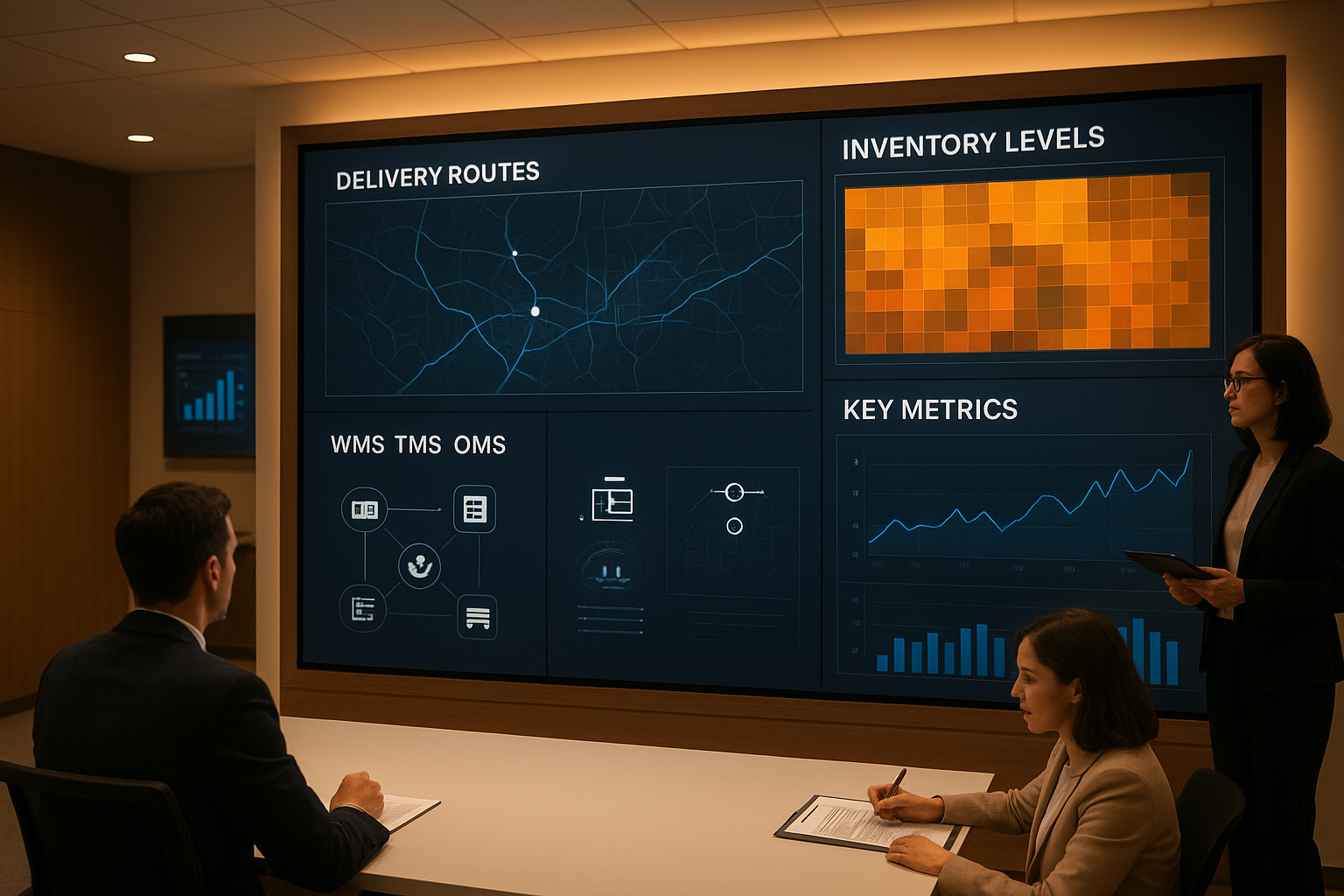
To realize the benefits of demand sensing and dynamic routing, decisions must be woven into execution systems. WMS, TMS, and OMS integration is the connective tissue that turns predictions into movement. Event-driven APIs push recommended transfers from the demand sensing layer into the WMS for pick planning, while the TMS receives routing plans and executes carrier tendering. Status updates flow back to the OMS so customer promise times and inventory availability remain accurate.
Automation handles the common flows: auto‑tendering to preferred carriers, pushing dock appointment windows, and updating track-and-trace milestones. Exceptions — a failed tender, an overloaded DC, or a sudden weather closure — surface as alerts for planner review with suggested mitigations. The result is a closed loop where sensing informs decisions, execution updates the enterprise systems, and feedback refines future sensing, improving decision intelligence retail workflows over time.
MLOps and Decision Intelligence at Scale
Models that power forecasting and routing must be treated as production artifacts. MLOps disciplines ensure models remain accurate and auditable in the face of seasonal shifts, product assortment changes, and promotional cycles. Continuous monitoring catches drift; automated retraining pipelines incorporate new features and feedback from actual fulfillment outcomes. A scenario library enables safe testing of policy changes: run an alternate allocation logic against last quarter’s data and compare cost-to-serve and service metrics before committing to a rollout.

Decision intelligence retail is about more than models. It requires versioning, explainability, and governance so that planners and auditors understand why a particular transfer or routing decision was made. Explainable recommendations increase adoption because operators can validate decisions against business rules and regulatory needs. For COOs, these capabilities mean scaling AI in retail logistics without losing control or traceability.
Sustainability and Cost: The Twin Targets
Middle-mile optimization has an environmental dividend. Better load factors and smarter routing reduce vehicle miles traveled, lowering CO2 per shipment. Idle time reduction in yards and terminals decreases fuel burn and emissions. When route planners can incorporate energy-aware constraints — for example, preferring daytime consolidation to avoid night-time congestion or prioritizing higher-capacity carriers for long hauls — sustainability metrics improve alongside financial KPIs.
Finance teams will track cost-to-serve, inventory turns, and on-time-in-full performance, while sustainability teams measure emissions per shipment and improvements in load efficiency. Presenting both sets of metrics in the same dashboard aligns stakeholders: a routing decision that saves 8 percent in transport cost and reduces CO2 by 10 percent becomes easier to champion when both outcomes are visible and quantifiable.
Phased Roadmap and Value Realization
Scaling these capabilities is best done in phases. Start with a narrow scope: identify two to three high-volume lanes and one distribution center cluster where demand volatility produces visible costs. Implement demand sensing on those SKUs, integrate the WMS and TMS for automatic transfer recommendations and routing, and instrument metrics for cost and service.
Once the initial lanes demonstrate improved cost-to-serve optimization and OTIF, expand to multi-region orchestration, adding more DCs and cross-dock logic. Establish a center of excellence that standardizes policies, maintains model governance, and runs A/B tests when policy changes are proposed. Training planners to trust and interpret AI recommendations is essential; operational adoption unlocks the measurable ROI that executives expect.
The endpoint is an enterprise platform where retail supply chain AI is not a special project but the default way decisions are made: near-real-time demand sensing drives inventory positioning, dynamic routing preserves service while minimizing cost, and WMS/TMS/OMS integration ensures automated execution and traceability. For COOs, that combination transforms the middle mile from a margin sink into a strategic lever for growth and resilience.
If you are evaluating how to scale AI in your retail logistics operations, consider mapping your highest-variability lanes and the downstream systems you need to connect. The measurable gains — lower cost-to-serve, improved OTIF, reduced emissions, and faster inventory turns — are achieved when sensing, optimization, execution, and governance operate as an integrated system rather than isolated capabilities.
To discuss how this approach could apply to your operations, contact us.


Sign Up For Updates.