

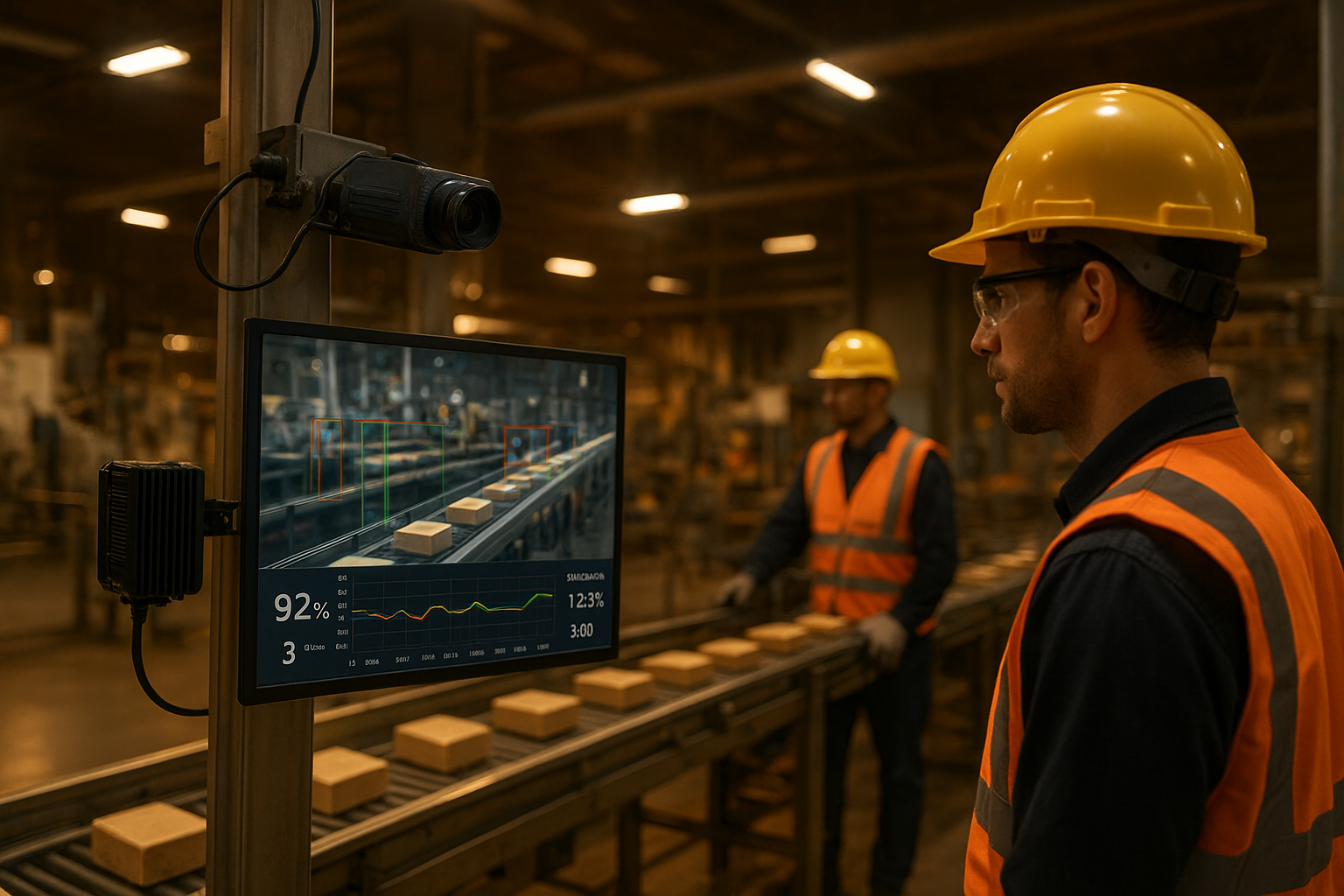

Why Edge AI Now for Manufacturing
When a part fails inspection or a spindle stalls for an hour, the cost is felt immediately on the line. For mid‑market manufacturers, the promise of edge AI in manufacturing is pragmatic: move decisioning to the machine, reduce latency, and cut the data and cloud costs tied to streaming raw video. Edge AI delivers faster quality decisions at takt time, improves first‑pass yield, and protects uptime — all metrics that translate straight to margin.

Latency matters when defects must be ejected before packaging or when a safety system must act in milliseconds. Running industrial computer vision quality inspection on or near the device also avoids shipping large volumes of images to the cloud, reducing bandwidth spend and exposure of IP. For teams starting with AI, these concrete benefits — fewer scrapped parts, less rework, and measurable OEE uplift — create the business case executives will back.
Selecting the First Use Case: A 3-Filter Method
Choosing the right first use case is less about novelty and more about predictable payoff. Apply three simple filters: value, feasibility, and data readiness. Value ties to clear KPIs such as scrap rate or mean time between failures. Feasibility considers if the sensors and controls already exist. Data readiness checks whether you can collect representative samples without months of heavy engineering.
Vision‑based QC and predictive maintenance edge analytics often surface as top candidates. A single camera pointed at a consistent inspection point can reduce false accepts quickly, while vibration or current sensors can support an early anomaly detection model for rotating assets. Map the pain — scrap, rework, downtime — to measurable targets and pick the pilot that can pay back within the pilot window.
OT/IT Alignment and Governance at the Edge
Deploying inference at the edge means bringing IT concerns and operational technology realities together. Network architecture must respect industrial protocols like OPC UA and Modbus, while secure gateways bridge the plant floor to enterprise systems. Make device selection a joint OT/IT decision: rugged industrial PCs or edge accelerators such as NVIDIA Jetson offer different tradeoffs for throughput and manageability.

Governance is critical. Define access control, versioning, and audit trails before any model touches production. Line changes demand safety and change‑control procedures: who can update models, how releases are staged, and how rollbacks occur. Establish these rules early to de‑risk deployments and accelerate approvals.
Data Readiness and Model Approach
Data wins pilots. A golden dataset sampled from the line, with representative lighting, part variation, and correct labels, speeds iteration. Instead of attempting to label everything, focus on slices that matter — common rejects, edge cases, and the process states where decisions will shift operator behavior. Protect IP with on‑device encryption and by limiting raw data export.
From a modeling perspective, classical computer vision techniques still solve many inspection problems efficiently. For more complex patterns, deep learning can outperform but needs model compression and pruning to run on edge compute. Consider transfer learning with domain‑specific fine‑tuning and benchmark models for latency and accuracy on the exact device you plan to deploy.
Process Automation Around the Model
Predictions only create value when they trigger action. Design the downstream workflow early: automated routing for rework, digital QC logs for traceability, and human‑in‑the‑loop review stations for exceptions. This orchestration turns edge inference into measurable outcomes — fewer escapes to customers, clearer audit trails, and faster mean time to repair.
Integration with MES, SCADA, and ERP is where predictions deliver business value. A failed inspection should automatically flag a batch in MES, trigger a kanban for manual rework, and add metadata for warranty accounting in ERP. These simple automations make it clear to executives that the pilot is not a research project but a process improvement with financial impact.
90‑Day Pilot Plan and ROI Targets
A timeboxed approach keeps momentum and limits risk. The first 30 days are about discovery: map the process, sample data, lock down architecture, and get safety and change approvals. Days 31–60 focus on model training, hardware validation, and human‑in‑the‑loop testing in a controlled bay. The final 30 days expand the trial to representative shifts, collect KPI baselines, and quantify lift against targets such as scrap reduction or downtime minutes saved.

Set clear go/no‑go criteria up front: target lift percentages, confidence intervals, and operational readiness checks. With those in place, a successful pilot becomes the funding vehicle for a broader rollout rather than an open‑ended experiment.
Upskilling for the Line and IT
People enablement is often the make‑or‑break. Design short, role‑based training that arms operators with exception handling playbooks and visual job aids. For OT and IT teams, establish safe‑change procedures and edge management practices so updates and monitoring don’t interrupt production. Identify super users on the line to shadow early releases and certify them to support peers.
These human measures reduce support load and institutionalize changes. When operators and engineers understand both the why and the how, adoption is sustained and the pilot’s gains persist after initial vendor support winds down.
Build vs. Buy and Partnering Smart
Decisions around build versus buy hinge on speed, core competencies, and long‑term lock‑in. Off‑the‑shelf vision models accelerate time to value for common defects, while custom models capture unique product characteristics. Favor open standards and containerized deployment (for example, Docker on edge devices) to keep future choices flexible.
When engaging partners, define scope tightly: strategy workshops, the 90‑day pilot, and a clear scale roadmap. Avoid one‑vendor lock‑in by insisting on interoperability, exportable models, and documented integration points. This approach preserves optionality as you transition from pilot to plant‑wide rollout.
Executive Checklist and Next Steps
Executives back pilots with clarity. Provide a concise checklist that includes KPI templates, a risk register, and a simple architecture sketch that shows where edge inference lives relative to MES and ERP. Include budget bands for pilot and scale phases and a timeline that maps to the 90‑day plan. Finally, offer a clear engagement: an Edge AI strategy plus an AI strategy pilot 90 days that aligns OT and IT, protects IP, and aims for an early, measurable ROI.
For CTOs and plant managers ready to move from curiosity to tangible outcomes, the starter blueprint here reduces risk, accelerates learning, and sets the stage for scalable edge AI deployments that improve quality, uptime, and safety on the shop floor. Contact us to schedule an Edge AI strategy workshop and pilot.


Sign Up For Updates.