


When telematics first became ubiquitous across fleets it delivered a steady drumbeat of incremental improvements: location, speed, harsh braking alerts, and maintenance flags. For many logistics organizations those wins started to plateau. The data was there, but the actions were not: GPS pings and back-office reports rarely translated into real-time operational autonomy on the road or in the yard. For COOs and CTOs committed to scaling AI across their operations, the next wave is about moving from telematics to edge intelligence — an architectural and organizational shift that turns sensors into decision agents and systems into closed-loop automation.

The Shift from Telematics to Edge Intelligence
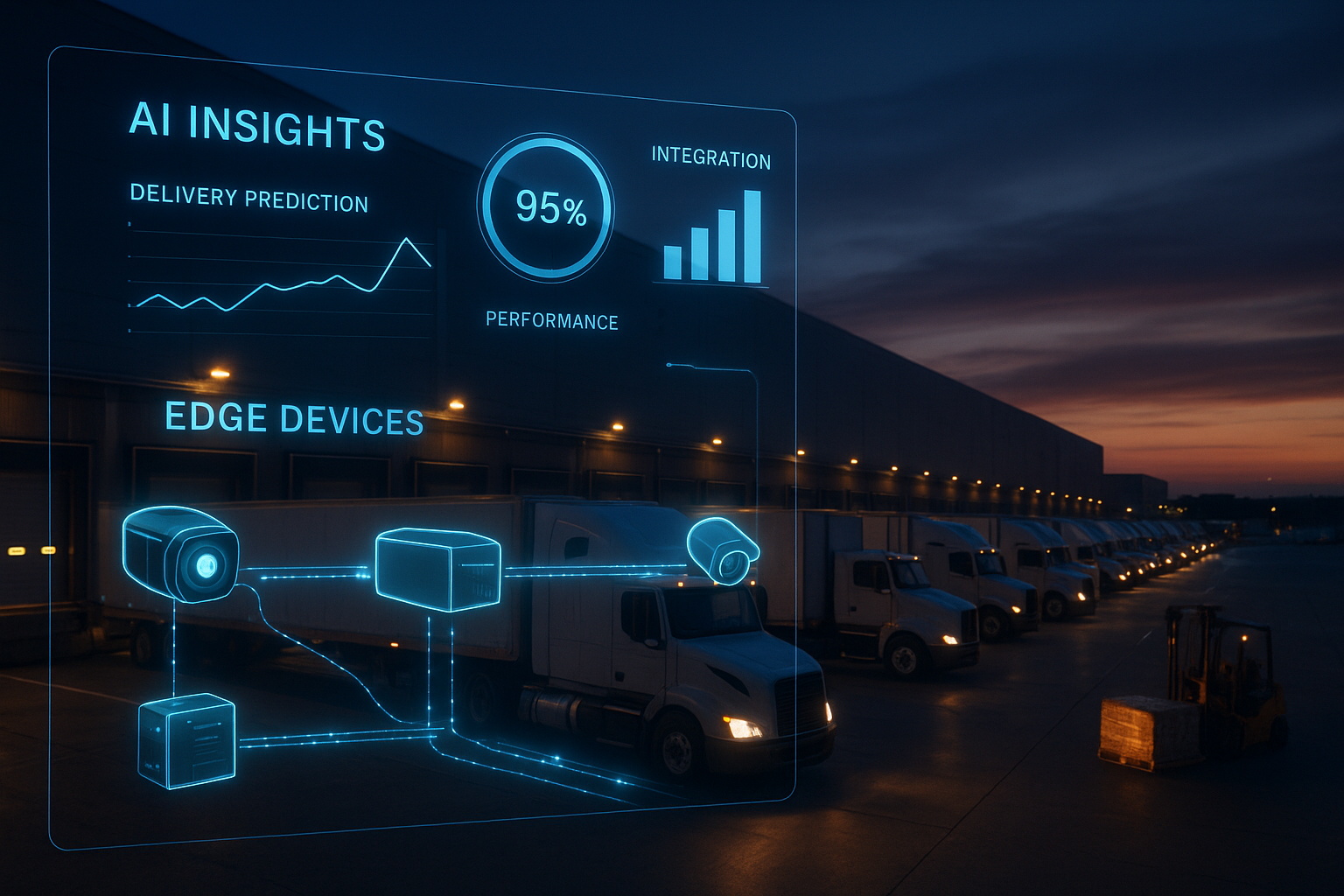
Telematics gave fleets situational awareness. Edge intelligence turns that awareness into short-latency, context-rich decisions. Beyond GPS and alerts, the vehicle itself can perceive and act: driver monitoring, ADAS add-ons, and local fuel optimization models can reduce incidents and improve mpg without waiting for a central server to respond. Likewise, warehouse and dock cameras evolve from passive recorders into edge agents that detect trailer IDs, measure dwell time, and trigger automatic door assignments. Crucially, the ROI accelerates when you adopt platform thinking — a unified event model that treats vehicle and facility edges as peers feeding a consistent stream of events into TMS and WMS systems.
Reference Edge Stack for Fleet and Hubs
A practical edge AI stack blends lightweight compute at endpoints with robust orchestration. On vehicles, that stack includes driver monitoring cameras, ADAS sensors, an edge compute box that runs quantized perception and fuel optimization models, and a secure connectivity module. In hubs, purpose-built dock cameras and short-range sensors become the eyes for yard automation. The orchestration layer routes events to TMS/WMS with low-latency SLAs so that a detected trailer ID and predicted dwell can immediately influence scheduling and routing. When you design for fleet edge computing AI, think in terms of event streams and command streams: events flow up and across, commands flow down and laterally.

Model Portfolio and A/B Testing in the Wild
At scale you will manage dozens of models across domains and geographies. That portfolio should include region-specific variants tuned for different weather and road conditions and domain-adapted models for particular trailer types or terminal layouts. You need safe experiment mechanics — canary rollouts and A/B testing — to compare routing models or safety interventions under live traffic. Implementing A/B testing edge models routing means instrumenting key metrics at the edge and in aggregate: incident rate, mpg, on-time performance, and dwell reduction. Metrics must be observable in near real time so you can roll back or promote models based on statistically significant changes, not gut instinct.
Cost and Reliability Engineering
Edge deployments change the cost equation. Model compression and quantization reduce CPU/GPU requirements and extend battery life, while smart bandwidth management — store-and-forward patterns and prioritized telemetry — control connectivity costs. Reliability engineering covers both software and hardware: device lifecycle planning, spare pools for edge boxes, and defined RMA processes reduce downtime. Design for graceful degradation so that if an edge model or connectivity fails, critical safety alerts still reach command centers and drivers. Optimizing TCO while improving resilience is a balancing act of right-sizing compute, telemetry cadence, and field support.
Automation that Moves the Needle
Automation delivers value when it closes the loop: predictions become actions that change outcomes. For terminals and DCs, warehouse dock automation vision can detect incoming trailers, auto-assign dock doors, and route yard tractors dynamically to cut dwell times. On the fleet side, edge models can trigger proactive maintenance tickets and parts pre-pick in the nearest service hub, reducing unplanned stops. Edge vision also creates reliable documentation for claims and compliance by capturing tamper-evident footage and metadata. The difference between analytics and operational impact is whether insights produce automated, measurable changes to day-to-day workflows.
Security, Compliance, and Driver Trust
No edge program scales without addressing privacy and security. Drivers must see transparent policies about what is recorded, how long data is retained, and how it’s used. Privacy-preserving monitoring — local anonymization or selective upload — lowers resistance and aligns with regional regulations. On the technical side, zero-trust device identities, mutual TLS, and key rotation are baseline requirements; incident forensics require immutable chain-of-custody for edge data so you can support audits and claims. Building trust is both a governance and design exercise: make consent, auditability, and minimal exposure defaults in your architecture.
Operating Model and Training at Scale
Edge AI changes roles on the ground. Dispatchers become decision partners with models; terminal staff manage sensors as operational assets. Training programs must be role-specific, combining simulator drills for drivers and playbooks for command centers to handle exceptions. Create command center playbooks that map model outputs to human actions and escalation paths. Identify change champions in terminals and DCs who can pilot process changes and disseminate best practices. Without intentional training and change management, even highly accurate models will underperform in production.
Scale Plan and Vendor Strategy
Scaling from pilot to enterprise requires a phased, measurable roadmap. A typical 12–18 month plan moves from proof-of-value at a handful of sites to a regional rollout and then full fleet integration, with a calibrated CapEx/OpEx mix and clear ROI milestones. Use vendor scorecards that evaluate not just model accuracy but edge runtime efficiency, security posture, and serviceability. Standardize SOW templates around SLAs for latency, model lifecycle, and fault remediation. For organizations that lack in-house edge experience, an Edge AI platform assessment plus a pilot-to-scale program can shorten the learning curve and de-risk the expansion.
Moving from telematics to real-time autonomy is both technical and cultural. For COOs and CTOs, the practical path is clear: evolve your stack to support fleet edge computing AI, invest in warehouse dock automation vision, and operationalize experiments with rigorous A/B testing edge models routing strategies. When TMS WMS AI integration is treated as an event-driven program rather than a set of point integrations, the organization gains the low-latency control needed to improve safety, MPG, and throughput. If your goal is scaling AI from point improvements to platform-level transformation, start with an assessment that maps your devices, events, and operating model — and build the edge-first roadmap that turns telematics data into autonomous action.
If you’d like help mapping an edge-first roadmap or running a pilot assessment, contact us to get started.


Sign Up For Updates.