

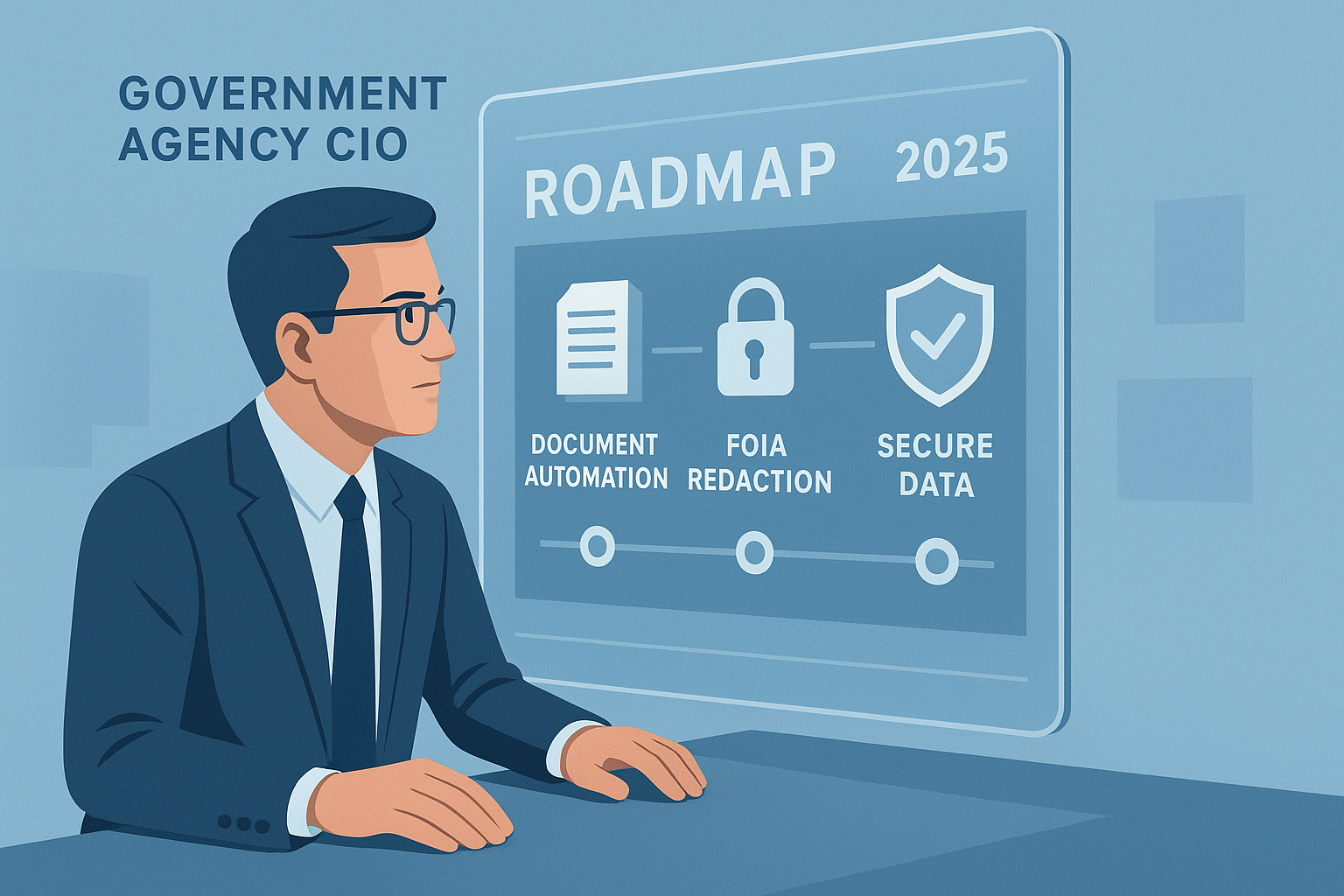

Agency CIOs who are just beginning to plan for artificial intelligence face a familiar tension: pressure to modernize services and reduce backlogs, while protecting privacy, equity, and public trust. That tension is precisely why a government AI roadmap 2025 should not be framed as a technology sprint but as a mission-first program to deliver measurable outcomes. When public sector automation is applied with clear guardrails, it can shorten timelines, improve accuracy, and free staff for higher-value work—if the approach foregrounds transparency and controls.
Mission first: Why AI now for public services
Across agencies the same operational symptoms are showing up: high document burden, long cycle times, and citizen expectations shaped by commercial experiences. Benefits programs, permitting offices, and FOIA teams are swamped with documents and manual review steps. Budgets rarely allow doubling staff to catch up, so leaders are looking to technology to shave days off decision timelines and reduce error rates.
But modernizing in the public sector comes with extra responsibilities. Equity mandates require that automation does not introduce disparate impacts. Public trust depends on transparent processes and the ability to explain decisions. That means a government AI roadmap 2025 must pair ambition with provable controls: measurable service improvements tied to documented governance and auditability.
The 2025 trends that matter for agencies
Not every advance in AI is relevant to every agency. For agency CIOs building an agency CIO AI strategy, the trick is to filter the noise and focus on practical capabilities that map to program outcomes. In 2025, several trends matter for the public sector:
Generative AI that can answer policy questions and summarize case files with source citations is becoming reliable enough for internal use. When configured correctly, these models can accelerate legal and policy research, and generate draft responses with references for human review. Document understanding tools are now capable of extracting structured fields from permits, eligibility forms, and FOIA requests—reducing data entry and speeding validation. For sensitive workloads, privacy-preserving analytics and on-premises options allow agencies to benefit from automation without cross-border or vendor data exposure.
Equally important are emerging frameworks for responsible AI in government. Risk-tiered approaches, explicit transparency requirements, and mandatory documentation such as model cards are rapidly becoming standard expectations. Any practical AI plan should bake these frameworks into design and procurement from day one.
Pick starter use cases that de-risk and deliver
An effective government AI roadmap 2025 begins with use cases that are both high-impact and low-policy-risk. Three categories frequently meet that bar.
First, FOIA intake triage and FOIA AI redaction. Automated intake can classify and route requests, and redaction tools can pre-process documents to remove or flag sensitive information before human release. These workflows reduce backlog and minimize the repetitive exposures that cause delay.
Second, benefits eligibility document extraction and benefits processing automation. Extracting identity, income, and supporting documentation into structured formats shortens verification cycles and provides clear audit trails for decisions. Pair the extraction with human validation for edge cases to keep errors and fairness concerns in check.
Third, internal knowledge copilots with source citations. For program staff who must interpret policy or precedent, a citation-aware copilot can increase productivity while making it easy to trace answers back to authoritative sources. That transparency supports both quality control and public accountability.
Data stewardship and security from day one
Data governance is not an afterthought; it is the backbone of any public sector automation effort. Start with data classification aligned to agency policy so teams know which data can be used for modeling, which must remain on-premises, and which require special handling. Logging prompts and responses, implementing strict access controls, and preserving audit trails are non-negotiable for FOIA responses, appeals, and oversight reviews.

Also require PII redaction and zero-retention configurations when working with vendors. Many commercial tools offer options to prevent training on agency inputs—insist on those terms where needed. For the highest-risk data, evaluate FedRAMP or StateRAMP offerings and consider hybrid deployments so sensitive processing remains within approved infrastructure.
Procurement pragmatism: Buying speed without lock-in
Procurement should enable iteration without creating vendor lock-in. Pilot-friendly blanket purchase agreements and modular contracts let agencies try narrow, well-scoped pilots and scale what works. Contracts must state clear data-use rights, portability obligations, and exit clauses, so agencies can move models or data if the vendor relationship changes.
Alignment with FedRAMP and StateRAMP accelerates approval paths, and insisting on on-prem or private-cloud deployment options for sensitive workloads protects mission integrity. Keep procurement language straightforward: define the expected outcomes, the data protections required, and the governance checkpoints that trigger scale decisions.
Human-in-the-loop and equity considerations
Automation in government must preserve human oversight. Design workflows where AI handles routine classification, extraction, or drafting, but where humans review and certify decisions for benefits denials, FOIA releases, and other material outcomes. Establish clear escalation paths so ambiguous or high-stakes cases go to trained staff.
Equity work should be explicit: conduct bias testing and demographic impact assessments before deployment, and publish plain-language model cards that describe capabilities, limitations, and known risks. Clear documentation builds public confidence and gives program managers a basis for monitoring fairness over time.
90‑day roadmap to a transparent pilot
A pragmatic 90‑day pathway helps agencies move from planning to evidence quickly. In the first 30 days, convene program leads to publish a concise problem statement and measurable KPIs: days to decision, backlog reduction, and citizen satisfaction. The next 30 days focus on prototyping using synthetic or approved datasets, followed by a privacy and policy review. The final 30 days concentrate on usability testing, documentation of results, and an evaluation report for an oversight board to make a go/no-go decision.

This short cycle emphasizes transparency: publish the problem statement and evaluation criteria publicly, and make a summary of results available so stakeholders can see the actual impact and control measures applied.
Communicating value to stakeholders and the public
Visibility is essential for trust. Report on KPIs that matter to programs and citizens, such as days to decision, percent backlog reduction, and satisfaction scores. Use public FAQs and transparency portals to explain how models are used, what data are processed, and how individuals can appeal automated decisions. Internally, a concise training program for staff adoption—covering interpretation, escalation, and documentation—reduces resistance and operational risk.
Our public sector acceleration services
For agencies that prefer help standing up a responsible approach, services that combine technical delivery with policy and procurement expertise speed safe adoption. Practical offerings include use-case discovery workshops, governance frameworks that align with AI governance public sector standards, and policy artifacts such as model cards and privacy impact assessments. Implementation services focus on document automation and knowledge copilots with citation capabilities, secure deployment patterns including on-prem options, and staff training tailored to operational roles.
For agency CIOs beginning to build an agency CIO AI strategy, the path forward is iterative: choose low-risk, high-value use cases, enforce strong data stewardship, procure with clear exit and data-use terms, and make equity and human oversight non-negotiable. That combination turns the promise of public sector automation into durable mission improvements that citizens can see and trust.
If you want a focused checklist to translate these trends into your first 90 days, start by defining the problem statement and KPIs, identify a single low-risk use case like FOIA AI redaction or benefits processing automation, and require a privacy review and audit trail in the procurement language. Small, transparent wins build the foundation for broader, responsible automation across your agency.


Sign Up For Updates.