

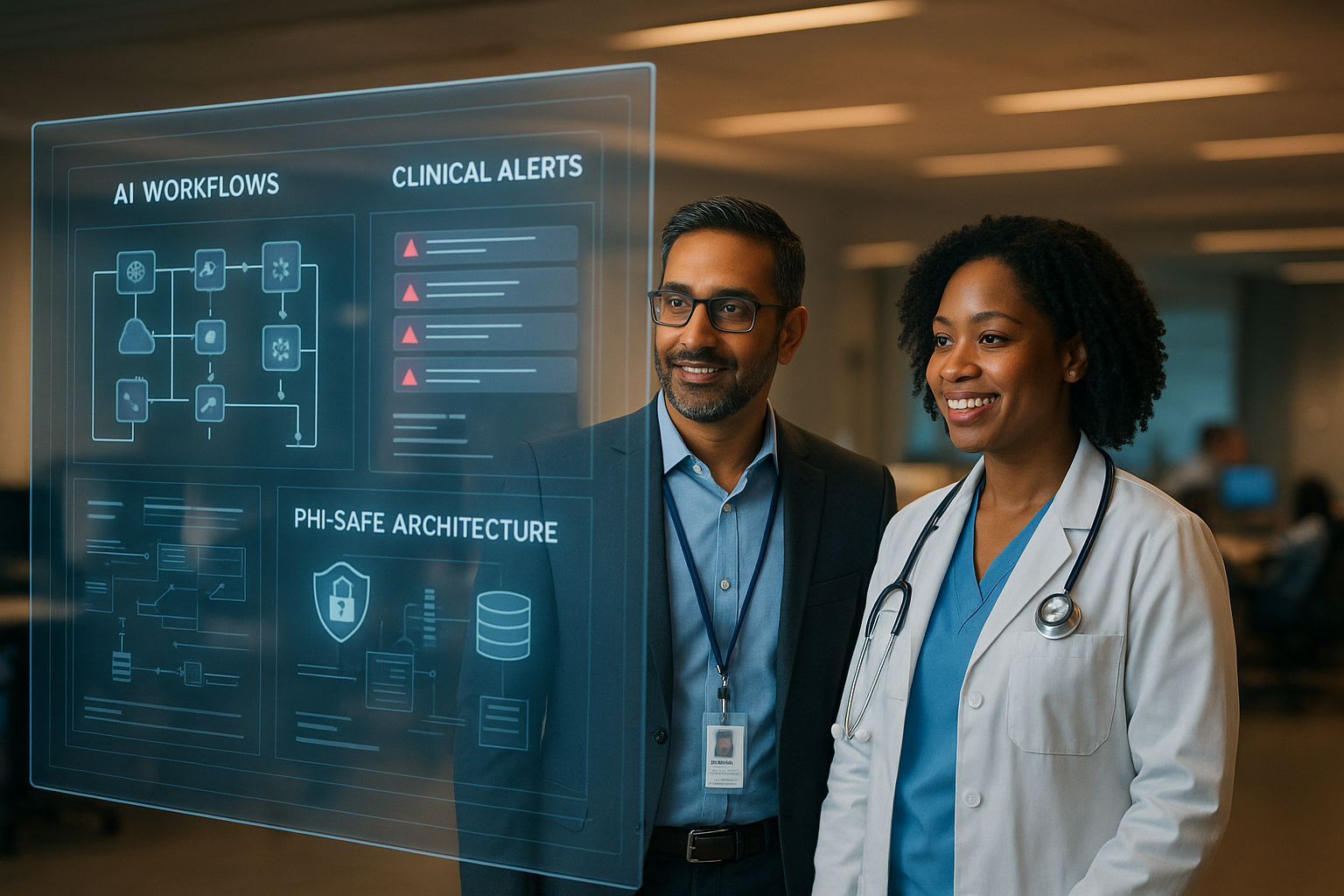

When a health system’s first generative AI pilot succeeds, the instinct is understandable: replicate it everywhere. But for CTOs and CMIOs charged with moving genAI in healthcare from a handful of department pilots into enterprise-wide clinical workflows, the real work is not the model itself. It’s the roles, processes, and architectures that make AI predictable, auditable, and safe at scale.

From pilots to platform: why roles break the bottleneck
Pilots reveal potential; platforms create reliable outcomes. In practice, what trips teams up as they scale is variation. Different specialties, EHR integrations, and clinical risk tolerances compound, creating a brittle landscape where the same model behaves differently across contexts. The missing lever is role clarity. Defining who owns clinical safety, who verifies data provenance, and who operationalizes prompts does more than redistribute workload — it reduces clinical risk and variance by setting standards for evaluation and change control. That standardization is what unlocks operational scalability across service lines.
The must-have roles to scale responsibly
At the center of a responsible scale program are roles that marry clinical judgment with engineering rigor. A Clinical AI Safety Officer anchors incident response and change control, owning the lifecycle from model updates to adverse-event investigation. The Medical Data Steward ensures terminologies are consistent, provenance is tracked, and mapping between local codes and clinical concepts is accurate—critical when LLMs consume or produce structured and unstructured data. An AI Validation Committee, multidisciplinary by design, sets thresholds for clinical utility and harm, signing off before models reach the bedside.
Operational roles are just as important. A Prompt Librarian curates and version-controls safe clinical prompts, documenting indications, contraindications, and failure modes. That role prevents impromptu prompt-tweaks that introduce risk. The LLMOps Engineer builds PHI-safe pipelines and evaluation tooling, operating private endpoints and automating test harnesses for hallucination, bias, and performance drift. Together, these roles form a governance spine that lets clinicians trust AI outputs.
Safety by design: guardrails that clinicians trust
Clinicians will adopt tools that they can explain and audit. Safety-by-design means embedding guardrails directly into workflows: model and prompt cards that list intended use, contraindications, and known failure modes; clinician-in-the-loop checkpoints for high-risk tasks such as discharge summaries or diagnostic reasoning; and immutable audit trails mapped to clinical governance structures so every AI-influenced decision is traceable. These artifacts are not bureaucratic overhead. They are the lingua franca that lets informaticists, risk officers, and frontline staff speak the same language about when to intervene.
Scaling use cases across the system
Different use cases carry different levels of clinical risk, and that dictates how roles and guardrails operate. Documentation tools like ambient scribe assistants can deliver near-term ROI in reduced charting time, but only with local PHI protections and clinician checkpoints to catch errors in medication lists or problem lists. Imaging triage can prioritize studies for radiologists, but must be governed by the AI Validation Committee and integrated with radiology workflows so prioritization rules reflect clinical urgency, not model confidence alone. Operational assistants for capacity and discharge planning can smooth throughput if they are validated for local workflows and linked to business rules that reflect staffing and resource constraints.
Data architecture for HIPAA-aligned genAI
Scaling generative models while protecting PHI requires a thoughtful architecture. Private LLM endpoints, behind the health system’s network perimeter, reduce exposure. De-identification layers and purpose-based policies limit what data reach models and how outputs are routed back into the EHR. Access controls—both role-based and attribute-based—ensure only authorized components or users can query models with PHI. Instrumentation for continuous evaluation watches for hallucination and bias, flagging performance drift before it becomes a patient safety issue. This PHI-safe AI architecture is not a single product but a set of reference patterns that combine infrastructure, identity, and monitoring.

People plan: upskill and align incentives
Even the best architecture and roles will fail without people who understand how to use AI well. Create training pathways that produce champions and super users within departments who can model safe behavior and mentor peers. Tie incentives to metrics clinicians care about, like documentation quality and time saved, rather than adoption counts. Build rapid feedback loops from frontline clinicians to product owners and the AI Validation Committee so issues discovered in practice inform prompt updates, retraining decisions, or deployment rollbacks. A human-centered implementation reduces clinician fatigue and sustains adoption.
Measuring clinical and financial ROI
To maintain executive support, define measures that bridge clinical and financial perspectives. Track charting time reduction and note quality to show immediate clinician-facing benefits. Measure coding accuracy and denial reductions as downstream revenue-cycle improvements. Importantly, monitor safety events per 1,000 AI-assisted encounters and time-to-detect for AI-related incidents—these safety metrics communicate risk in operational terms. When ROI narratives link improved clinician efficiency with measurable safety and revenue outcomes, scaling gets the cross-functional mandate it needs.
How we help health systems scale safely
We work with health system leaders to translate these principles into operational programs. That includes co-designing role frameworks and governance structures that fit existing committees, building genAI development pipelines that maintain PHI-safe AI architecture patterns, and automating processes such as prior authorization and revenue-cycle tasks where repeatable gains exist. The goal is not to replace clinicians but to enable them with tools that are predictable, explainable, and auditable.
90-day scale sprint
For teams ready to act, a focused 90-day sprint can create momentum. In the first 30 days stand up the AI Validation Committee, appoint a Clinical AI Safety Officer, and map data stewardship responsibilities. In the next 30 days deploy a PHI-safe prompt library for one or two clinical departments, instrument evaluation metrics, and pilot clinician-in-the-loop checkpoints. By day 90, formalize metrics and feedback loops, expand the LLMOps pipeline for broader deployment, and begin scheduled reviews for change control. This cadence helps convert an ad-hoc pilot mentality into a disciplined, production-oriented practice.
Scaling genAI in healthcare is not primarily an engineering challenge or a procurement exercise. It’s a people-and-process challenge that requires new roles, clear guardrails, and PHI-aware architectures that clinicians can trust. For CTOs and CMIOs, the leverage point is role design: put safety, data stewardship, and operational rigor at the center, and the rest of the platform follows.


Sign Up For Updates.