

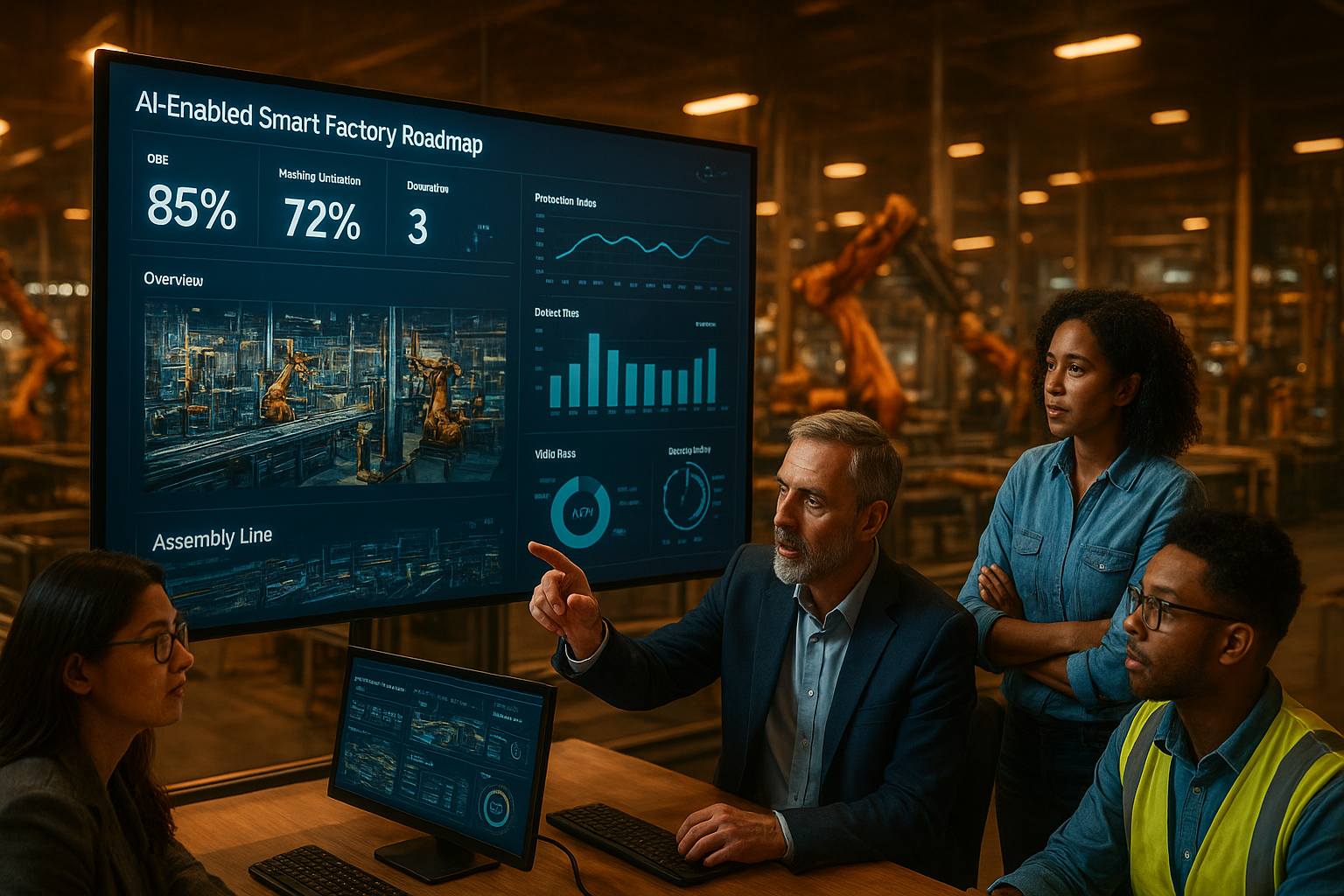

For mid-market manufacturing CTOs and COOs moving past scattershot pilots, 2025 is the year to stop experimenting in isolation and start orchestrating. The promise of manufacturing AI 2025 is not shiny proof-of-concepts; it is a pragmatic consolidation of capabilities that measurably improves OEE and working capital. This narrative lays out a smart factory roadmap that translates current pilots—vision AI, predictive maintenance, scheduling tools—into a coherent program that scales across plants.

From islands of automation to an intelligent plant network
Many manufacturers know the frustration: a promising pilot reduces scrap on one line, another team tests a predictive maintenance AI on a single asset, yet the plant-level metrics barely budge. The reason is familiar and solvable. Historically, pilots lived on islands because sensors were expensive, connectivity was unreliable, and model lifecycle management was immature. In 2025, edge AI and cheaper sensors broaden coverage, while improved model lifecycle tooling makes reliability achievable. More important is the emergence of unified data layers—time-series stores, image repositories, and metadata catalogs—that let you correlate a vision-detected defect with line throughput, maintenance signals, and supplier batch attributes. When pilots speak a common data language, their impact compounds rather than plateaus.
2025 manufacturing AI trends that pay off
Not every AI trend merits equal investment. The right bets are those tied directly to throughput, scrap, downtime, and inventory—the levers that move OEE improvement with AI and reduce working capital. First, computer vision quality control is no longer just edge proof-of-concept theater; matured models deliver traceability and automated defect classification that feed corrective actions into MES systems. Second, predictive maintenance AI now ingests multimodal signals—vibration, thermal imaging, PLC telemetry—to predict failures earlier and with fewer false positives.

Third, AI-assisted scheduling and inventory optimization begin to bend performance metrics by aligning production with real constraints—machine health, material availability, and labor. Lastly, safety analytics and ergonomic risk detection protect people and reduce unplanned downtime, a crucial but often undercounted component of OEE. Prioritize these trends where they map to the largest dollar impacts and repeatable use cases across plants.
Architecture to scale across plants
Scaling requires an architecture that balances real-time inference at the line with centralized model training and oversight. Edge inference at the line keeps latency low and protects IP-rich image data; the cloud handles heavy model training, versioning, and aggregated analytics. The data backbone should combine a robust time-series store for sensor telemetry, an image store for visual records, and a metadata catalog to relate parts, batches, and shift context.

Manufacturing MLOps is the glue: model versioning, automated A/B testing, drift detection, and rollback mechanisms. Without these controls, models degrade and teams lose trust. Design the stack so that operators see concise, explainable suggestions on the line and engineers can trace predictions back to training batches and feature distributions. This traceability is essential for regulatory audits and for building frontline confidence in automated recommendations.
Operational change: Marrying lean with AI
Technology alone does not transform output. To convert models into sustained gains, AI must be embedded into continuous improvement routines. Imagine AI suggestions feeding Kaizen boards: visual defect clusters recommend a tooling change, but human verification refines the root cause and updates standard work. That human-in-the-loop pattern keeps operators accountable while letting the algorithm surface opportunities.
Practical steps include codifying AI-driven adjustments into standard work documents, training operators to interpret confidence scores and alerts, and establishing short feedback loops so model outputs improve from frontline corrections. Transparent metrics—showing how AI recommendations affect availability, performance, and quality—are the currency for frontline buy-in. Explainability tools that relate a defect classification to concrete image features or sensor thresholds help supervisors make fast, trusted decisions.
ROI model executives trust
Senior leaders fund projects that clearly tie to OEE improvement with AI and working capital reduction. Frame ROI in familiar terms: availability (downtime avoided), performance (cycle times improved), and quality (scrap and rework reduced). For predictive maintenance AI, quantify mean time between failures improvements and converted hours of unplanned downtime. For computer vision quality control, estimate defect escape rate reductions and the downstream cost of rework or warranty exposure avoided.
Working capital benefits show up as better forecasting, lower safety stock, and faster turn on constrained sku lines. Present scenarios with conservative and aggressive adoption curves and connect them to cash flow timing—executives need to see how reduced scrap and improved throughput shorten lead times and free up capital for other investments.
Scale plan: 3 horizons over 12 months
A pragmatic 12-month sequence lets momentum build and benefits compound. In Horizon 1 (months 1–4), deploy one line per plant for computer vision quality control and a predictive maintenance AI on the most critical asset. These are high-impact, repeatable wins that validate data pipelines and MLOps practices. In Horizon 2 (months 5–8), expand to the top 20% of lines by volume and deploy the scheduling optimizer where machine health data and inventory signals matter most. In Horizon 3 (months 9–12), coordinate multi-plant workflows and introduce supplier quality analytics to reduce incoming defects.
Each horizon should include checkpoints for MLOps maturity—model drift monitoring, retraining cadence, and operator feedback incorporation—so gains in early horizons are preserved and amplified.
Build vs. buy: When to customize
Decisions on building versus buying hinge on repeatability and differentiation. Commodity elements—cameras, edge appliances, and pre-trained computer vision backbones—are typically bought. Customization is justified when defects are unique to your product geometry or when a proprietary sensor fusion approach differentiates quality outcomes. Adopt open data formats and standard APIs to avoid vendor lock-in and require SLAs that guarantee uptime and line-level support. That combination lets you accelerate deployment while retaining the ability to innovate where it matters most.
How we help manufacturers scale confidently
Scaling to an intelligent plant network requires both technology and change leadership. We design factory data backbones and edge-to-cloud patterns that respect plant constraints, build and validate computer vision and predictive maintenance models tailored to your equipment, and operationalize them with manufacturing MLOps practices that keep models reliable. Equally important, we run operator-centric training and change management so that AI outputs are integrated into standard work and continuous improvement cycles.
Manufacturing AI 2025 is less about flashy demos and more about disciplined consolidation: choose the right bets, build a stack that scales, and couple it with operational rigor. For mid-market manufacturing CTO strategy, the outcome is clear—integrated AI that measurably improves OEE, reduces working capital, and turns pilots into predictable production advantage.
If you’d like to discuss a roadmap tailored to your plants, contact us.


Sign Up For Updates.