


Trustworthy Personalization: Ethical AI Marketing for Retail CMOs and CIOs That Respects Privacy and Grows CLV
Retail leaders are waking up to a paradox: personalization has never mattered more to customer lifetime value (CLV), yet trust and privacy concerns make it riskier than ever to scale. For CMOs and CIOs formalizing AI governance, the challenge is not whether to personalize, but how to do so in a way that is ethical, privacy-preserving, and measurably better for the business. Ethical AI marketing retail practices—centered on privacy-first personalization—can reduce acquisition costs, lift conversion, and extend CLV while protecting the brand and remaining compliant.
Privacy-first personalization is a competitive advantage
Customers increasingly expect control over their data; consent is becoming a brand asset. When shoppers feel respected, they share higher-quality signals—relevant preferences, verified emails, and repeat behaviors—that power better models and stronger recommendations. In a cookieless future, first-party data strategy is not optional. Retailers that invest in transparent consent flows and clear value exchange will have richer, more reliable data to feed responsible recommendation engines, which in turn improves media efficiency and reduces customer acquisition cost.
Think about it this way: a higher opt-in rate directly improves match quality for personalization. That means lower CAC for the same conversion, higher average order value (AOV), and longer CLV. Conversely, fishing for signals through opaque tracking can produce noisy data, regulatory risk, and higher churn. Privacy-first personalization aligns marketing return with long-term trust.
Data minimization, clean rooms, and safe collaboration
Designing data flows that respect purpose limitation starts with data minimization. Collect only what you need to deliver a clear customer promise, then isolate that data for modeling and measurement. Clean rooms and retail media network patterns let retailers collaborate with partners—advertisers, platforms, or marketplace sellers—without exporting raw identifiers. Instead, aggregated or privacy-preserving joins enable attribution and audience activation while avoiding identity sprawl.

For CMOs and CIOs, the governance questions are practical: which fields are essential for personalization, which can be hashed or tokenized, and where do we enforce retention windows? Responsible architectures bake those answers into pipelines so that downstream teams never accidentally use disallowed attributes in training. That type of engineering discipline pays off in lower compliance cost and more trustworthy insights.
Fairness and bias in targeting and recommendations
Recommendation engines power merchandising, email, and onsite experiences, but they can also reinforce unfair outcomes or echo chambers. Shopper data often contains proxies for protected classes—postal codes, purchase patterns, or lookalike features—that can produce discriminatory targeting if left unchecked. Ethical AI marketing retail programs require bias testing, diverse training data, and explicit mitigation tactics to avoid excluding groups or amplifying negative stereotypes.
Explainability is critical for merchandising decisions. Merchants and category managers need to understand why an item was surfaced to certain segments and how that choice aligns with commercial goals. When explainability is built into the model lifecycle, teams can detect harmful patterns early and tune recommenders to balance relevance, fairness, and inventory objectives.
Experimentation governance for GenAI content and offers
GenAI is changing how retailers create copy, images, and personalized offers, but it also raises new governance challenges. Guardrails for AI-generated content must protect brand voice, legal exposure, and intellectual property. Experimentation systems should include holdouts and uplift measurement so you know whether the genAI variant truly improves outcomes without eroding trust.
Operationally, that means implementing kill-switches for variants that perform poorly or generate risky outputs, and routing high-visibility campaigns through human review before launch. GenAI governance marketing practices are most effective when they combine automated safety checks with clear human accountability for final decisions.
Transparency and preference management
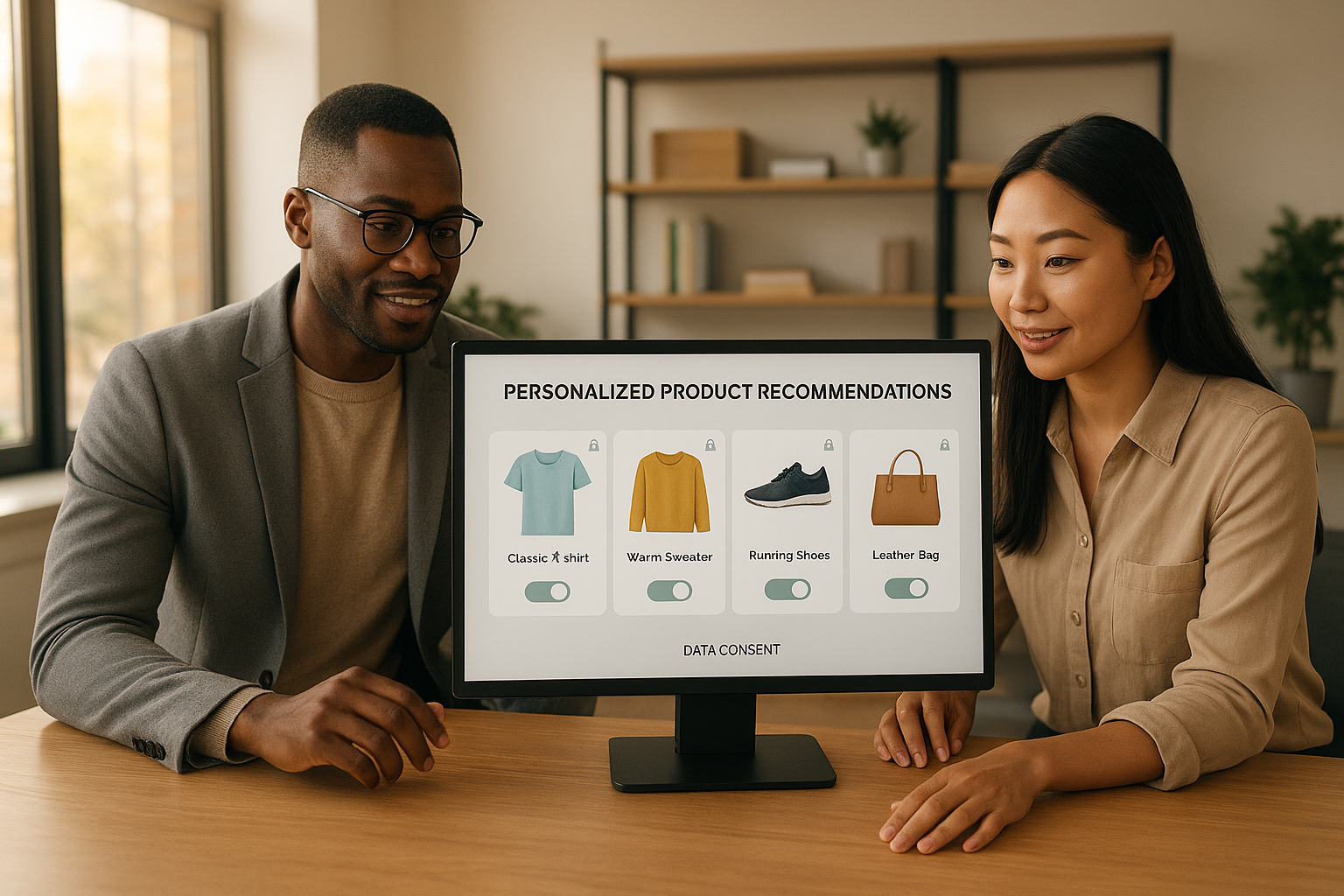
Customers who understand what they’re sharing are more likely to participate. Clear notices, granular consent, and easy opt-out options are not just legal hygiene; they are features that increase loyalty. A robust preference center is a live interface between the customer and your model decisioning layer: when preferences are updated, the change should feed real-time personalization signals so shoppers immediately see the impact of their choices.

Feedback loops are equally important. When a model misfires—showing irrelevant items or repeating the same suggestions—customers should be able to correct or rate the recommendation. Those corrections become supervised signals for retraining and reduce repeat errors, improving both experience and metrics like complaint rates and suppression list accuracy.
KPIs and value realization
To secure buy-in, responsible AI initiatives must link privacy and governance to concrete KPIs. Track opt-in rates, complaint rates, and the accuracy of suppression lists alongside commercial metrics: conversion rate, average order value, CLV, and media efficiency. Responsible recommendation engines often show improved AOV and CLV due to better match quality and fewer irrelevant impressions.
Don’t forget cost avoidance: fewer regulatory fines, lower legal spend, and reduced brand risk are real financial benefits. Over time, these savings compound into a competitive moat for retailers who make ethical AI marketing retail a core competency rather than an afterthought.
60-day starter plan
For teams ready to act, a compressed timeline helps demonstrate value quickly while embedding governance from day one. Weeks 1–2 begin with a focused data audit and consent baseline: map data sources, identify sensitive attributes, and measure current opt-in rates. Weeks 3–6 run a governed recommendation pilot on a lower-risk category—use clean room joins if partners are involved, instrument bias tests, and include holdouts for uplift measurement. Weeks 7–8 expand to priority segments with dashboards that surface opt-in trends, model fairness metrics, and commercial outcomes like conversion and CLV uplift. Throughout, maintain human review checkpoints for campaign approvals.
How we help retailers scale trustworthy AI
We work with mid-market retailers to translate these principles into operational systems. Our services include AI strategy and privacy-by-design architecture, where we help define what data to collect and how to isolate it for safe modeling. We develop recommenders and genAI content pipelines with built-in guardrails—bias testing, explainability layers, and kill-switch integration—so marketing teams can iterate fast without risking reputation.
We also automate consent, preference, and governance workflows so real-time decisioning respects customer choices. That automation ties directly to KPIs: higher opt-ins, fewer complaints, and measurable lifts in AOV and CLV. For CMOs and CIOs, that combination of technical discipline and ethical practice makes personalization sustainable and profitable.
If your team is formalizing AI governance, privacy-first personalization is an opportunity to differentiate. Responsible recommendation engines and clear genAI governance marketing will not only reduce risk—they will create a stronger, more loyal customer base that drives lifetime value.


Sign Up For Updates.