

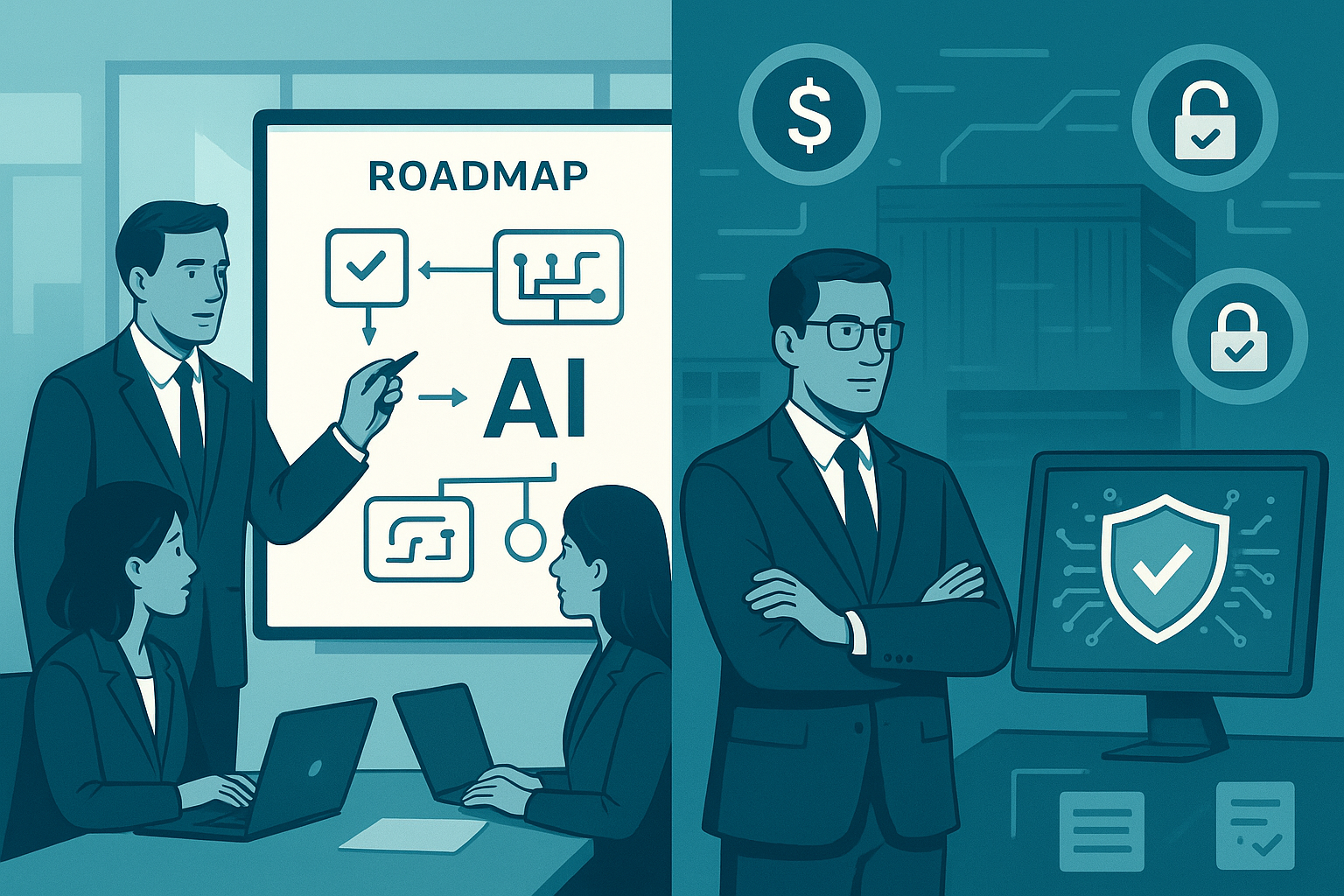

Part A — Your First AI Maturity Baseline: A CEO’s Guide for Professional Services
For many professional services firms, the first disciplined step toward AI begins with a simple but powerful question: where are we now, and which early wins will prove the value of an AI roadmap to clients and partners? A practical AI maturity assessment gives founders and CEOs a grounded answer. This assessment is not a theoretical exercise; it is a prioritization engine that converts the hype around generative models into tangible client value through targeted process automation use cases like research automation, proposal generation, and knowledge retrieval.
Start by applying a five-dimension maturity model that captures the essentials of readiness: strategy, data, tech, people, and governance. Under strategy, you want clarity on how AI aligns with your service lines and pricing models. For data, evaluate the hygiene of your knowledge repositories and whether retrieval-augmented generation (RAG) can be implemented with existing content. Technology covers tooling and integration readiness: do you have secure APIs and a place to host prototypes? People means both the skills on your team and the advisory capacity required to translate model outputs into client recommendations. Governance is the set of rules that ensures client confidentiality, accuracy, and billable impact.

Conduct a short diagnostic that blends a peer benchmark survey with a fast artifact review. Rather than long questionnaires, gather three things: a list of priority client problems, a representative sample of internal knowledge assets, and an org chart showing who owns client delivery. That lightweight audit surfaces where you’re ahead of peers and where you are lagging, and it provides the inputs to triage use cases by revenue impact, delivery efficiency, client experience, and technical feasibility.
When choosing initial use cases, favor those that change the economics of client engagement quickly. Research automation and proposal generation often produce measurable billable-efficiency improvements that can be tracked as AI ROI measurement. Knowledge retrieval projects powered by RAG tend to deliver immediate advisor productivity gains and better client conversations. Frame these as experiments with specific success criteria: percent reduction in time-to-proposal, lift in win rates, or hours reclaimed per advisor per month.
Deciding whether to build, buy, or partner is another practical step in the roadmap. For many professional services firms, partnering with niche AI development services accelerates time-to-value: you avoid a long internal build cycle and get a productized integration that respects your client data. Where you do build, focus on modular components that can be reused across engagements rather than bespoke models per client. Pair this with a 30/60/90-day plan that delivers quick proof points and a 12-month vision for broader transformation so leadership can see both early wins and the path to scaled impact.
Change management matters as much as technology. Incentives should recognize that AI can be billable if it increases the average revenue per advisor or shortens delivery cycles while preserving client outcomes. Engage partners and staff early, provide role-based training, and measure adoption with both quantitative metrics and qualitative feedback from client teams. This approach keeps momentum and helps the CEO translate a maturity assessment into a living AI roadmap for professional services that maps directly to client value.
Part B — From Good to Great: Financial Services CIOs Advancing AI Maturity with Controls and Scale
Scaling AI in regulated finance demands a different posture: speed balanced with controls. Financial services CIOs moving from pockets of excellence to enterprise-grade AI need frameworks that prioritize AI platform standardization, rigorous model risk management AI practices, and the ability to quantify AI ROI measurement across fraud, AML, underwriting, and personalization use cases. The goal is to turn scattered pilots into an accountable, auditable program that reduces loss, improves revenue, and strengthens compliance.
Begin with a concise enterprise AI reference architecture that spans lines of business. This architecture should define shared services—secure data lakes, model registries, monitoring layers, and deployment pipelines—so that teams can move quickly without reinventing core controls. Standardization reduces duplication, eases onboarding of third-party models, and creates a single source of truth for governance decisions.

Model risk management is the backbone of trustworthy AI in finance. Validation, ongoing monitoring, clear documentation, and auditability are non-negotiable. Make validation a lifecycle activity rather than a one-off checkpoint: build automated tests, performance baselines, drift detection, and explainability reports into your MLOps workflow. These artifacts will be critical when internal or external auditors review model behavior, and they make it possible to scale while maintaining confidence in outcomes.
Data controls intersect with both risk and innovation. Deploy techniques that protect sensitive information—PII tagging, synthetic data generation for development, differential privacy where appropriate, and zero-trust APIs for production access. These safeguards allow teams to experiment with sophisticated models while ensuring that data handling meets regulatory requirements and internal policies.
Platform strategy must reconcile performance needs with cost discipline. Standard tooling for orchestration, GPU scheduling, and observability simplifies operations and enables FinOps practices that allocate costs to lines of business. When MLOps and FinOps are integrated, CIOs can predict run costs, identify runaway experiments, and make informed decisions about decommissioning low-ROI models. Treat the use case portfolio like any investment portfolio: map value versus risk, prioritize those that deliver measurable reduction in false positives for fraud or lift in underwriting accuracy, and sunset models that no longer justify their operational footprint.
Executive reporting should translate technical metrics into business language. Tie monitoring outputs to reduced losses, revenue lift from personalization, fewer false alarms in AML workflows, or fewer manual reviews in underwriting. These translations make it easier for boards and regulators to see the ROI of AI investments and understand the risk controls in place. The combination of robust model risk management AI processes, AI platform standardization, and disciplined cost governance converts experimental wins into sustainable, enterprise-grade capability.
Both parts of this maturity journey—building a first AI roadmap for professional services and scaling AI responsibly in financial services—share a common truth: maturity is not a binary state but a sequence of decisions. A focused assessment sets priorities; a pragmatic roadmap ties experiments to ROI; and standardized platforms with strong governance turn pockets of excellence into durable advantage. Use these frameworks to benchmark your progress, measure outcomes, and steer investments where they create the most client and enterprise value.


Sign Up For Updates.