

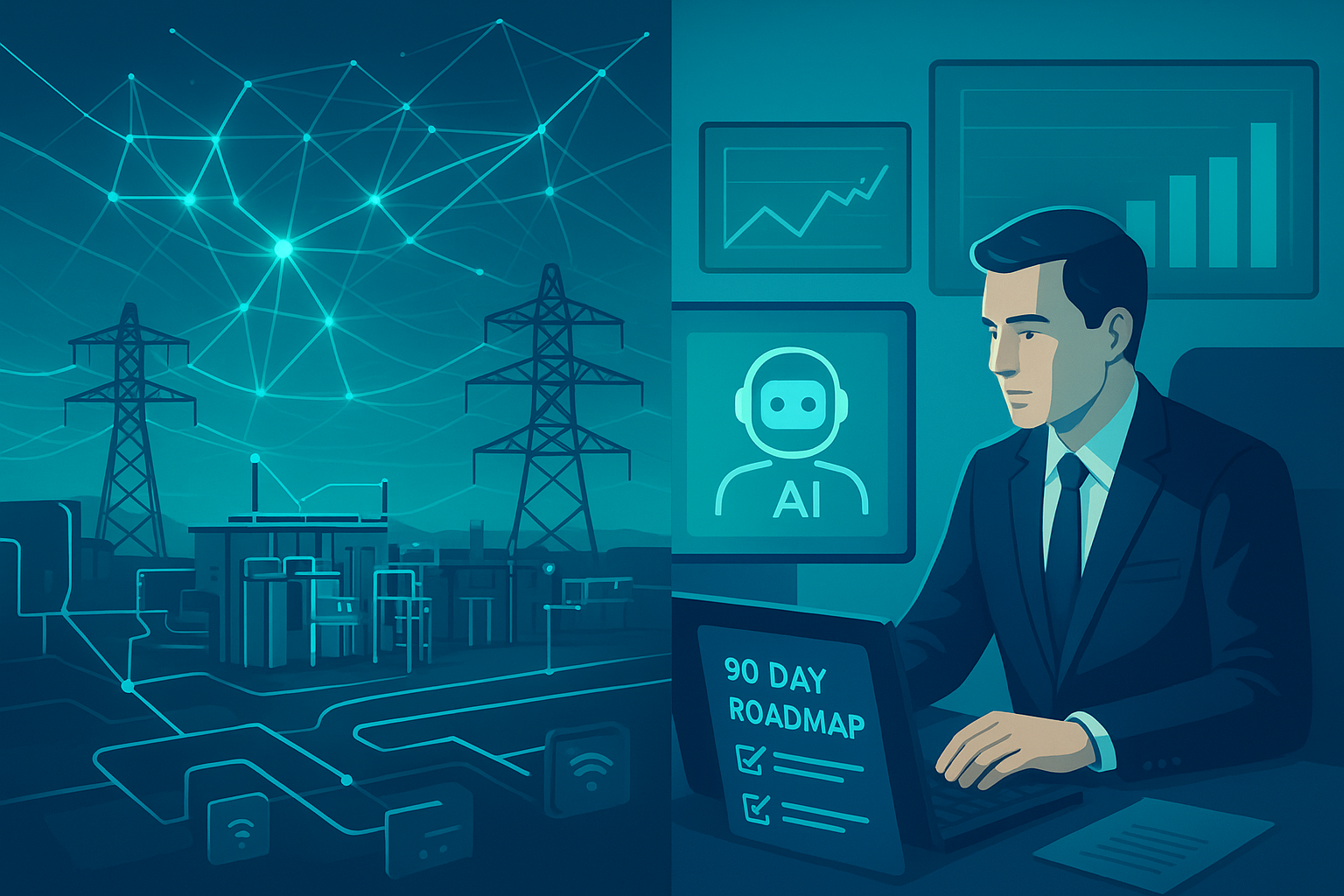

Part One: 2026 AI in Energy & Utilities — Edge Intelligence for a Smarter, More Resilient Grid
CTOs entering 2026 are no longer asking whether edge AI belongs in utilities; the question is how to make it reliable, auditable, and scalable across substations and distributed energy resources (DERs). Edge AI utilities initiatives are shifting from pilots to operational programs, with an emphasis on inference efficiency, federated learning, and the emergence of energy digital twin concepts that map the physical grid to continuous virtual models. The narrative for the year ahead is about practical scaling: fewer experimental proofs, more hardened architectures that deliver measurable reliability and cost outcomes.

Real-time use cases are now the main currency of value. Load forecasting at the distribution edge enables more granular demand response and reduces peak risks. Camera-based vegetation management systems using computer vision catch encroachment earlier, lowering the frequency of outages and the expense of emergency patrols. Asset health models run inference on site to flag impending transformer issues, reducing unnecessary truck rolls and shortening time-to-repair. The combination of grid optimization AI and edge intelligence produces measurable improvements in SAIDI and SAIFI, but more importantly it helps utilities predict and prevent outages with better outage prediction accuracy and fewer manual interventions.
OT/IT convergence is no longer a buzz phrase; it’s a necessary program. Secure data pipelines from SCADA and data historians into AI inference layers require careful design: role-based access, air-gapped validation for model updates, and compliance with NERC/CIP frameworks. Federated learning presents a compelling middle ground where local models learn from distributed patterns without moving sensitive telemetry off-site. This reduces attack surface while enabling shared improvements across service territories.
Cyber-resilience must be baked into model lifecycles. Hardening endpoints, signing model artifacts, and instituting anomaly detection for model drift will be table stakes in 2026. For utilities, the intersection of model security and regulatory obligations changes procurement and operational plans. Reference architectures matter: clear patterns for secure model deployment, telemetry ingestion, and rollback routines speed time-to-value and make build-versus-partner decisions more data-driven.
Funding models are evolving alongside technology patterns. Regulators are testing shared-savings contracts that let vendors earn a portion of operational savings, while grants and targeted regulatory treatment make long horizon investments in edge AI utilities more palatable. For CTOs, a hybrid approach—combining in-house platform work with accelerators from specialized partners—often offers the fastest path to demonstrable impact without losing control over critical OT integration.
Part Two: The 2026 Mid-Market CEO Agenda — Practical AI Bets That Pay Off in 90–180 Days
For mid-market CEOs, 2026 is the year to choose pragmatism over platform shopping. A concise mid-market AI strategy 2026 centers on three early bets that de-risk investment while producing measurable ROI: document automation to cut processing time, sales and customer-success copilots to accelerate pipeline velocity and improve CSAT, and analytics acceleration to make better decisions faster. These bets create compounding value because each reduces cycle time, cost-to-serve, or both.
Start with data readiness lite. Instead of building a monolithic data lake, companies can adopt a retrieval-augmented generation (RAG) approach over existing content, applying metadata hygiene and simple access controls to make knowledge useful. RAG enables copilots to answer questions from contracts, product docs, and support tickets without upfront reengineering. Metadata hygiene—consistent tagging of documents and records—turns messy repositories into searchable, trustworthy inputs for AI copilots for SMBs.
The platform choice should favor low-code, API-first tools that let teams iterate quickly and avoid vendor lock-in. Deploying an AI automation 90-day plan focused on a single workflow—such as invoice processing or lead qualification—creates an early performance baseline. Within 30 days you can validate data accessibility and model outputs; by 60 days you can integrate with core systems and demonstrate cycle-time reductions; by 90 days you should have measurable cost savings and a repeatable playbook to scale to adjacent workflows.
Change management is lightweight but deliberate. Enablement sprints that coach teams on new copilot behaviors, combined with governance that defines acceptable use and escalation paths, will reduce resistance. Create short playbooks showing how a salesperson or customer-success manager uses a copilot in a typical interaction; those playbooks are the operational glue that turns capability into adoption. KPIs should be business-centered: reduction in cycle time, improved pipeline velocity, cost-to-serve improvements, and CSAT gains measured against pre-deployment baselines.

When to engage a partner is a strategic choice. Early on, strategy sprints with a focused partner can align leadership and produce a prioritized backlog. For scale, an automation factory model or managed MLOps service can run the pipeline of small projects while keeping costs predictable. AI development accelerators—prebuilt templates, connectors, and governance molds—shorten delivery cycles and lower risk, enabling mid-market firms to punch above their size when executing an AI roadmap.
Practical timelines matter because executives need early wins to sustain investment. The 30/60/90-day proof points are not a silver bullet but a disciplined staging mechanism: verify data and user needs in 30 days, build and integrate in 60 days, and demonstrate operational ROI by day 90. After the first cohort of wins, a phased scale plan across functions—finance, sales, operations, and support—creates an ecosystem where AI process automation services compound benefits and create defensible efficiency advantages.
Both parts of this look-ahead emphasize an ROI-first mindset. Whether the focus is grid optimization AI at the edge or pragmatic copilots for SMB teams, the mechanics are similar: choose high-value use cases, build secure and auditable data pipelines, and iterate quickly with partner accelerators where it de-risks delivery. The difference is cadence and scale. Utilities must prioritize reliability and compliance while weaving AI into long-lived OT environments. Mid-market leaders must prioritize speed, measurable cost reductions, and user adoption so AI becomes a business capability rather than an experiment.
As 2026 approaches, the leaders who win will be those who balance ambition with rigor—deploying edge intelligence that measurably improves grid resilience and standing up mid-market AI strategies that deliver tangible business outcomes in 90–180 days. The emerging toolkit—energy digital twin models, federated learning patterns, RAG for knowledge systems, and AI development accelerators—makes those outcomes feasible. The remaining challenge is organizational: commit to pragmatic pilots that scale, safeguard the operational surface area, and treat AI as a continuous improvement engine rather than a one-off project.


Sign Up For Updates.