Computer Vision and Digital Twins for Port & Yard Orchestration: A COO’s Guide

Throughput, Safety, and Visibility: The Modern Ops Trilemma

As a COO responsible for maritime terminals, inland yards, or airport ramps, you live with a constant tension: throughput targets push operations to move more containers, pallets, and aircraft faster, while safety and regulatory requirements insist on slower, more controlled behavior—and visibility across partners is often fragmented. Dwell penalties and congestion costs appear on monthly P&Ls, yet a single safety incident can trigger regulatory reviews and reputation damage that far outweigh incremental efficiency gains. Bringing computer vision and digital twin technologies together creates a path to resolve that trilemma: improving throughput, bolstering safety, and delivering consistent visibility for stakeholders.

A digital twin dashboard on a large monitor showing simulated crane movements, queue lengths, and KPIs in a control room, modern UI
Digital twin dashboard used to simulate queueing, crane movement, and KPIs for operational planning.

Computer Vision at the Edge: What It Can See Reliably

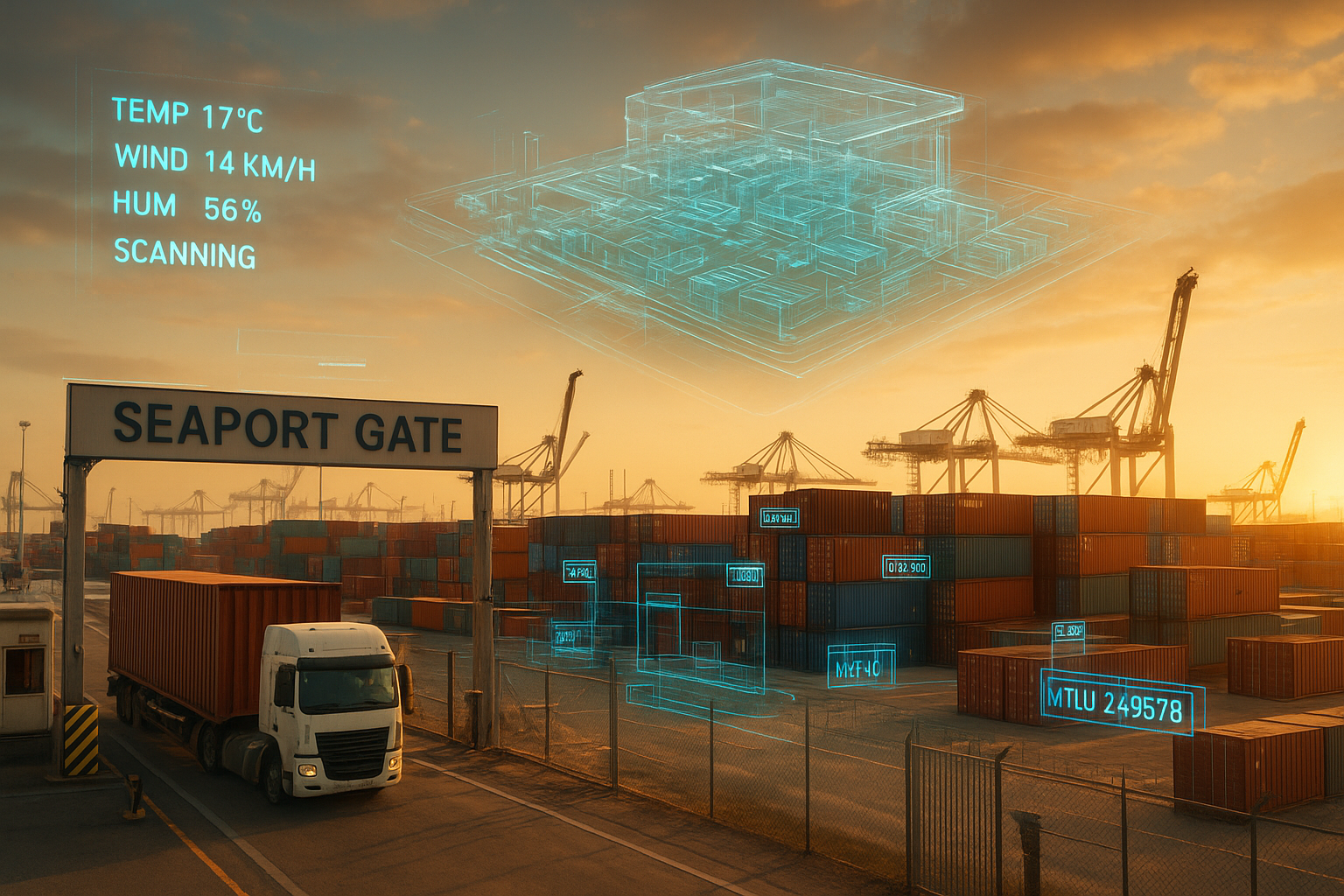
In outdoor, harsh environments the right combination of rugged cameras, edge compute, and models trained for variability delivers dependable results. Common, high-value use cases include gate OCR for container and ULD IDs, license plates, and trailer markings—what many teams refer to as container OCR AI. Reliable optical recognition at gates eliminates manual tag-in delays and reduces reconciliation errors that drive dwell time. Beyond text recognition, yard management computer vision can assess dock and ramp occupancy, estimate queue length, and detect PPE compliance or hazardous behaviour among personnel.

Close-up of container code being captured by a camera with OCR bounding boxes and confidence scores, outdoor, weatherproof camera
OCR capture showing bounding boxes and confidence scores for container codes at a gate.

Computer vision models also excel at condition assessment: detecting trailer or container damage, punctures, or misplaced cargo that would otherwise be discovered only after costly delays. Because many of these detections must operate even with limited connectivity, edge AI in transportation—deploying inference at local gateways with GPU or TPU acceleration—becomes essential. Edge inference lowers latency for time-sensitive alerts while buffering streams for central analysis, making vision-based safety and throughput features practical at scale.

Edge compute box mounted on an industrial pole near a container gate with status LEDs and cables, photorealistic
Rugged edge compute gateway installed near a gate to perform low-latency inference and local buffering.

Digital Twins for Planning and ‘What‑If’

Once you have reliable telemetry from computer vision, the next step is to project outcomes. Digital twin logistics brings a real-time mirror of gates, lanes, cranes, and vehicles into a simulation environment where policies can be stress-tested without touching live operations. Discrete-event simulation reproduces queuing at gates, lane conflicts, and crane interactions, allowing planners to run policy experiments: tighter appointment windows, priority lanes for high-value customers, or different sequencing rules for truck arrivals.

These controlled experiments let teams quantify trade-offs before implementation. More advanced programs incorporate reinforcement learning agents to recommend dynamic slotting policies, though many organizations find immediate value in scenario-based simulations that tune appointment rules and staffing levels. Using operations simulation logistics to iterate on policies reduces the risk of negative operational impacts while providing defensible, data-backed decisions for boardrooms and regulator conversations.

Closed-Loop Orchestration and Automation

Vision and simulation generate insights, but real impact comes from closing the loop: translating those insights into automated orchestration and human-guided execution. Integration into YMS, TOS, or GH systems is the practical glue—pushing automatic lane reassignments, dispatch instructions, and updated appointment slots back into operational workflows. Real-time location systems (RTLS) and dispatch logic can use vision-derived occupancy and queue metrics to re-route incoming trucks or reprioritize cranes, reducing idle time and smoothing throughput peaks.

Automation also supports human-in-the-loop controls. When the system recommends a lane change or an exception, operators receive an alert with an SOP playbook and the key data behind the recommendation: camera snapshots, queue projections, and runway/ramp constraints. This keeps the operator in control while enabling faster, more consistent decisions across shifts and sites.

Architecture & MLOps for CV + Simulation

Deploying these capabilities at industrial scale requires an architecture that supports both robustness and maintainability. Edge gateways should incorporate GPU acceleration and local buffering to handle intermittent connectivity; they must also support secure model deployment and rollback. A disciplined MLOps pipeline tracks model performance in production, flags drift when environmental conditions change, and automates safe rollbacks to earlier model versions when confidence drops.

Data governance is equally important. Define privacy zones (virtual areas in camera views where no recording or PII extraction occurs), retention policies, and secure transfer channels for recorded events used in incident forensics. For rare event detection—such as a dangerous vehicle maneuver or catastrophic container failure—synthetic data augmentation helps close gaps in training data without exposing employees to risk during labeling, improving model recall for low-frequency but high-impact events.

Safety, Compliance, and Stakeholder Trust

Designing for safety and compliance from day one builds trust with regulators, labor partners, and customers. Visible signage, clear policies about recording and data use, and privacy zones are not optional niceties but operational necessities. Computer vision systems should generate auditable trails: time-stamped evidence for incident investigation, model confidence scores for any automated action, and immutable logs showing what data was shared externally under cross-tenant agreements.

Transparency matters: when terminals share data with carriers, third-party logistics providers, or airport authorities, contractual agreements should define the scope of sharing, retention windows, and anonymization requirements. A robust approach protects sensitive information while enabling the collaboration necessary to reduce systemic congestion across the supply chain.

Business Case and Phased Rollout

For COOs, the technology conversation always narrows to KPIs. Measure success using dwell time, turn time, asset utilization, and incident rates, and prioritize zones with high variance in those metrics—typically gates and ramps with unpredictable peaks. Start with a focused pilot on a handful of gates or a single ramp, instrumenting them with container OCR AI and occupancy vision, and use digital twin experiments to identify the highest-leverage policy changes. From there, scale in waves tied to capital projects and staffing cycles, aiming for a 12–18 month roadmap aligned with procurement and infrastructure upgrades.

This phased approach reduces risk, produces early ROI that can fund subsequent phases, and creates repeatable playbooks for expanding yard management computer vision across terminals and airports. When done correctly, the combined stack—edge AI in transportation, robust MLOps, and digital twin logistics—delivers measurable throughput optimization AI outcomes while strengthening safety and stakeholder confidence in operations.

Adopting computer vision and digital twins is not a single technology purchase; it is an operations play that requires cross-functional commitment. For leaders ready to scale, the promise is clear: faster turns, fewer incidents, and a living model of your operations that helps you make better choices every day.
From Paperwork to Predictive: A No‑Regrets AI Roadmap for 3PL CIOs

For many mid-market 3PLs the shift from manual paperwork to machine-assisted operations feels inevitable but risky. CIOs tasked with delivering efficiency and reliability are caught between margin pressure, rising customer expectations, and the need to protect data. The pragmatic path forward is not a big-bang AI experiment; it’s a staged program that automates document-heavy workflows now and builds the foundation for predictive, autonomous operations later. This roadmap explains how to get measurable logistics ROI automation quickly while preserving optionality for more advanced ETA prediction AI, TMS integrations, and LLM customer service logistics.

Why 2026 Is the Year to Start: Cost, Service, and Compliance Pressures

Market forces are converging to make AI in logistics not a luxury but a necessity. On-time performance SLAs are tighter, and penalties for missed windows are increasing; customers demand near-real-time visibility into shipments and expect carriers and 3PLs to proactively explain exceptions. Meanwhile, labor and fuel costs remain volatile, compressing margins and making process efficiency a competitive differentiator. Add rising regulatory and data security demands—SOC 2 and ISO 27001 audits, contractual privacy obligations—and you have a powerful incentive to automate predictable tasks and reduce human exposure to sensitive data.

Identify High-ROI Starter Use Cases in Weeks, Not Months

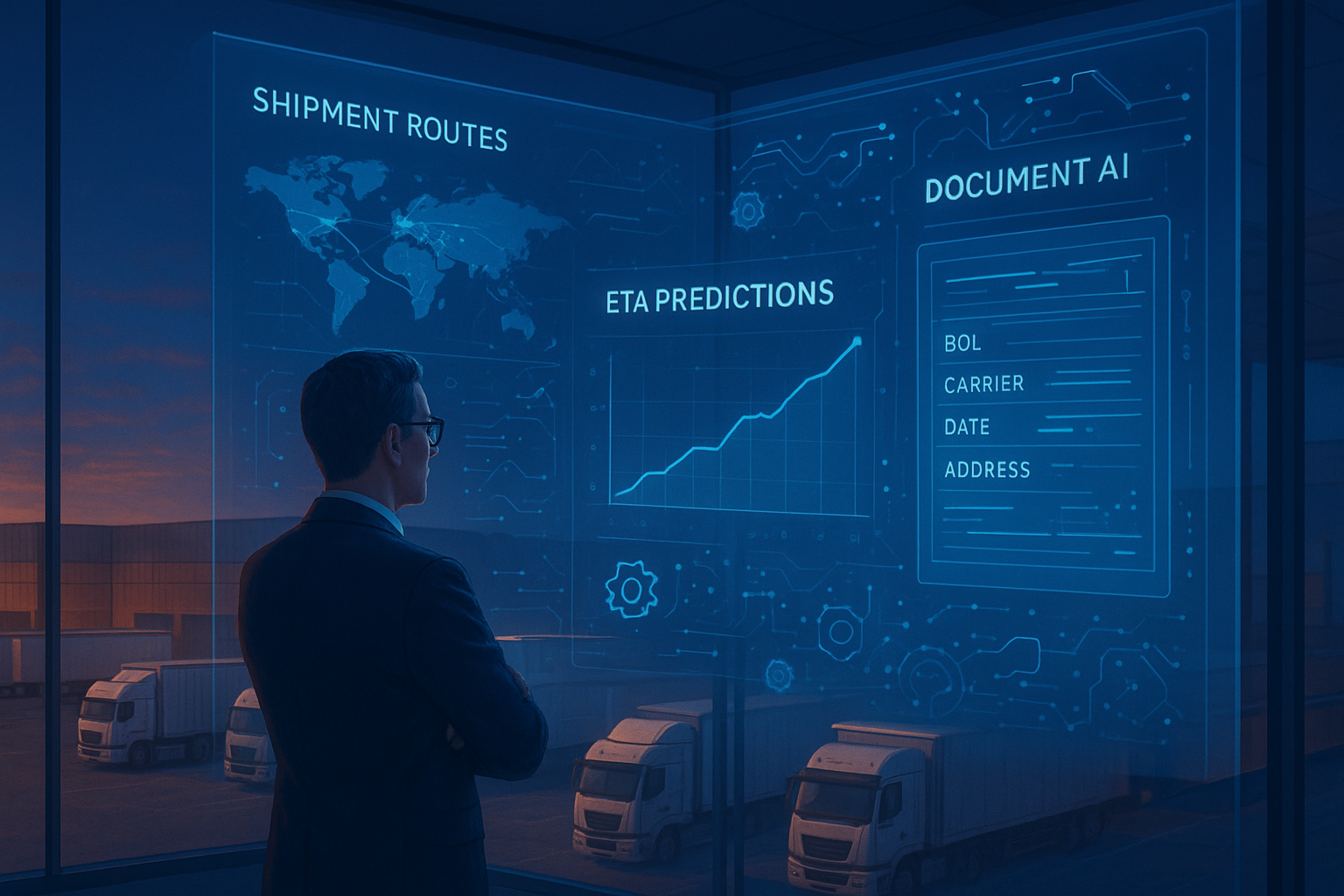
The fastest wins come from replacing manual, repetitive work with reliable automations that also produce reusable artifacts for later AI capabilities. Start with document intelligence: document AI logistics solutions that extract structured data from BOLs, PODs, carrier invoices, and customs forms will eliminate keyboarding, speed validation, and support faster invoicing. Pair OCR with validation rules and business logic so extracted values are cross-checked against TMS events and shipment manifests.

Close-up of document AI extracting data from a Bill of Lading and invoice, with highlighted fields and confidence scores, on a laptop screen in a warehouse office.

Exception management is another prime starter use case. Use NLP to triage exception text, flag high-risk items, and route issues to the correct queue with suggested resolution steps. Virtual agents can handle routine customer ETA inquiries using retrieval-augmented context from your TMS and telematics, freeing CSRs to focus on complex cases. Claims intake can be automated to capture claim details, check for duplication, and surface fraud indicators—turning a slow, error-prone process into a controlled workflow.

Data Readiness for Logistics AI

Practical data work keeps momentum. The first priority is connecting core sources: TMS event streams, telematics and ELD feeds, WMS updates, ERP invoicing records, and CRM touchpoints. From those sources create a lightweight shipment event schema and a golden shipment ID that bridges carrier lane data, internal orders, and billing entities. Normalizing event timestamps and geodata lets you calculate ETA baselines and build signals for predictive models.

Dashboard showing ETA prediction AI with historical arrival scatterplot, live telematics feed, and TMS integration status on a tablet held by an operations manager beside a loading dock.

Impose data quality SLAs early—missing or malformed timestamps, inconsistent identifiers, and duplicate manifests are common blockers. Monitor quality with simple dashboards and alerts so engineers can remediate before AI models rely on bad inputs. Finally, resolve privacy and vendor-sharing questions up front: redact PII where possible, document allowable use cases, and negotiate secure access with carriers and partners.

Build the Minimum Viable AI Platform (without Overbuilding)

Design a 3–6 month platform that costs little to start but can scale. A cloud data lakehouse with streaming ingestion handles TMS events and telematics in near real time; store raw documents and processed outputs so you can retrain models later. Use off-the-shelf, pre-trained document models fine-tuned on your company’s forms to get to production quickly—custom training from scratch is rarely necessary for BOLs and invoices.

For user-facing automation, deploy LLM-powered copilots for CSRs that combine retrieval-augmented generation and explicit source attribution. These copilots can draft responses to ETA queries, summarize exceptions, and pull the most relevant contract terms or SLA clauses. Ensure the platform enforces role-based access, data masking, and audit trails—security and compliance are executional priorities, not afterthoughts.

CSR using an LLM-powered assistant on a desktop: chat pane with retrieval-augmented answers about shipment status, suggested responses, and a sidebar showing source documents.

Process Automation that Sticks: People, SOPs, and Change

Technology is only half the battle. The other half is embedding automation into SOPs, role expectations, and change management so tools replace work, not people. Define human-in-the-loop thresholds where AI confidence below a set point routes tasks for verification. Build exception playbooks and clear escalation paths so CSRs and operations staff know exactly when to intervene and how to document actions.

Track metrics that matter to the business—cycle time for document processing, average handle time for customer inquiries, and days sales outstanding for billing improvements. Train teams with real examples from the system so they learn to trust AI outputs; involve frontline staff in tuning thresholds and refining templates so the automation complements their expertise rather than feels like a black box.

Buy vs. Build: Where Custom Delivers Advantage

Not every component should be built in-house. Commodity capabilities—OCR, basic entity extraction, and cloud infrastructure—are faster and cheaper to buy. Build where you differentiate: custom adapters to your TMS/WMS and carrier portals, microservices that apply your business rules to extracted document fields, and ETA models tuned to your lane characteristics. Use composable architecture to avoid vendor lock-in: interchangeable microservices and APIs let you swap document AI providers or upgrade your LLM without reengineering the whole stack.

Frame initial engagements as discovery, pilot, and scale phases. The discovery phase clarifies data sources and SOPs; the pilot validates models and measures accuracy; scale focuses on integrations, performance, and governance.

Roadmap & ROI: 90-Day Plan and 12-Month Outcomes

A focused 90-day plan is a practical way to de-risk early adoption. In the first 30 days, connect your top two data sources (TMS and document repository) and run a small-scope extraction experiment on a single document type. By day 60, deploy document validation rules and an exception routing workflow; by day 90, put three workflows into limited production—document extraction, claims intake triage, and CSR ETA co-pilot—with target accuracy above 95% for structured fields.

Over 12 months, realistic targets include 20–30% lower processing costs for document-centric work, 10–15% faster cash cycles from accelerated invoice processing, and measurable reductions in average handle time for customer inquiries. Risk mitigation is essential: phase rollouts, run A/B comparisons where feasible, and maintain rollback plans and human-approval gates while confidence builds. Executive dashboards that show AI accuracy, processing savings, and service KPIs will keep stakeholders aligned and demonstrate logistics ROI automation in clear financial terms.

Starting with document AI, practical process automation, and a lean platform gives CIOs a no‑regrets route to AI in logistics. The early wins fund the work needed for ETA prediction AI, deeper TMS integration AI, and LLM customer service logistics that deliver higher-touch automation. By treating early projects as productized building blocks rather than one-off experiments, 3PLs can move from paperwork to predictive operations with speed, control, and measurable ROI.

Fleet-Scale Predictive Maintenance: MLOps Patterns for Trucking CTOs

When a trucking CTO commissions a successful 20-vehicle pilot for predictive maintenance trucking, the victory lap is real but short. The real challenge begins when that concentrated success needs to scale across thousands of assets, multiple vehicle makes, varied duty cycles, and the messy realities of weather, network gaps, and spare-parts logistics. This article maps an MLOps blueprint that helps transportation leaders go from pilot models to fleet outcomes while minimizing downtime, cutting parts costs, and keeping models trustworthy in the hands of technicians.

Close-up of a telematics device connected to a truck ECU with data packets visualized flowing to cloud and edge nodes

From Pilot Models to Fleet Outcomes

Pilots are controlled environments: a fixed depot, a handful of drivers, and a short season. Fleet-wide deployments live in a different universe. Concept drift creeps in through shifts in weather patterns, load distributions, and driver behavior. A model trained on summer data in the Southwest often misfires in winter routes across the Midwest. Sparse failure labels and severe class imbalance—where catastrophic failures are rare but costly—add another dimension of difficulty. CTOs must think end-to-end: it is not enough to detect anomalies; the ML stack must tie predictions into maintenance planning and parts inventory so that an alert leads to a scheduled repair, not a paper report.

Data & Feature Pipeline Across Edge and Cloud

The telemetry pipeline is the nervous system of fleet-scale predictive maintenance. Edge buffering and prioritization are essential because trucks routinely cross connectivity dead zones. Architectures that allow devices to queue telemetry and send high-priority events first reduce data loss and keep the models informed in near-real time. Event time alignment across sensors—RPM, coolant temperature, vibration, and GPS—ensures features represent the same operational moment. When telemetry is inconsistent, even the best RUL estimation trucking models will underperform.

To maintain consistency between training and inference, deploy a feature store that serves identical feature logic to cloud training jobs and edge-serving components. This guardrail prevents the classic mismatch where a feature computed slightly differently on-device yields a cascade of false positives. Privacy and cost controls should be baked in: sample telemetry where full resolution is unnecessary and encrypt sensitive channels to comply with regional data policies.

Modeling Approaches That Work in the Wild

No single model architecture wins across all trucks and components. In practice, a hybrid approach is more robust: gradient-boosted trees for feature-rich, tabular signals and deep temporal models for long-range patterns in vibration and temperature. Ensembles let you combine the fast, interpretable outputs of tree-based models with the pattern recognition of LSTM or transformer-based temporal networks.

There are two complementary problem statements to consider: RUL estimation trucking and telematics anomaly detection. RUL estimation predicts the remaining useful life of a component, which feeds parts planning and scheduling. Anomaly detection surfaces out-of-distribution behavior that may indicate a new failure mode. Transfer learning—pretraining on a large corpus of mixed-fleet telemetry and fine-tuning per make/model—accelerates rollout to new asset classes while maintaining accuracy. Calibration and explainability techniques such as SHAP values help technicians trust model outputs by showing which signals drove a prediction.

MLOps: Deploy, Monitor, Adapt

Operationalizing models requires disciplined MLOps logistics: a model registry with lineage and approvals, CI/CD for models and feature pipelines, and controlled rollout patterns. Canary releases across depots or regions reveal edge cases early. Define performance SLOs that matter to maintenance teams—precision and recall per component, false alert rate per thousand miles, and time-to-detection relative to failure. Automated data drift detection alerts you when input distributions change; automated performance drift detection verifies that business KPIs such as AI downtime reduction remain on target.

Feedback loops are critical. When technicians complete work orders, their notes, repair outcomes, and failure codes should flow back into the training data. This closes the label loop and turns real operations into a continuous improvement engine. Governance matters: approvals, access controls, and an auditable model registry preserve accountability while enabling rapid iteration.

Process Automation in the Maintenance Shop

Predictions must create actions. Integrating models with CMMS integration AI is a multiplier: automated work order creation populated with priority scoring, failure likelihood, and recommended parts reduces human friction. Parts reservation logic tied to supplier lead-time checks prevents delays—if a predicted failure requires a hard-to-find component, the system can flag expedited procurement or recommend a reroute.

Mechanic using a tablet showing RUL estimation and maintenance work order created by AI integrated with CMMS

Technician workflows improve when alerts are actionable. Mobile notifications with explainable reasons, an ordered checklist, and routing optimized for depot constraints increase first-time-fix rates. Maintain an audit trail so warranty claims and compliance checks have a tamper-evident record of when a prediction was made and how it was acted upon.

Security, Compliance, and Safety

Telematics and model artifacts are sensitive. Device identity management, typically implemented with PKI, ensures only authorized edge devices connect to the platform. Encrypt data both in transit and at rest, and implement role-based access in your MLOps platform so that engineers, data scientists, and maintenance managers see only what they need to do their jobs.

Safety thresholds and human oversight are non-negotiable. Models should suggest actions but not automatically ground fleets without a human-in-the-loop for critical decisions. Regulatory considerations—records retention policies for maintenance logs, compliance with local transportation laws, and traceability of model changes—must be part of the deployment checklist.

The Business Case: Downtime, Parts, and Fuel

CTOs need CFO-friendly framing. Predictive maintenance trucking projects typically deliver ROI through downtime reduction, avoided catastrophic failures, and parts optimization. Quantify AI downtime reduction in revenue-protected hours and translate improved first-time-fix rates into labor savings. Early detection of failing components also improves fuel efficiency by ensuring engines operate within optimal parameters.

Scenario analysis over 12–24 months helps stakeholders understand sensitivity: how much does ROI vary with detection lead time, false positive rate, or supplier lead times? When the math is clear and the technology stack includes edge AI transportation for local inference, CMMS integration AI for automated workflows, and MLOps logistics for reliable delivery, the path from pilot to fleet outcomes becomes executable rather than aspirational.

If you are preparing to scale predictive maintenance across your fleet, the technical and organizational patterns outlined here provide a pragmatic roadmap. The combination of resilient data pipelines, hybrid modeling strategies, governed MLOps, secure edge architectures, and tightly coupled maintenance automation is what turns telematics anomaly detection and RUL estimation trucking into measurable operational value. Partnering with AI development services that understand both the transportation domain and enterprise MLOps can accelerate that transition and keep your trucks moving with fewer surprises. Contact us to discuss how to operationalize predictive maintenance at fleet scale.

Smart Transit Scheduling with AI: A Practical Playbook for Public Agency CIOs

Public transit agencies are living through a paradox: demand and expectations are rising while budgets remain constrained. For chief information officers in government transit agencies, that means exploring AI in public transit not as a novelty but as a practical set of tools to extract more value from existing assets. This playbook is written for CIOs starting their AI journey and needing concrete guidance on transit scheduling optimization, transit demand forecasting, and responsible deployment within public-sector constraints.

Public Sector Realities: Doing More with Less

Every chief information officer knows the context: ridership variability since the pandemic, pressure to limit cancellations and maintain on-time performance, and mandates to serve riders equitably across neighborhoods. These forces shape any project using AI. You cannot treat AI as a black box. Procurement rules, union agreements, and transparency obligations require vendor-neutral architectures and auditable workflows. Building trust begins with acknowledging constraints and designing AI as an assistive system that respects accessibility requirements and service equity.

Starter Use Cases That Build Trust

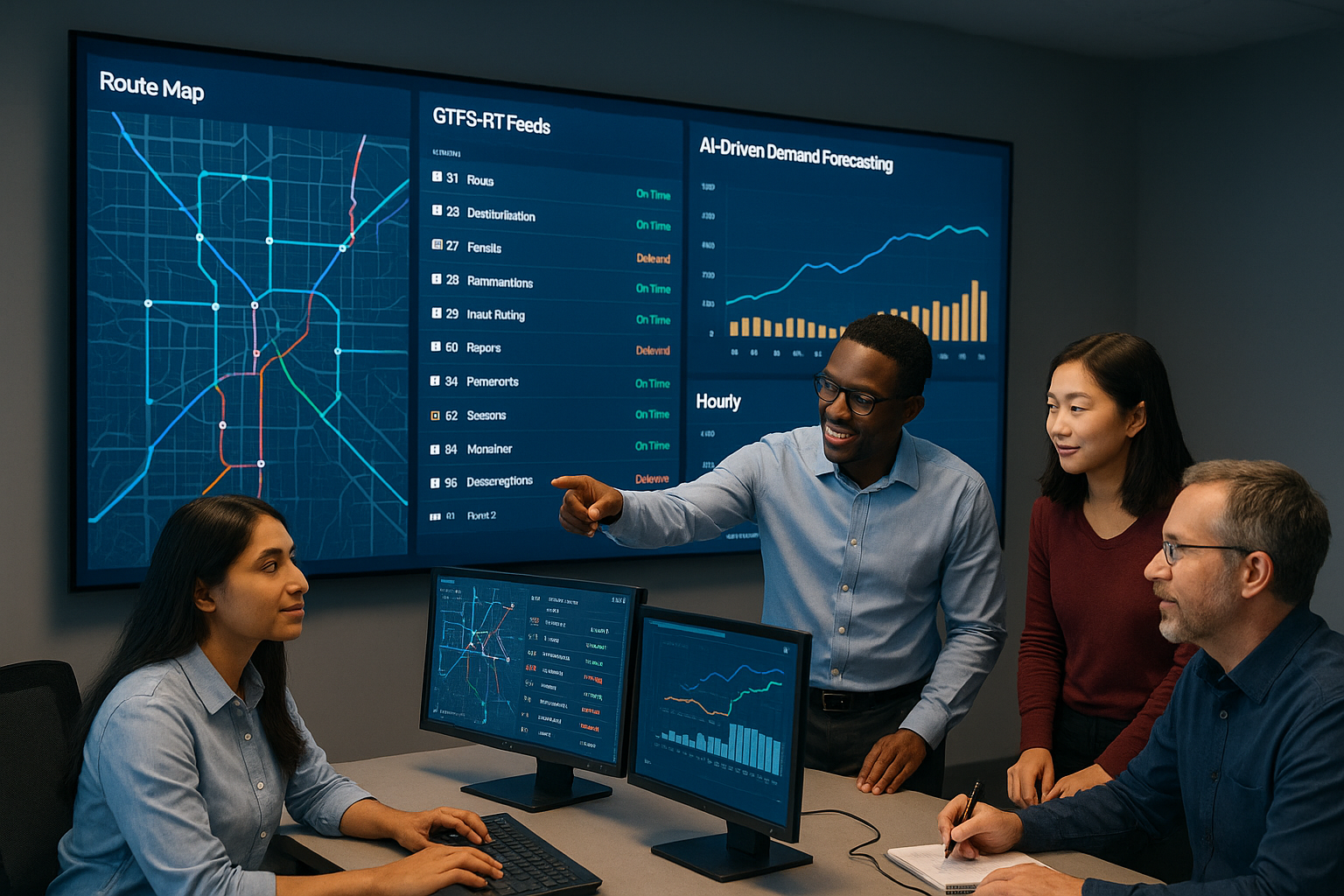
Begin with low-risk, high-value pilots that improve everyday operations and rider experience. Short-term transit demand forecasting for the next few hours or days is one of the quickest wins; it feeds headway adjustments and targeted dispatching to smooth peaks without ripping up schedules. Another practical application is AI-assisted crew and vehicle rosters that respect complex union rules and certification requirements while suggesting swaps and trade-offs for planners to review. For riders, deploy a rider information chatbot that integrates GTFS and GTFS-RT data to answer trip planning questions in multiple languages and provide ADA-compliant disruption notices. These starter projects demonstrate tangible gains while keeping humans in the loop.

A commuter interacting with a multilingual rider information chatbot on a smartphone with transit map overlay
Commuter using a multilingual rider information chatbot integrated with transit map overlays and real-time updates.

Data & Integration with Legacy Systems

Legacy systems aren’t obstacles to change if you use open standards as the backbone. GTFS and GTFS-RT provide an integration model that lets AI access schedules, realtime vehicle positions, and stop-level updates without a rip-and-replace approach. Practical integration also requires data quality checks and lineage so every forecasting or schedule-change recommendation can be traced back to source feeds. Protecting rider privacy and fare transaction data means applying privacy-by-design principles: anonymize or aggregate PII where possible and ensure encryption in transit and at rest. Build adapters that wrap legacy CAD/AVL, dispatch, and fare systems with a small, auditable service layer that converts feeds into GTFS/GTFS-RT formats for your models.

Diagram illustrating data flows between GTFS, GTFS-RT, AVL, fare systems, and an AI model with audit logs and privacy locks
Diagram showing data flows, audit logging, and privacy safeguards across GTFS, GTFS-RT, AVL, fare systems, and AI components.

AI and Optimization Methods That Work

Explain the technology simply to executive stakeholders. Time-series forecasting models estimate near-term ridership by combining historical boardings, special events, weather, and current GTFS-RT feeds. For dispatch and rostering, constraint optimization and integer programming translate legal rules—like maximum shift lengths and crew qualifications—into feasible schedules. Natural language interfaces let operations planners query “show potential swaps that keep coverage on Route X” and see ranked options. Importantly, design human-in-the-loop reviews: AI should surface vetted options and confidence scores, while planners approve changes. This hybrid approach eases adoption and preserves accountability.

Close-up of a scheduler's dashboard showing constraint optimization for crew and vehicle assignments with union rules highlighted
Scheduler dashboard illustrating constraint-based crew and vehicle assignment recommendations with union rule annotations.

Process Automation in the Operations Center

Automation only succeeds when embedded into daily workflows, not as parallel tools that operators ignore. Start by automating routine what-if scenarios: when a vehicle goes out of service, the system simulates redistribution of trips and estimates customer impacts within minutes. Pre-approved playbooks codify decisions—such as short-turns, dispatch of spare vehicles, or targeted service reductions—so the AI can propose actions that align with board-approved policies. Integrate these tools into CAD/AVL consoles and internal communications platforms so operators receive recommendations in the same interfaces they already use, reducing context-switching and speed of execution.

Governance, Ethics, and Transparency

Responsible deployment is non-negotiable for public agencies. Model cards and impact assessments make the behavior and limits of each model transparent for audits and public reporting. Bias testing should be part of the release checklist, with equity analysis that measures predicted impacts across neighborhoods, routes, and rider demographics. Where appropriate, publish non-sensitive outputs as open data to support community oversight, and maintain FOIA readiness by logging decisions, data sources, and human approvals. These practices build public trust in AI in public transit and reduce political risk.

Funding, Procurement, and ROI

Structuring pilots and selecting vendors requires precise language and measurable outcomes. Use outcome-based RFP clauses that specify milestones and KPIs such as improvements in on-time performance, reductions in cancellations, increased driver utilization, and gains in rider satisfaction. Consider hybrid procurement models that pair commercial vendors with in-house development to retain institutional knowledge and avoid vendor lock-in. Federal grants and infrastructure funding often prioritize projects that demonstrate equity and accessibility gains; frame proposals around those benefits to improve funding eligibility.

Measure return on investment with realistic KPIs and a 12–18 month roadmap. Early months focus on data readiness and integration; months 6–12 move into constrained pilots like short-term demand forecasting and roster assistance; months 12–18 scale successful pilots into operations center automation and multilingual rider chatbots. Track both quantitative KPIs—on-time performance, cancellations avoided, spare usage—and qualitative measures such as planner time saved and rider complaint reductions.

Practical Next Steps for CIOs

Start by convening a small cross-functional team: operations, planning, legal, procurement, and accessibility specialists. Prioritize one or two starter use cases that map to clear KPIs. Design a lightweight governance framework: model cards, data lineage, and human-in-the-loop checkpoints. Insist on GTFS and GTFS-RT compatibility when evaluating vendors and require FOIA-ready logging from day one. Finally, frame your roadmap as a set of incremental bets designed to de-risk each phase while delivering measurable service gains. AI in public transit is not a silver bullet, but with careful planning it becomes a pragmatic toolkit for transit scheduling optimization, better rider communication, and resilient operations.

Public-sector AI succeeds when it is built on open standards, auditable processes, and strong governance. For CIOs who balance fiscal constraints with service obligations, this playbook provides a pathway: small, transparent pilots that prove value, technical choices that integrate with legacy systems, and governance that protects riders and the agency. Pursued thoughtfully, AI can help cities deliver more reliable, equitable transit within the realities of public administration.