AI Year in Review 2025 in Healthcare: Safer GenAI, Ambient Clinical Tools, and Admin Automation — A 2026 Playbook

Part I — Where to Start with Clinical-Grade GenAI in 2026 (For Hospital CIOs)

The past year felt like a turning point. The healthcare AI 2025 review reads like a short list of practical advances rather than distant promises: ambient clinical documentation AI matured beyond transcription into context-aware summarization with safety guardrails, prior authorization automation moved from proof-of-concept to measurable throughput gains, and patient engagement bots began reliably reducing simple message backlogs. For mid-market hospitals that are starting with clinical-grade GenAI, the playbook for 2026 needs to be pragmatic, safety-forward, and tightly integrated with existing EHR workflows.

Illustration of ambient clinical documentation AI interface transcribing a clinician-patient interaction in real-time; UI overlays with summaries and confidence scores, modern flat design.
Ambient documentation UI showing real-time transcription, summaries, and confidence scores.

Begin by defining the first three clinical and administrative use cases that will deliver measurable ROI while minimizing risk. Ambient clinical notes, clinical documentation improvement (CDI) support, and patient message drafting are good first steps because they directly reduce clinician after-hours work and improve documentation completeness. Pair these with early revenue cycle work: eligibility checks and prior authorization automation that combine intelligent document processing (IDP), business rules, and LLM summarization. These are the places where revenue cycle AI can quickly show first-pass approval improvements and shorter days-in-arrears.

Protecting PHI must be central. HIPAA-compliant GenAI strategies in 2026 are not optional engineering add-ons but foundational design constraints. De-identification, secure enclaves for model inferencing, data minimization policies, and prompt-level PHI controls should be implemented from the start. Consider using private model instances behind a BAA with end-to-end encryption and audit logging. For hospitals leaning on vendor models, insist on clear SLA and latency guarantees: clinician workflows cannot tolerate unpredictable delays when documentation is generated in real time.

EHR integration AI starts with standards. FHIR APIs and eventing patterns enable safe, auditable exchanges between the EHR and AI services. SMART on FHIR apps remain the most practical vendor pathway for embedding ambient documentation and message drafting in the clinician workflow. Prior authorization automation benefits from structured data pulled via FHIR plus IDP for payer documents. Keep the integration footprint minimal at first: a read-only scoped token for clinical summaries and a tightly-scoped write path for authoring drafts into the note buffer under clinician control.

Governance must be explicit and operational. A clinical safety committee that includes CMIO and privacy officers should define acceptable failure modes, exception handling, and auditability requirements. Build continuous quality review into the deployment cadence: periodic model evaluations against curated ground truth for factuality and toxicity, and a clinician feedback loop that is easy and low-friction. Track the right ROI and quality metrics from day one — note completion time, clinician after-hours reduction, first-pass auth approvals, and patient response times — because the business case for more expansive investments will be judged by these early wins.

Part II — Scaling Ambient AI and Revenue Cycle Automation System-Wide (For CTOs and COOs)

When a single-clinic pilot turns into a system-level initiative, the architectural and operational requirements change quickly. Enterprise-grade deployments of ambient clinical documentation AI and revenue cycle automation need a centralized services layer: a prompt hub for consistent instruction sets, a vector store for clinical guidelines and site-specific policies, a model registry for version control, and telemetry that captures latency, accuracy, and usage patterns. This shared services approach reduces variability, simplifies audits, and accelerates new use-case rollout.

Enterprise AI architecture diagram for health systems: centralized model registry, vector store for clinical guidelines, FHIR API integrations, telemetry dashboards; clean schematic style.
Enterprise architecture schematic showing a centralized model registry, vector stores, FHIR integrations, and telemetry.

EHR and workflow scale-out demand standardized integration patterns. That means consistent SMART on FHIR implementations across hospitals, standardized documentation templates, and shared eventing for updates. Automation at scale also invites more sophisticated patterns: scheduling optimization tied to capacity forecasts, denial prediction models that flag high-risk claims before submission, and multi-payer prior authorization orchestration that routes requests using payer-specific rules. Revenue cycle AI at scale is as much about data orchestration and business-rule engines as it is about model performance.

Quality and safety at scale require gold-standard datasets and ongoing comparative audits. Maintain curated test sets that reflect each hospital’s patient mix and coding patterns. Implement clinician feedback loops that feed directly into model retraining pipelines and comparative audits that assess new model versions against the incumbent for factuality and hallucination rates. Operational readiness depends on playbooks, role-based training, and a super-user network that can triage issues locally and escalate consistently.

Cost control becomes a major operational lever. Plan for concurrency and peak loads, use caching and prompt engineering to reduce per-call compute, and adopt a task-driven model selection approach — cheaper models for summarization, more rigorous guarded models for clinical reasoning. Negotiate vendor contracts around observability and cost transparency, and build an internal model for TCO that includes annotation, governance, and ongoing retraining costs.

Security and compliance scale with the footprint. Ensure BAA coverage for all vendors, enforce fine-grained access governance for model inferencing and vector stores, and rehearse incident response drills at the enterprise level. These are not check-box activities; they underpin trust between clinicians, patients, and the organization. Similarly, health system AI governance should be formalized — policies for model approval, deployment gates, and continuous monitoring are essential to avoid alert fatigue and drift-related failures.

The outcomes are what justify the complexity. When done well, scaling ambient clinical documentation AI and revenue cycle automation reduces clinician burnout, shortens revenue cycles, increases net revenue capture, and improves patient experience by returning faster, more accurate responses. A hospital AI roadmap 2026 that builds on the healthcare AI 2025 review will emphasize safe, integrated deployments that prove value early and prepare the organization to iterate rapidly while keeping safety and compliance front and center.

Start small, instrument everything, and make governance non-negotiable. The investments you make now in secure EHR integration AI, robust health system AI governance, and disciplined ROI measurement will determine whether 2026 is the year AI becomes a reliable clinical partner rather than a costly experiment.

AI Year in Review 2025 for Government: From Pilots to Public Value — What Agency Leaders Should Scale in 2026

How 2025 set the stage

As 2025 closed, government teams saw a clear shift: experimental pilots matured into repeatable workflows that delivered measurable improvements in citizen outcomes. The headline advances included wider adoption of citizen service chat, scaled FOIA triage using FOIA automation AI, automated benefits intake powered by intelligent document processing (IDP), and concise case summarization that saved frontline workers hours each week. This government AI 2025 review is less about vendor hype and more about what program managers and CIOs can realistically scale in 2026 to turn momentum into public value.

Part 1: Automating document-heavy work to improve citizen services (for program managers starting out)

For program managers, the promise of public sector automation is concrete: reduce backlog, shorten turnaround, and improve service satisfaction without sacrificing transparency. Start by mapping the backlog hotspots where repetitive document handling dominates staff time — FOIA requests, appeals, eligibility checks, and correspondence drafting are consistent winners. Early wins in 2025 came from applying FOIA automation AI to triage and prioritize requests and from using IDP to extract structured data from benefits forms.

A program manager reviewing a 30/60/120-day AI rollout plan on a tablet, with sticky notes labeled 'FOIA automation AI' and 'citizen service chatbot government'.
Program manager reviewing a 30/60/120-day AI rollout plan with FOIA automation and citizen chatbot notes.

Begin with a 30/60/120-day rollout plan that sets achievable milestones. In the first 30 days, assemble stakeholders, classify data sources, and agree on measurable success criteria that will go into the AI procurement SOW. The 60-day milestone should demonstrate a working pipeline: documents ingested, sensitive fields redacted, and a human-in-the-loop review queue delivering explainable outputs. By 120 days, aim to ship a production workflow where automated actions are reversible and escalation routes to human reviewers are clear.

Data stewardship must be baked into every step. Classify records according to retention and sensitivity, apply minimization so only needed fields are processed, and encrypt and redact PII before it leaves agency systems. Accessibility and language support are not optional; Section 508 compliance and multilanguage capabilities ensure the benefits of automation reach all communities. Program-level equity assessments — running bias tests on model outputs and auditing differential outcomes by demographic groups — should be part of the acceptance criteria in your SOW.

Procurement pathways in 2025 emphasized modular acquisitions: buy microservices and integrations rather than monolithic “AI solutions.” Structure SOWs to require explainability, logging, and performance SLAs tied to measurable targets — backlog reduction, per-case cost, and service satisfaction scores. Include clauses that require vendors to support red-team testing and public transparency reporting so your automation aligns with principles of responsible AI government.

Human oversight is the safety net. Even well-trained models produce errors; the design that worked in 2025 and will continue to work in 2026 includes review queues, clear explainable outputs, and citizen escalation routes. Measurement drives iteration: track turnaround times, reduction in backlog, citizen satisfaction ratings, and error rates. Use those KPIs to refine thresholds where automation is authorized to act autonomously versus when it must surface a decision to a caseworker.

Part 2: Building a shared AI platform for agencies (for CIOs scaling enterprise AI)

If program managers focus on localized wins, CIOs must build the plumbing that turns pilots into consistent, governable services. A GovCloud AI platform is the backbone: this is where shared services like a common vector store, a prompt registry, a model registry, and a secure API gateway live. In 2025, federated experiments spotlighted the efficiency gains when teams reuse core building blocks instead of re-creating the same capabilities program by program.

Technical diagram of a GovCloud AI platform: vector store, prompt registry, model registry, API gateway, and security layers (FedRAMP), rendered in flat infographic style.
GovCloud AI platform diagram showing vector store, prompt and model registries, API gateway, and security/compliance layers.

Design the platform with data governance at its center. Define an agency-wide taxonomy, enforce lineage and retention policies, and negotiate cross-program data sharing agreements with legal and privacy teams. Security and compliance are operational imperatives: align with FedRAMP and StateRAMP where applicable, implement comprehensive logging, and institutionalize red-teaming and adversarial testing to detect failure modes before they affect citizens. Transparency isn’t optional — audit trails and public reporting build trust and are essential elements of agency AI governance.

Reusable automation services are what make the platform cost-effective. Expose document AI microservices for extraction and summarization, translation layers for multilingual support, and routing services that hand off to human agents. These microservices accelerate use-case delivery across programs while maintaining consistent security and privacy controls that a shared GovCloud AI platform enforces.

Operational models vary. Some agencies benefit from a central AI center of excellence that handles core infrastructure and governance, while others prefer a federated model where program teams build on shared primitives. A hybrid approach often wins: central teams operate the platform, publish standards, and provide onboarding and support; federated teams own domain-specific integrations and subject matter adaptation. Financial operations, whether chargeback or showback, help charge teams for usage and create incentives for efficient consumption.

The vendor ecosystem will remain diverse: integrators, ISVs, and academic partners all have roles. Prioritize interoperability and open standards to avoid lock-in, and use procurement language that emphasizes modular deliverables and shared APIs. Risk and ethics frameworks must be operationalized — routine bias testing, public transparency reports, and mechanisms for citizen advisory input should be scheduled as standard governance activities.

Finally, measure success against tangible KPIs that matter to leaders and citizens alike. Cost-to-serve reduction, service-level adherence, accessibility scores, and trust indicators such as error transparency and citizen appeal rates turn abstract benefits into boardroom metrics. These KPIs become the language that connects program managers’ 120-day wins with CIOs’ multi-year platform investments.

As agency leaders plan for 2026, the path forward is clear: program managers should focus on high-ROI document automation with strong data stewardship and human oversight, while CIOs must converge on shared GovCloud AI platforms and agency AI governance that make automation repeatable, auditable, and equitable. Together these moves translate the 2025 experimentation into sustainable public sector automation that improves services, protects privacy, and builds public trust.

AI Year in Review 2025 in Manufacturing: Edge Intelligence, Vision QA, and Predictive Maintenance — Scaling Smarter Plants in 2026

AI Year in Review 2025 in Manufacturing: Edge Intelligence, Vision QA, and Predictive Maintenance — Scaling Smarter Plants in 2026

Walking the plant floor at the end of 2025 felt different. Cameras that would once have cost a small fortune were now routine tools on every line; tiny, optimized neural networks were catching defects that eluded human eyes; and vibration sensors paired with lightweight models were predicting bearing failures days before a line would stall. This manufacturing AI 2025 review is not just a catalog of shiny new tools — it shows how teams translated those tools into measurable improvements in yield, throughput, and uptime. For teams planning next year, the question is how to convert those wins into predictable, repeatable programs. The next sections map a pragmatic path: rapid plant-level wins for plant managers, and the systems-level discipline CTOs need to scale across multiple sites.

Part: Quick Wins with Vision QA and PdM Starter Kits (For Plant Managers — Starting Out)

For plant managers who must deliver results on the next production quarter, 2025 proved one thing: you can get meaningful OEE improvement AI outcomes fast if you focus. Vision quality inspection AI and predictive maintenance AI moved from experimental to operational because of three converging developments — affordable edge cameras, robust small models for defect detection, and better sensor fusion stacks. That means a one-quarter lift in first-pass yield is realistic when projects are scoped tightly.

Begin with use-case selection. Pick a high-frequency failure mode: visual defect detection on a finished assembly, parts counting during packaging, or an anomaly detection target on a critical pump. Narrow scope reduces the labeling burden and lets you create a golden dataset in weeks, not months. Practical data work includes camera placement to capture the key view, consistent lighting to reduce false positives, and focused sample labeling (include the worst failures first). Early collaboration between operators, quality engineers, and OT technicians ensures camera mounts and cable runs don’t interfere with standard work and that visual criteria reflect human inspection standards.

Close-up of an edge camera inspecting a circuit board on a conveyor belt with overlayed AI inference boxes and confidence scores; clean industrial background, realistic rendering.
Edge camera inspecting a circuit board with AI inference overlays and confidence scores.

Automation integration accelerates value. Connect inference outputs to simple PLC triggers so a detected defect can stop a short segment of the line, tag the affected batch, and feed an RPA task that logs a quality report. Those feedback loops make AI outcomes visible to operators and create a traceable record for continuous improvement. Safety and change management matter just as much as model accuracy; engage unions and operators early, update standard work, and publish transparent pass/fail rules so acceptance isn’t a black box.

Do the math openly. ROI for vision and PdM starter kits typically comes from scrap reduction, rework time saved, and downtime avoided. If a vision model reduces scrap by five percent on a line doing 10,000 units per week, that reduction—times material cost and labor savings—paints a clear payback schedule. For predictive maintenance, even a modest MTBF improvement shifts emergency repairs to scheduled maintenance, trimming MTTR and avoiding the high cost of unplanned stops.

A pilot plan should be short and surgical: define scope, collect a golden dataset, set acceptance criteria (precision/recall thresholds that match operator risk tolerance), and train operators on interpreting model outputs. Move from pilot to line-wide deployment by packaging models with simple deployment playbooks — model artifacts, inference container settings, camera calibration notes, and a two-week maintenance schedule for re-calibration or incremental retraining. These building blocks let a successful pilot expand without reinventing the deployment steps on every line.

Part: Rolling Out Edge AI Across Multi-Site Operations (For CTOs — Scaling)

If plant managers convert pilots into line-level wins, the CTO’s job is to compound those wins across sites. In 2025 the biggest barrier to scale was not model accuracy but the lack of repeatable operations: inconsistent stacks, fragile update processes, and insecure OT connections. Edge AI in factories needs an enterprise reference stack to change that reality — edge gateways that host containerized inference, a model registry for versioning, centralized telemetry for drift detection, and remote orchestration that can push updates safely to thousands of inference nodes.

A control room with CTO and engineers reviewing a multi-site deployment map, showing containerized inference nodes and telemetry charts; modern UI panels and secure network icons; professional, photorealistic style.
Control room view of multi-site deployment, telemetry, and containerized edge inference nodes.

Manufacturing MLOps at the edge looks different from cloud-centric MLOps. You need rigorous model versioning, A/B testing on the line, and canary rollouts that limit exposure when a new vision quality inspection AI model is introduced. Drift monitoring must run close to the source, flagging changes in input distributions so teams can decide whether to retrain or adjust thresholds. A centralized defect library and feature store accelerate new deployments by reusing labeled examples and standardized features across sites, turning local learning into enterprise data products.

Digital twins and simulation became practical enablers in 2025: you can simulate line changes and test new control strategies without stopping production. That reduces the risk of yield loss when rolling out new computer vision inspections or modified PdM thresholds. Combine simulation with staged rollouts — test in a digital twin, deploy to a pilot line, run a canary on a single shift, then expand — and you get predictable outcomes faster.

Security is non-negotiable. OT cybersecurity AI can help by monitoring for anomalous network traffic patterns and unauthorized firmware changes, but architecture matters: adopt zero-trust networks, segment inference nodes from critical control systems, and use signed, auditable update pipelines for models and software. Secure update mechanisms let you push patched models or bug fixes without risking plant operations.

Successful multi-site rollouts depend on a clear partner and vendor ecosystem. Define who owns cameras, who manages the edge gateways, and who provides the model lifecycle tooling. System integrators often orchestrate the initial hardware and integration, cloud providers supply centralized model registries and telemetry, and camera vendors support calibration. Clear SLAs and responsibilities avoid the finger-pointing that kills momentum.

Finally, workforce enablement must be part of the scaling plan. Upskill maintenance techs and quality engineers as citizen AI operators who can re-calibrate cameras, validate retraining datasets, and run basic model health checks. Track enterprise KPIs that matter to leadership: OEE improvement AI targets, MTBF/MTTR trends from predictive maintenance AI, and throughput gains per site. With those metrics tied to clear ownership and an MLOps backbone, a multi-site AI rollout turns into a compounding business capability rather than a set of siloed experiments.

The arc from 2025’s tactical wins to a 2026 program is straightforward in concept: lock down quick, high-impact plant projects, then standardize the stack, security, and operational practices that let those projects scale. When vision quality inspection AI and predictive maintenance AI are treated as productized services — with versioning, telemetry, and retraining pipelines — the result is not just better models, but measurable enterprise improvements in yield, uptime, and predictable growth across sites.

AI Year in Review 2025 in Retail & eCommerce: Personalization, Search, and Inventory AI — From First Wins to Unified Intelligence in 2026

Part 1: Personalization Quick Wins with GenAI for Mid-Market Retailers (For CMOs and Heads of eCommerce)

When I look back across 2025, one practical lesson stands out: you do not need to rebuild your entire commerce stack to get meaningful lift from ecommerce personalization AI. Marketers who leaned into generative AI for content and conversational surfaces captured early conversion wins, increased average order value (AOV), and reduced service friction—often by layering intelligent services on top of existing platforms.

A marketer reviewing AI-generated product descriptions on a laptop with charts showing conversion uplift; warm office setting, realistic
Example: AI-assisted product copy review and performance charts.

Product detail page copy generation became a pragmatic first step. With better product copy generation models available last year, teams spun up pipelines that enriched catalog copy at scale—normalizing taxonomy, injecting benefit-led language, and surfacing related items. The impact was immediate: a clearer product narrative converts more browsers. Paired with AI search and recommendations, those improved PDPs helped shoppers find the right item faster and increased attachment rate.

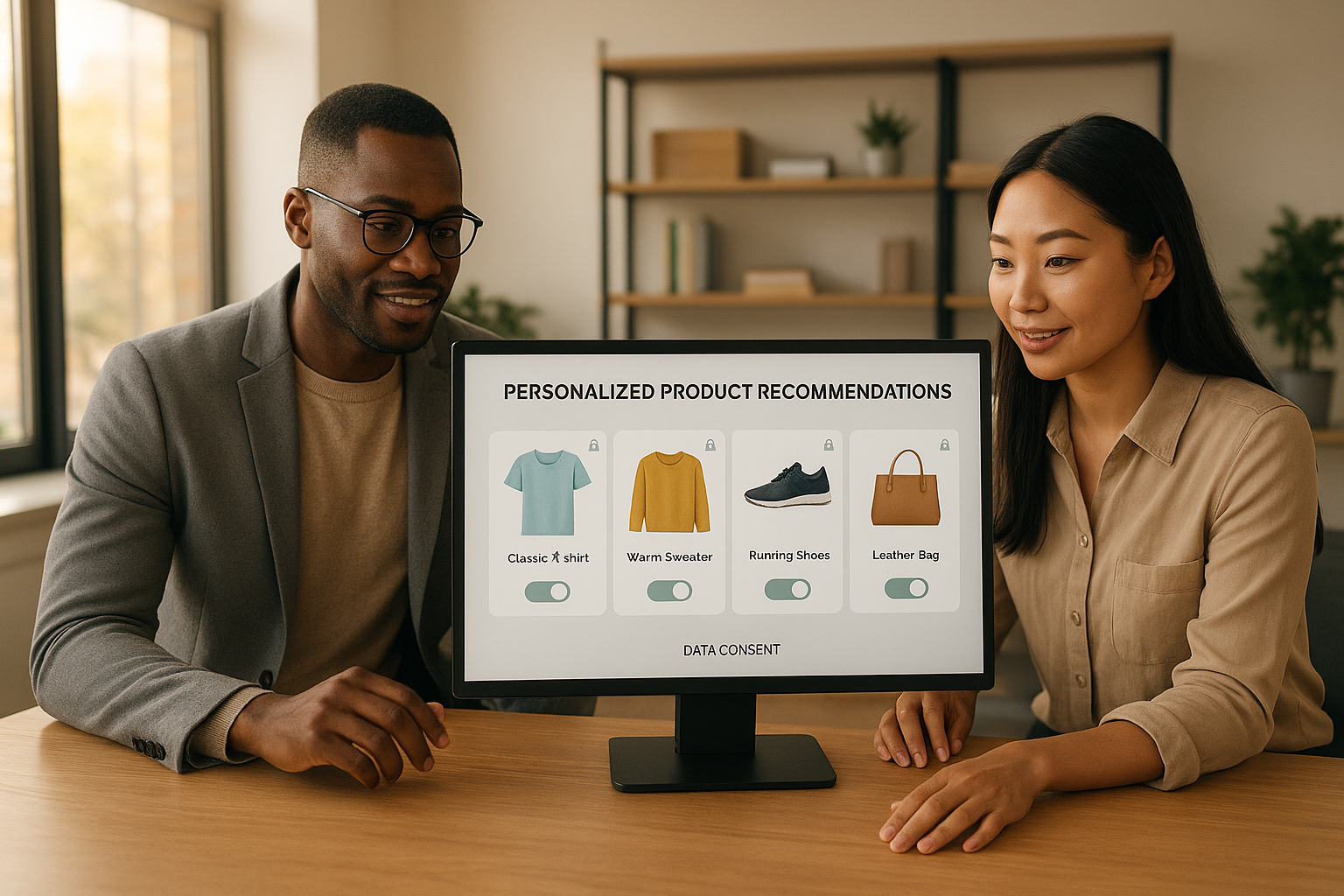
Conversational shopping assistants also matured in 2025. Not only could they answer questions, but they could be tuned for commerce signals: recommending size adjustments, prompting complementary items, and collecting zero- and first-party data for better personalization later. These assistants worked best when tied to consented data capture and a simple rules engine to maintain brand voice and compliance.

For teams getting started, data readiness is often the gating factor. A focus on product catalogs, taxonomy normalization, and clean mappings between SKUs and attributes unlocks most personalization use cases. Invest early in feed validation and enrichment; automation here—using IDP (intelligent document processing) for feed ingestion and LLMs for enrichment—reduces manual effort and speeds syndication across channels.

Experimentation is critical. Rather than treating prompts as one-off tricks, approach prompt engineering as a testable discipline: run A/B tests on prompt variants, measure content quality KPIs (engagement, clickthrough, conversion), and establish guardrails for brand safety and factual accuracy. This experimentation mentality enables fast learnings without exposing the brand to risk.

The build vs. buy decision typically breaks down to time-to-value versus differentiation. Off-the-shelf plugins and headless commerce extensions get you to lift quickly, while microservices and custom APIs let you own unique experiences. For many mid-market retailers the fastest path is hybrid: deploy plugins for rapid wins (PDP copy, recommendation widgets) while investing a small engineering squad to expose unified personalization signals for future differentiation.

Set achievable ROI targets: aim for measurable uplifts in conversion rate, AOV, attachment rate, and reduced service handle time. A focused 30/60/90-day plan might begin with a pilot on high-volume categories, followed by a QA playbook for content, and cross-functional reviews to expand the scope. These short cycles keep senior stakeholders engaged and make performance visible.

Part 2: Unifying Forecasting, Pricing, and Inventory with Enterprise AI (For CIOs and COOs)

For operational leaders, 2025 confirmed that demand forecasting AI and inventory optimization AI scale best when they are part of a governed omnichannel AI platform. Incremental model improvements are valuable, but the full financial upside—fewer stockouts, lower markdowns, better margins—comes from integrating forecasting, pricing optimization AI, and real-time inventory visibility into the same decision fabric.

Lessons from the past year were practical: hierarchical demand models that incorporate causal signals (promotions, local events, product launches) outperformed flat models, and vector search improved recommendation relevance when combined with behavioral embeddings. The reference architecture that emerges as a best practice starts with a data lakehouse for raw and processed signals, a feature store for production-ready features, a model registry and CI/CD pipeline for retail MLOps, and a vector search layer for semantic retrieval.

Data architects mapping a retail AI reference architecture on a glass board showing data lakehouse, feature store, model registry, vector search; collaborative meeting, techy visuals
Reference architecture sketch for a governed omnichannel retail AI platform.

Omnichannel inventory optimization requires real-time visibility and flexible fulfillment rules. Safety stock can no longer be a blunt instrument; it needs to incorporate lead times, local demand elasticity, and store-level conversion behavior. Combining inventory optimization AI with a dynamic store/DC balancing mechanism reduces lost sales while minimizing excess stock in slow-moving channels.

Pricing and promotions began to shift from gut-driven decisions to elasticity-informed optimization. Pricing optimization AI and markdown engines that model price sensitivity at the SKU and segment level allow merchants to set price ladders that protect margin while accelerating sell-through when needed. These engines are most effective when coupled with planners’ workflows via trust-building dashboards that show recommended actions, uplift estimates, and the constraints used in the models.

Retail MLOps matters in the real world. Continuous integration and deployment for models, monitoring for drift and business KPIs, cost controls on training and inference, and prompt governance for GenAI surfaces must all be operationalized. Without these controls, models drift, legal risks emerge, and business trust erodes.

Privacy and compliance should be built into every layer: consented data use, regional compliance checks, and audit trails for model decisions make it feasible to scale. When merchants and planners can see why a recommendation or price moved, they are more likely to adopt the system. Change enablement—training, operating playbooks, and incremental rollout of automated controls—creates the bridge from pilots to enterprise adoption.

The business outcomes are measurable: lower markdowns through smarter pricing, reduced stockouts through unified forecasting, and higher lifetime value as personalization and timely fulfillment improve customer experience. In 2026, the biggest returns will go to teams that treat these capabilities as an integrated omnichannel AI platform rather than separate point solutions.

From 2025 Wins to 2026 Execution

As you plan for 2026, think about sequencing: let CMOs drive fast personalization experiments that generate revenue lift and data capture, while CIOs and COOs build the foundational data and MLOps platform that turns those signals into enterprise-grade decisions. Automate feed enrichment and content syndication to support marketing scale. Build a feature store and model registry to support demand forecasting AI and pricing optimization AI at scale. And finally, prioritize governance and observability so business users trust the recommendations they see.

Retail leaders who connect the dots—content and conversational AI that improves conversion, semantic search that improves findability, and forecasting and inventory AI that protects margin—will move from first wins to sustained advantage. 2025 gave us the tools; 2026 is the year to weave them into a unified, governed omnichannel AI platform that drives measurable business outcomes across the funnel.

Week 49 — AI Talent Strategy: Hiring, Retaining, and Developing the Right Skills

Part 1: Building Your First AI-Capable Team in Government — A Practical Playbook for Agency CIOs (Starting Out)

Agency CIOs often inherit long backlogs, high expectations for citizen services, and an environment where auditability and compliance are non-negotiable. The question is not whether to adopt AI; it is how to assemble the right team and partnerships so AI delivers tangible improvements in citizen experience and processing efficiency without adding risk. An effective AI talent strategy in the public sector starts with realistic workforce planning, a prioritized list of quick wins, and governance baked into every hire and vendor contract.

Why government needs AI now

Citizen expectations have shifted toward instant, personalized digital services. Meanwhile, agencies face paper-heavy processes and rising caseloads. Targeted AI-driven automation can reduce processing backlogs, surface insights for policy decisions, and create audit trails that improve accountability. Framing the program around service-level improvements—reduced queue time, faster adjudication, improved accuracy—aligns AI workforce planning with mission outcomes.

Core skills stack for your first team

A small, effective government AI team balances product, data, and compliance. Product managers who understand service-level targets, data engineers who can catalogue and secure datasets, and ML engineers who can prototype models are the backbone. Add a prompt engineering resource for conversational systems, a privacy/legal specialist to navigate data retention and FOIA implications, and a change manager to shepherd adoption. This mix keeps you lean while covering critical capabilities for public sector AI upskilling.

Close-up of a training workshop with mixed government staff learning AI tools on laptops; diverse participants, classroom setting, whiteboard with diagrams labeled 'Data, Models, Governance'.
Government AI upskilling workshop: hands-on training for product, data, and governance roles.

Build vs. partner: choosing the right mix

With constrained budgets and procurement rules, most agencies benefit from hybrid models: hire core capabilities and engage AI development services for heavy-lift engineering or specialized model builds. Use vendors for sandbox projects and to accelerate proofs of concept while focusing internal hires on aspects you must own—data governance, citizen interfacing, and responsible use policies. Clear scopes and outcomes in contracts ensure vendors transfer skills rather than create permanent dependencies.

Upskilling pathways and role-based learning journeys

Public sector AI upskilling should be pragmatic. Create micro-credential paths that map to roles: product owners take courses in AI product design and metrics; data staff gain certificates in data engineering and secure data handling; operations learn to run copilots for contact centers. Sandbox projects with anonymized data are essential to build confidence and demonstrate value. Encourage short, focused learning sprints tied to 90/180/365-day milestones so skills development is measurable.

Governance and compliance tailored to government

Government AI programs must prioritize procurement transparency, security, and data retention. Draft responsible use policies early and embed them in SLAs. Ensure all tools and models produce audit logs and can be inspected. Procurement pathways may need templates for vendor confidentiality, model explainability requirements, and provisions for data residency. When governance and workforce planning are integrated, risk becomes manageable rather than an obstacle to innovation.

Quick wins and a 90/180/365 roadmap

Start with high-impact, low-complexity projects: document processing to reduce manual intake, case triage to route complex requests faster, and contact center copilots to lower average handle time. A 90-day plan should establish core hires and a sandbox with one pilot. At 180 days scale the vendor partnership, operationalize the best-performing prototype, and launch targeted upskilling. By 365 days, aim to institutionalize an AI Center of Excellence or working group to share patterns and govern reuse. Tie KPIs to citizen-facing metrics so the AI talent strategy demonstrates clear service-level improvements.

Part 2: Scaling an AI Engineering Org in Manufacturing — From Pilots to Plant-wide Impact (Scaling)

Manufacturing CTOs face a different, but related challenge: moving from promising pilots to reliable, plant-wide AI systems that improve OEE, reduce scrap, and increase uptime. The leap requires shifting from ad hoc projects to an operating model that combines strong engineering discipline, MLOps for industry, and a talent strategy that balances domain knowledge and platform expertise.

Operating model: hub-and-spoke CoE

Scaling manufacturing AI benefits from a hub-and-spoke Center of Excellence. The CoE provides platform capabilities—data pipelines, model registries, CI/CD for ML, and reusable edge deployment patterns—while product-aligned spokes live with value streams on the shop floor. Product owners in each value stream translate business problems into scoping documents the CoE can industrialize, creating consistent throughput and faster time-to-value.

Right talent mix for manufacturing AI teams

A mature manufacturing AI organization needs platform engineers to maintain data and edge infrastructure, ML engineers who build models for vision and forecasting, data engineers to curate OT/IIoT streams, DevSecOps to enforce security, reliability engineers for monitoring, and technical program managers to coordinate releases. This blend ensures models move from research to production with robust retraining cadences and safety-conscious deployment practices.

Factory floor with edge devices and sensors, engineers reviewing model performance on a large monitor; industrial setting with clear displays showing model metrics and OEE graphs.
Industrial AI in practice: engineers monitoring edge-deployed models and OEE dashboards on the shop floor.

MLOps excellence and edge deployment

MLOps for industry is not theoretical—it’s the set of practices that keep models reliable on the factory floor. Implement model registries, automated validation tests, CI/CD pipelines for model and data changes, and clear rollback procedures. Edge deployment patterns must account for intermittent connectivity, model compression, and local inference monitoring so OT teams can trust AI interventions. Human-in-the-loop safeguards and safety SOPs are essential where automation affects physical processes.

Skills development across the organization

Upskilling here means more than data teams learning model architecture; it requires factory floor AI literacy so operators understand model outputs and failure modes. Safety training, human-in-the-loop SOPs, and collaborative workshops between engineers and operators accelerate adoption and reduce resistance. A combination of hands-on certifications, shadowing shifts with AI-enabled tools, and continuous learning sprints yields a resilient workforce.

Build vs. buy and vendor management

Computer vision libraries and anomaly detection toolkits are often available from vendors, but integration, customization, and retraining cycles are where value is created. Use a build vs. buy calculus that weighs time-to-value, intellectual property needs, and the ability to retrain models on proprietary data. Contracts should include SLAs for uptime, retraining cadence, and clear responsibilities for edge support, because vendor performance directly impacts production metrics.

Measuring ROI with an operations-focused dashboard

Translate AI outcomes into operations metrics: OEE gains, scrap reduction percentage, MTBF/MTTR improvements, and energy per unit produced. These KPIs make the case for continued investment and guide workforce planning. When AI talent strategy is directly tied to measurable plant economics, leaders can justify expanding the CoE, hiring for specialized MLOps roles, and investing in ongoing public sector AI upskilling or industry-specific training for staff.

Both government and manufacturing leaders can accelerate ROI by aligning AI workforce planning with service and production outcomes, combining targeted hiring with partnerships, and investing in durable MLOps and governance practices. Whether you are building your first AI-capable team or scaling an enterprise-grade AI engineering org, the clearest path forward starts with a prioritized roadmap, a role-based upskilling plan, and operating models that institutionalize repeatable success.

Week 50 — Assessing AI Maturity: Frameworks to Benchmark Your Progress

Part A — Your First AI Maturity Baseline: A CEO’s Guide for Professional Services

For many professional services firms, the first disciplined step toward AI begins with a simple but powerful question: where are we now, and which early wins will prove the value of an AI roadmap to clients and partners? A practical AI maturity assessment gives founders and CEOs a grounded answer. This assessment is not a theoretical exercise; it is a prioritization engine that converts the hype around generative models into tangible client value through targeted process automation use cases like research automation, proposal generation, and knowledge retrieval.

Start by applying a five-dimension maturity model that captures the essentials of readiness: strategy, data, tech, people, and governance. Under strategy, you want clarity on how AI aligns with your service lines and pricing models. For data, evaluate the hygiene of your knowledge repositories and whether retrieval-augmented generation (RAG) can be implemented with existing content. Technology covers tooling and integration readiness: do you have secure APIs and a place to host prototypes? People means both the skills on your team and the advisory capacity required to translate model outputs into client recommendations. Governance is the set of rules that ensures client confidentiality, accuracy, and billable impact.

A diagram of a five-dimension AI maturity model (strategy, data, tech, people, governance) styled for a professional services firm, clean infographic
Five-dimension AI maturity model: strategy, data, tech, people, governance — visualized for professional services leaders.

Conduct a short diagnostic that blends a peer benchmark survey with a fast artifact review. Rather than long questionnaires, gather three things: a list of priority client problems, a representative sample of internal knowledge assets, and an org chart showing who owns client delivery. That lightweight audit surfaces where you’re ahead of peers and where you are lagging, and it provides the inputs to triage use cases by revenue impact, delivery efficiency, client experience, and technical feasibility.

When choosing initial use cases, favor those that change the economics of client engagement quickly. Research automation and proposal generation often produce measurable billable-efficiency improvements that can be tracked as AI ROI measurement. Knowledge retrieval projects powered by RAG tend to deliver immediate advisor productivity gains and better client conversations. Frame these as experiments with specific success criteria: percent reduction in time-to-proposal, lift in win rates, or hours reclaimed per advisor per month.

Deciding whether to build, buy, or partner is another practical step in the roadmap. For many professional services firms, partnering with niche AI development services accelerates time-to-value: you avoid a long internal build cycle and get a productized integration that respects your client data. Where you do build, focus on modular components that can be reused across engagements rather than bespoke models per client. Pair this with a 30/60/90-day plan that delivers quick proof points and a 12-month vision for broader transformation so leadership can see both early wins and the path to scaled impact.

Change management matters as much as technology. Incentives should recognize that AI can be billable if it increases the average revenue per advisor or shortens delivery cycles while preserving client outcomes. Engage partners and staff early, provide role-based training, and measure adoption with both quantitative metrics and qualitative feedback from client teams. This approach keeps momentum and helps the CEO translate a maturity assessment into a living AI roadmap for professional services that maps directly to client value.

Part B — From Good to Great: Financial Services CIOs Advancing AI Maturity with Controls and Scale

Scaling AI in regulated finance demands a different posture: speed balanced with controls. Financial services CIOs moving from pockets of excellence to enterprise-grade AI need frameworks that prioritize AI platform standardization, rigorous model risk management AI practices, and the ability to quantify AI ROI measurement across fraud, AML, underwriting, and personalization use cases. The goal is to turn scattered pilots into an accountable, auditable program that reduces loss, improves revenue, and strengthens compliance.

Begin with a concise enterprise AI reference architecture that spans lines of business. This architecture should define shared services—secure data lakes, model registries, monitoring layers, and deployment pipelines—so that teams can move quickly without reinventing core controls. Standardization reduces duplication, eases onboarding of third-party models, and creates a single source of truth for governance decisions.

An enterprise AI reference architecture for financial services showing model governance, secure data pipelines, monitoring, and deployment platforms, professional infographic
Enterprise AI reference architecture for financial services illustrating governance, secure pipelines, monitoring, and deployment.

Model risk management is the backbone of trustworthy AI in finance. Validation, ongoing monitoring, clear documentation, and auditability are non-negotiable. Make validation a lifecycle activity rather than a one-off checkpoint: build automated tests, performance baselines, drift detection, and explainability reports into your MLOps workflow. These artifacts will be critical when internal or external auditors review model behavior, and they make it possible to scale while maintaining confidence in outcomes.

Data controls intersect with both risk and innovation. Deploy techniques that protect sensitive information—PII tagging, synthetic data generation for development, differential privacy where appropriate, and zero-trust APIs for production access. These safeguards allow teams to experiment with sophisticated models while ensuring that data handling meets regulatory requirements and internal policies.

Platform strategy must reconcile performance needs with cost discipline. Standard tooling for orchestration, GPU scheduling, and observability simplifies operations and enables FinOps practices that allocate costs to lines of business. When MLOps and FinOps are integrated, CIOs can predict run costs, identify runaway experiments, and make informed decisions about decommissioning low-ROI models. Treat the use case portfolio like any investment portfolio: map value versus risk, prioritize those that deliver measurable reduction in false positives for fraud or lift in underwriting accuracy, and sunset models that no longer justify their operational footprint.

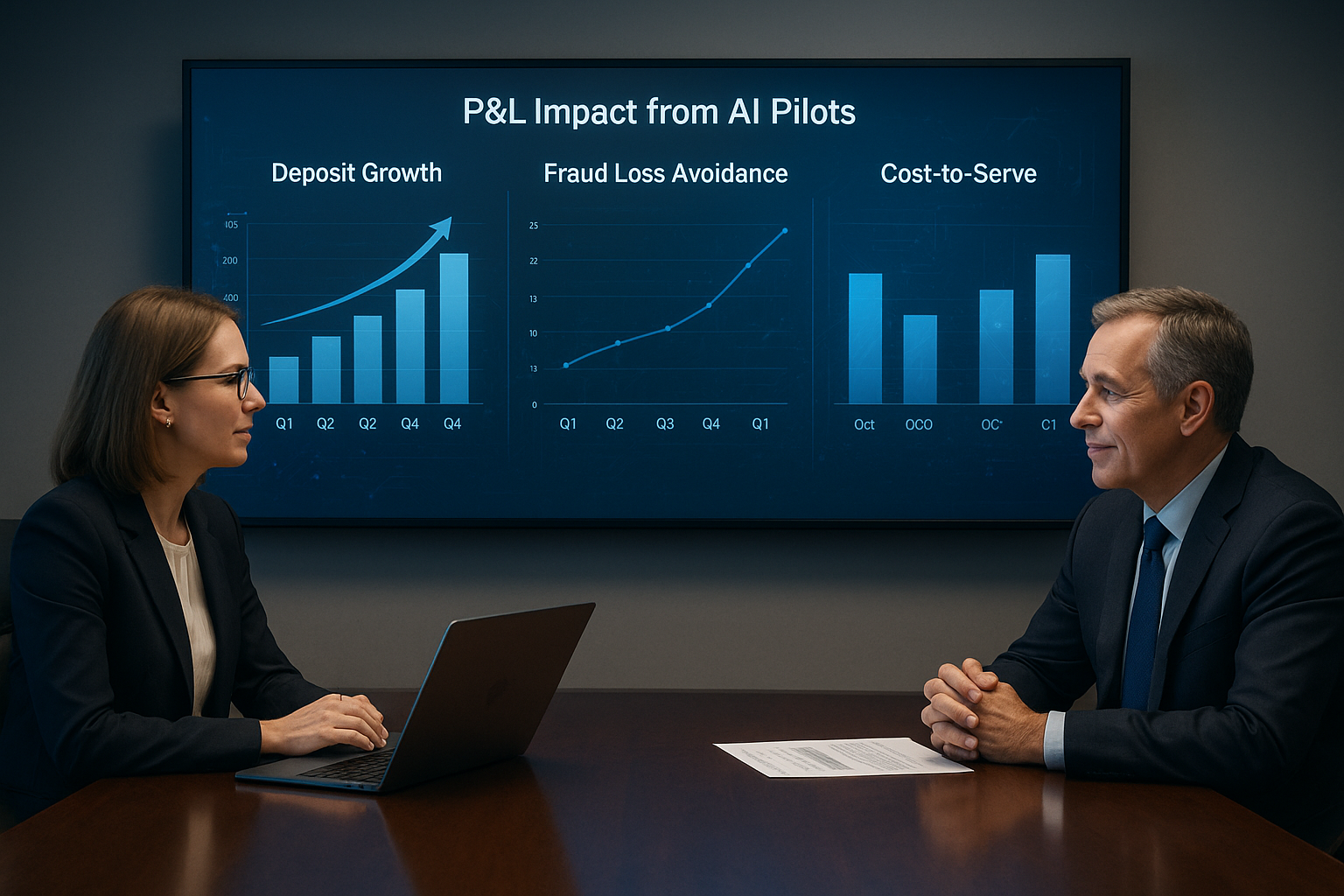
Executive reporting should translate technical metrics into business language. Tie monitoring outputs to reduced losses, revenue lift from personalization, fewer false alarms in AML workflows, or fewer manual reviews in underwriting. These translations make it easier for boards and regulators to see the ROI of AI investments and understand the risk controls in place. The combination of robust model risk management AI processes, AI platform standardization, and disciplined cost governance converts experimental wins into sustainable, enterprise-grade capability.

Both parts of this maturity journey—building a first AI roadmap for professional services and scaling AI responsibly in financial services—share a common truth: maturity is not a binary state but a sequence of decisions. A focused assessment sets priorities; a pragmatic roadmap ties experiments to ROI; and standardized platforms with strong governance turn pockets of excellence into durable advantage. Use these frameworks to benchmark your progress, measure outcomes, and steer investments where they create the most client and enterprise value.