Week 51 — AI Year in Review 2025: Key Milestones and Lessons

2025 felt like the year the promise of enterprise AI stopped being theoretical and started leaving practical footprints in hospitals and retail operations. The breakthroughs that dominated headlines — clinical LLMs tuned to medical knowledge, high-accuracy imaging models, and ambient scribing that can capture consults — are real technologies with immediate operational implications. But translating breakthroughs into dependable, compliant, and revenue-driving systems requires disciplined roadmaps. This post translates the most consequential advances of 2025 into two pragmatic playbooks: one for hospital leaders beginning their AI journey, and one for retail teams scaling personalization and intelligent inventory.

What 2025’s AI Breakthroughs Mean for Hospitals — A Starter Blueprint for CIOs (Starting Out)

Hospital CIOs and IT directors who are starting out need a clear sense of what’s real versus what’s marketing. In 2025, clinical LLMs emerged that can summarize literature, suggest evidence-based differentials, and draft notes; imaging models achieved levels of sensitivity and specificity for select read types; and ambient scribing systems moved from experimental to operational in several large health systems. These advances are meaningful, but they are not plug-and-play replacements for clinical judgment.

Close-up of an ambient scribing device capturing clinician-patient conversation with anonymized UI overlays showing HIPAA-compliant flags; clinical environment, realistic
Ambient scribing device in a clinical setting with anonymized overlays and HIPAA compliance flags.

Begin by prioritizing starter use cases that balance impact with risk. Ambient scribing can return clinician time by reducing documentation burden, but it must be paired with human review and clear auditing. Prior-authorizations and revenue-cycle automation are low-friction automation targets: AI that extracts structured data from notes and populates authorization forms can reduce denials and cycle time. Patient access chatbots and virtual front doors can smooth scheduling and triage, improving throughput when tied into EHR workflows. Coding support that suggests billing codes can accelerate billing, but require threshold checks and coder sign-off.

Data privacy and PHI handling are non-negotiable. HIPAA-compliant AI implementations typically start with strict de-identification rules, access controls, and data locality guarantees. Decide early on an on-prem versus private cloud strategy: on-prem solutions give maximum control over PHI, while private cloud vendors can offer compliant enclaves and robust managed services. For many hospitals just starting out, a hybrid model—keeping raw clinical data on-prem while consuming vendor models in a private cloud via vetted APIs—provides a pragmatic compromise.

Evaluation protocols must be rigorous and clinically meaningful. Build accuracy and safety tests aligned to clinical endpoints, not just predictive metrics. Include bias audits across demographics, track false-negatives in safety-critical pathways, and require human-in-the-loop sign-off criteria. A staged evaluation framework — retrospective validation, silent prospective monitoring, then supervised clinical pilot — helps manage risk while demonstrating value.

Pilot-to-scale also needs an EHR integration pattern and clinical governance. Lightweight integrations using FHIR for data exchange and SMART on FHIR for context-aware apps make initial pilots less invasive. Define clinical governance up front: who approves model updates, what incident response looks like when an AI suggestion is wrong, and how to log and audit decisions for patient safety and regulatory review.

ROI levers in hospitals are tangible: saved clinician time, reduced prior-authorization denials, faster throughput in ambulatory clinics, and fewer coding errors. Quantify baseline workflows so you can measure delta after deployment. Finally, choose partners who have proven clinical deployments and provide clear pathways for AI development integration when gaps remain. Vendors can deliver rapid time-to-value, but a thin center of excellence capable of custom development ensures you can integrate AI into local workflows and governance practices.

Retail After 2025 — Scaling AI for Hyper-Personalization and Inventory Agility (Scaling)

Retail teams scaling AI in 2025 must turn lessons into a unified execution model. The year delivered significant improvements in generative models for content creation, real-time demand-sensing models, and cross-system interoperability. For CMOs and CTOs, the first imperative is a unified data layer: a customer data platform (CDP) tightly integrated with product catalogs and event streams. Identity resolution across channels underpins both retail AI personalization and accurate measurement.

Retail command center screen showing unified customer profile (CDP), inventory forecasts, and personalized campaign variants generated by GenAI; modern office, high-tech monitors
Retail command center visualizing CDP profiles, inventory forecasts, and GenAI-generated campaign variants.

Generative AI transformed content operations; teams can generate creative variants at scale, but guardrails are essential. Brand safety controls, human review workflows, and style-guides embedded as model prompts stop plausible but off-brand content. Use GenAI to create personalization variants and then subject them to rapid A/B testing within an experimentation framework so creative outputs are evaluated for engagement and conversion rather than assumed effective.

Next-best-action engines that combine propensity models with business rules are the workhorses of modern personalization. These engines should be built with an experimentation mindset: serve recommendations, measure incremental lift, and iterate. Integrate such engines with adtech and martech through standardized APIs and leverage measurement in clean rooms when sharing data with partners. Clean rooms and privacy-preserving analytics are central to a sound first-party data strategy, enabling measurement without exposing raw PII.

Inventory intelligence moved from batch forecasting to continuous demand-sensing in 2025. Models that ingest point-of-sale, web signals, weather, and local events can update store and SKU allocations in near real-time. Pair demand forecasts with optimization engines for markdowns and fulfillment allocation to reduce stockouts and margin erosion. The tangible metrics here are reduced stockouts, improved sell-through, and less margin lost to emergency sourcing.

MarTech and AdTech interoperability is not just technical—it’s an operating model. Ensure your CDP, experimentation platform, and recommendation engine share schemas and unified identifiers so you can measure CAC versus LTV by cohort. Measurement should be tied to incremental lift tests, with clear KPIs for margin impact, stockouts avoided, and campaign efficiency. When a personalization experiment increases conversion but drives costly fulfillment, the net impact can be negative; measure holistically.

Finally, the operating model matters as much as the models. A cross-functional growth squad—combining data engineering, product managers, creative ops, and MLOps—keeps experiments fast and accountable. MLOps cadence should include model retraining windows, post-deployment monitoring for data drift, and a rollback plan for performance regressions. Put human review gates on creative AI outputs and inventory decisions that materially change customer experiences.

Across both sectors, 2025’s lesson is pragmatic: powerful models expand what’s possible, but dependable value comes from disciplined integration, governance, and measurement. Hospital leaders should focus on HIPAA-compliant AI pilots that free clinician time and reduce denials; retail leaders should stitch together a first-party data strategy, GenAI content ops, and intelligent inventory systems that optimize both customer relevance and margin. The next phase won’t be about whether AI works — it will be about whether organizations have the processes, governance, and integrations in place to make it consistently work where it matters.

Week 52 — Looking Ahead to 2026: Emerging AI Trends and Predictions

Part One: 2026 AI in Energy & Utilities — Edge Intelligence for a Smarter, More Resilient Grid

CTOs entering 2026 are no longer asking whether edge AI belongs in utilities; the question is how to make it reliable, auditable, and scalable across substations and distributed energy resources (DERs). Edge AI utilities initiatives are shifting from pilots to operational programs, with an emphasis on inference efficiency, federated learning, and the emergence of energy digital twin concepts that map the physical grid to continuous virtual models. The narrative for the year ahead is about practical scaling: fewer experimental proofs, more hardened architectures that deliver measurable reliability and cost outcomes.

A detailed diagram of a resilient grid architecture with edge AI nodes at substations, distributed energy resources, digital twin overlays, and secure data pipelines labeled OT/IT convergence. Clean, technical, infographic style.
Resilient grid architecture with edge AI nodes, digital twin overlays, and secure OT/IT data pipelines.

Real-time use cases are now the main currency of value. Load forecasting at the distribution edge enables more granular demand response and reduces peak risks. Camera-based vegetation management systems using computer vision catch encroachment earlier, lowering the frequency of outages and the expense of emergency patrols. Asset health models run inference on site to flag impending transformer issues, reducing unnecessary truck rolls and shortening time-to-repair. The combination of grid optimization AI and edge intelligence produces measurable improvements in SAIDI and SAIFI, but more importantly it helps utilities predict and prevent outages with better outage prediction accuracy and fewer manual interventions.

OT/IT convergence is no longer a buzz phrase; it’s a necessary program. Secure data pipelines from SCADA and data historians into AI inference layers require careful design: role-based access, air-gapped validation for model updates, and compliance with NERC/CIP frameworks. Federated learning presents a compelling middle ground where local models learn from distributed patterns without moving sensitive telemetry off-site. This reduces attack surface while enabling shared improvements across service territories.

Cyber-resilience must be baked into model lifecycles. Hardening endpoints, signing model artifacts, and instituting anomaly detection for model drift will be table stakes in 2026. For utilities, the intersection of model security and regulatory obligations changes procurement and operational plans. Reference architectures matter: clear patterns for secure model deployment, telemetry ingestion, and rollback routines speed time-to-value and make build-versus-partner decisions more data-driven.

Funding models are evolving alongside technology patterns. Regulators are testing shared-savings contracts that let vendors earn a portion of operational savings, while grants and targeted regulatory treatment make long horizon investments in edge AI utilities more palatable. For CTOs, a hybrid approach—combining in-house platform work with accelerators from specialized partners—often offers the fastest path to demonstrable impact without losing control over critical OT integration.

Part Two: The 2026 Mid-Market CEO Agenda — Practical AI Bets That Pay Off in 90–180 Days

For mid-market CEOs, 2026 is the year to choose pragmatism over platform shopping. A concise mid-market AI strategy 2026 centers on three early bets that de-risk investment while producing measurable ROI: document automation to cut processing time, sales and customer-success copilots to accelerate pipeline velocity and improve CSAT, and analytics acceleration to make better decisions faster. These bets create compounding value because each reduces cycle time, cost-to-serve, or both.

Start with data readiness lite. Instead of building a monolithic data lake, companies can adopt a retrieval-augmented generation (RAG) approach over existing content, applying metadata hygiene and simple access controls to make knowledge useful. RAG enables copilots to answer questions from contracts, product docs, and support tickets without upfront reengineering. Metadata hygiene—consistent tagging of documents and records—turns messy repositories into searchable, trustworthy inputs for AI copilots for SMBs.

The platform choice should favor low-code, API-first tools that let teams iterate quickly and avoid vendor lock-in. Deploying an AI automation 90-day plan focused on a single workflow—such as invoice processing or lead qualification—creates an early performance baseline. Within 30 days you can validate data accessibility and model outputs; by 60 days you can integrate with core systems and demonstrate cycle-time reductions; by 90 days you should have measurable cost savings and a repeatable playbook to scale to adjacent workflows.

Change management is lightweight but deliberate. Enablement sprints that coach teams on new copilot behaviors, combined with governance that defines acceptable use and escalation paths, will reduce resistance. Create short playbooks showing how a salesperson or customer-success manager uses a copilot in a typical interaction; those playbooks are the operational glue that turns capability into adoption. KPIs should be business-centered: reduction in cycle time, improved pipeline velocity, cost-to-serve improvements, and CSAT gains measured against pre-deployment baselines.

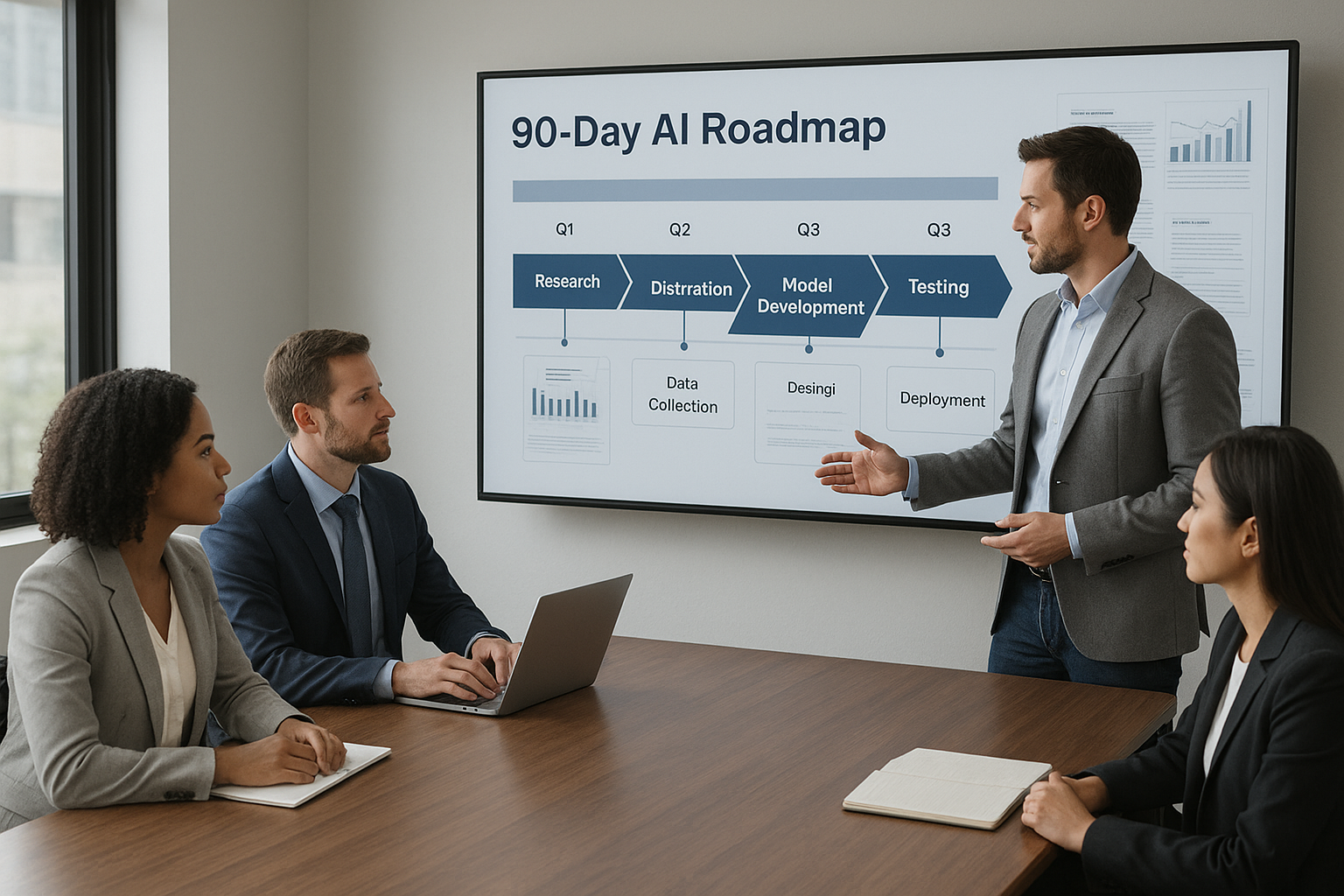
A visual 90/180-day roadmap for mid-market AI adoption showing milestones: data readiness lite, RAG deployment, sales and CS copilots, automation wins, and scale checkpoints. Modern, simple, corporate styling.
90/180-day roadmap for mid-market AI adoption: validate in 30, build in 60, demonstrate ROI in 90 and scale to 180.

When to engage a partner is a strategic choice. Early on, strategy sprints with a focused partner can align leadership and produce a prioritized backlog. For scale, an automation factory model or managed MLOps service can run the pipeline of small projects while keeping costs predictable. AI development accelerators—prebuilt templates, connectors, and governance molds—shorten delivery cycles and lower risk, enabling mid-market firms to punch above their size when executing an AI roadmap.

Practical timelines matter because executives need early wins to sustain investment. The 30/60/90-day proof points are not a silver bullet but a disciplined staging mechanism: verify data and user needs in 30 days, build and integrate in 60 days, and demonstrate operational ROI by day 90. After the first cohort of wins, a phased scale plan across functions—finance, sales, operations, and support—creates an ecosystem where AI process automation services compound benefits and create defensible efficiency advantages.

Both parts of this look-ahead emphasize an ROI-first mindset. Whether the focus is grid optimization AI at the edge or pragmatic copilots for SMB teams, the mechanics are similar: choose high-value use cases, build secure and auditable data pipelines, and iterate quickly with partner accelerators where it de-risks delivery. The difference is cadence and scale. Utilities must prioritize reliability and compliance while weaving AI into long-lived OT environments. Mid-market leaders must prioritize speed, measurable cost reductions, and user adoption so AI becomes a business capability rather than an experiment.

As 2026 approaches, the leaders who win will be those who balance ambition with rigor—deploying edge intelligence that measurably improves grid resilience and standing up mid-market AI strategies that deliver tangible business outcomes in 90–180 days. The emerging toolkit—energy digital twin models, federated learning patterns, RAG for knowledge systems, and AI development accelerators—makes those outcomes feasible. The remaining challenge is organizational: commit to pragmatic pilots that scale, safeguard the operational surface area, and treat AI as a continuous improvement engine rather than a one-off project.

Week 1 — AI Trends 2025 and Strategic Planning for Enterprises

Week 1 — AI Trends 2025 and Strategic Planning for Enterprises

Executives entering 2025 face a familiar tension: the promise of AI trends 2025 enterprise-grade capabilities and the practical constraints of existing operations. For COOs in transportation and logistics, that means converting generative copilots, predictive planning, and computer vision into reliable improvements in on-time performance and cost per mile. For CIOs in insurance, the ask is bolder: scale an insurance AI operating model that supports underwriting automation, smarter FNOL workflows, and fraud detection without introducing unmanageable model risk. This two-part brief lays out starting-roadmap guidance for logistics leaders and a scaling playbook for insurance technologists.

Part 1 — Logistics 2025: A COO’s Guide to Starting with AI (Starting Out)

When a logistics COO first evaluates AI, the right frame is pragmatic sequencing. The most immediate wins will not come from sweeping, network-wide optimization but from tactical improvements that reduce exceptions and free capacity. Begin by mapping customer-impact events — missed windows, damaged freight, invoice disputes — and match those to the 2025 trends that matter: genAI copilots for dispatcher assistance, predictive planning for demand smoothing, and computer vision for damage detection at docks and in yards.

A dynamic dashboard showing route optimization AI visualizations over a map, telematics data streams, and predicted demand curves. Clean UI, corporate style, realistic colors.
Route optimization AI dashboard showing telematics streams and predicted demand curves to support dispatcher decisions.

A practical logistics AI roadmap favors use case sequencing: prioritize quick wins such as route optimization AI pilots on constrained corridors, followed by demand forecasting in high-variance lanes, and then back-office automation for documents and exceptions. Route optimization AI can reduce empty miles and improve ETAs when integrated with telematics and order data; however, the most resilient gains come from coupling optimization with human-in-the-loop dispatching so drivers and planners retain control when rules or service priorities change.

Data prerequisites surface quickly. You will need synchronized orders, telematics, warehouse events, and the document flows that accompany shipments. Latency matters: real-time decision-making for route adjustments requires streaming telematics, while batch demand planning can tolerate daily aggregation. For many organizations, the first technical project is implementing a lightweight event bus and standardizing message schemas so a new route optimization AI service can subscribe to live updates without ripping out the TMS.

Automation targets in the near term are often mundane but high-value. Document processing for bills of lading and invoices eliminates bottlenecks in billing and carrier settlement. Exception triage that routes late deliveries or damaged-item reports to the right human queue reduces cycle time. Customer communication automation driven by generative copilots reduces inquiry volume while keeping customers informed with ETA updates. Consider AI process automation services that can be delivered as modular APIs, enabling rapid integration with your TMS and WMS.

The build versus buy decision is rarely binary. Off-the-shelf TMS/WMS extensions can provide rapid access to route optimization AI and predictive planning. Custom AI development for enterprises becomes compelling when you need microservices tailored to proprietary routing constraints, specialized cost models, or unique integration requirements across carriers. A hybrid approach — extend the TMS for baseline capabilities while developing custom microservices for core differentiators — tends to balance time-to-value with strategic control.

Model ROI must be grounded in operational KPIs: on-time rate, cost per mile, dock-to-stock time, and exception rate. Create a simple financial model that ties a percent improvement in on-time deliveries to revenue retention and reduced expedited costs. Beware the risk of model drift: seasonality, route changes, and carrier behavior will degrade model accuracy. A disciplined human-in-the-loop approach to dispatch and a plan for continuous retraining and validation will protect service levels as you scale.

Part 2 — Insurance CIO Playbook: Turning 2025 AI Trends into an AI-First Operating Model (Scaling)

An insurance operations hub screen showing underwriting automation, FNOL workflow, claims timeline, and fairness/explainability indicators. Include data fabric diagrams and audit logs in the background.
Insurance operations hub showing underwriting automation, FNOL workflows, and explainability indicators for governance.

For insurers, the transition from point solutions to an insurance AI operating model is a governance and platform story as much as it is a modeling one. The strategic themes for 2025 are clear: straight-through processing where risk permits, personalized pricing enabled by fine-grained risk signals, and intelligent claims workflows that reduce cycle time while preserving fairness. Scaling these themes requires a unified data fabric and a catalogue of reusable AI services.

A unified data fabric must harmonize policy records, claims histories, third-party data feeds, document images, and voice/text interactions. Without consistent identifiers and lineage, model performance will vary across lines of business. Invest early in master data management, message schemas, and an ingestion pipeline that tags data with provenance and timeliness. This fabric becomes the backbone for underwriting automation and claims AI and FNOL processes that depend on rapid, reliable access to policy and incident context.

At the service layer, design reusable AI assets: document IQ that extracts structured fields from PDFs and photos, entity extraction for third-party reports, risk scoring services that normalize exposures across products, and fraud detection modules that flag anomalies. These components accelerate deployments and reduce model sprawl. Standardizing APIs and response formats allows underwriting applications, call centers, and claims systems to share the same intelligence, simplifying governance and auditability.

Controls are non-negotiable as models influence pricing and customer outcomes. Implement fairness checks, explainability tools, and adverse action notice workflows so decisions tied to underwriting automation can be defended and audited. Maintain immutable audit logs for model inputs, predictions, and human overrides. These controls not only satisfy regulators and auditors but also reduce operational risk when models are retrained or updated.

MLOps practices should be organized by line of business. A central model catalog with metadata—owner, training data windows, performance metrics, retraining SLA—allows the CIO’s office to track model health. Retraining SLAs should be explicit: e.g., models for weather-sensitive property risk require shorter retraining cycles than long-tail commercial lines. Segmentation in MLOps prevents cascading failures and ensures the right teams own lifecycle responsibilities.

Partnerships and where to bring in external expertise is another strategic choice. For complex integrations into claims platforms or policy administration systems, partnering with AI process automation services and custom AI development for enterprises accelerates delivery while transferring knowledge. External teams can help integrate explainability libraries, instrument model monitoring, and implement deployment pipelines that meet enterprise security standards.

Finally, operational KPIs must translate model outputs into business impact: track loss ratio movement attributable to underwriting automation, claim cycle time improvements from FNOL automation, fraud leakage reduction, and customer NPS. Build executive dashboards that show these indicators alongside model performance metrics so business leaders can connect AI investments to financial and customer outcomes. This visibility sustains momentum and prioritizes the next set of investments across underwriting, claims, and servicing.

Both the logistics COO and the insurance CIO face a similar arc in 2025: start with targeted, high-impact pilots that validate data and integration patterns, then invest in platform and governance to scale. Whether your organization needs a logistics AI roadmap focused on route optimization AI and document automation, or an insurance AI operating model that enables underwriting automation and smarter claims AI and FNOL, the pattern is the same: prioritize reusable services, enforce controls, and measure impact in operational KPIs. That disciplined path turns the promise of AI trends 2025 enterprise into durable business value.

Banking on Realism: A CFO–CIO Playbook to Right‑Size GenAI ROI in Mid‑Market Financial Services

The board has asked for an AI agenda. The CFO is calculating capital impact while the CIO is excited about transformer models and automation platforms. Between the two sits a familiar danger: expectations running faster than the organization can responsibly deliver. For mid-market banks and insurers, the lure of dramatic outcomes from flashy vendor demos clashes with a reality of regulatory scrutiny, fragmented data, and legacy cores that make true AI ROI work more iterative than instantaneous.

Why Expectations Run Hotter Than Returns in Financial Services

Hype feeds itself. A viral case study of a large institution reducing call center costs by 40% becomes a boardroom tagline, and vendors amplify it with optimistic timelines. But regulated products—retail banking, commercial lending, and insurance claims—carry high-stakes compliance obligations. KYC/AML verifications, anti-fraud systems, and model risk management lengthen time-to-value because every change needs controls, documentation, and often independent validation. That reality is why conversations about AI ROI financial services frequently stall: the numerator (benefit) is visible in demos, but the denominator (cost, controls, and risk mitigation) is opaque without a cross-functional plan.

Data fragmentation and legacy cores further constrain GenAI efficacy. Models thrive on clean, joined datasets; many mid-market institutions wrestle with siloed ledgers and inconsistent document standards. Add the risk officer’s caution—insisting on explainability and audit trails—and you have a natural tension between speed and safety. Managing AI expectations begins with acknowledging these limits openly rather than treating them as late-stage surprises.

A CFO–CIO Value Thesis: Define, Bound, and Measure ROI

A practical CFO–CIO AI partnership starts with a shared value thesis: a focused hypothesis that links specific GenAI or automation use cases to P&L drivers and capital planning. Instead of abstract claims about machine learning, translate potential outcomes into reductions in cost-to-serve, improvements to loss ratio, lower fraud losses, or higher NPS and retention. When the business goal is clear—say, lowering average handle time or reducing claims leakage—the finance team can construct credible ROI models that incorporate operating expenses, projected adoption curves, and risk mitigation costs.

Differentiate leading indicators from lagging outcomes. Leading indicators—handle-time, first-contact resolution, triage accuracy—give early signals during pilots. Lagging measures like realized cost savings, claim recoveries, or updated loss ratios validate the sustained impact. Build confidence intervals into forecasts and run sensitivity analysis across adoption rates, error rates, and regulatory changes. A disciplined CFO–CIO AI strategy uses those bands to decide how much capital to commit and when to accelerate or pause.

90-Day Pilot Portfolio With Stage Gates

Large moonshots look attractive on slides but fail often when they collide with reality. A more resilient path is a 90-day pilot portfolio: run three to five targeted pilots that are low-risk and regulation-friendly, each designed with explicit go/kill/scale criteria. Candidates for this portfolio include call summarization to reduce agent time, intelligent claims triage to speed disposition, and automated extraction of KYC documents to compress onboarding timelines while preserving audit trails.

Illustration of a 90-day pilot roadmap with stage gates and metrics overlayed on a bank operations backdrop
Illustration: 90-day pilot roadmap with stage gates and measurable checkpoints for banking use cases.

Each pilot needs stage gates aligned to measurable checkpoints: initial data readiness and privacy assessments, human-in-the-loop validation thresholds, and a compliance sign-off before any model touches production data. Financial guardrails are essential: cap compute spend per pilot, isolate experiments in sandboxes, and require red-teaming and adversarial testing before scaling. These constraints protect capital while still creating a rapid learning loop. The CFO can monitor cost telemetry against expected uplift, and the CIO can ensure technical debt is not growing unchecked.

Practical AI Governance for CFOs and CIOs

Governance doesn’t have to be a heavyweight bureaucracy to be effective. Start with a pragmatic set of controls that reduce reputational and regulatory risk without stalling momentum. Maintain a model inventory with lineage and versioning so auditors can trace outputs back to inputs. Establish policies for PII handling, document retention, and prompt-injection defenses for any LLM interfaces. For models that influence credit, pricing, or claims, capture explainability artifacts and the assumptions used in any scoring.

Diagram of model governance: model inventory, lineage, PII controls, cloud cost telemetry, tech and finance teams collaborating
Diagram: model governance components and collaboration between technology, finance, and risk teams.

Financial controls are equally critical. Treat AI spend as a blend of OPEX and CAPEX—define approval thresholds for cloud consumption and third-party model licensing, and instrument cost telemetry so finance can see spend by pilot and by use case. Third-party risk reviews for LLM providers must be part of vendor selection: understand hosting models, data residency, and the provider’s incident-response commitments.

Operating Model and Skills: Finance + IT as Co‑Owners

To move from pilots to enduring capability, define decision rights and a shared operating model where finance and IT are co-owners. Stand up a joint steering committee with clear RACI definitions covering risk, architecture, product ownership, and procurement. Make the CFO accountable for ROI thresholds and capital budgeting; make the CIO accountable for technical hygiene and delivery pacing.

Skills and literacy matter. Equip finance teams with targeted AI fluency—how to prompt models responsibly, how to validate outputs, and how to review for bias. IT teams need runbooks for exception handling and model performance drift, and escalation paths that include risk and compliance. These simple, practical steps reduce the chance that a promising pilot collapses into a regulatory incident or an uncontrolled cost center.

How We Help: Strategy, Automation Discovery, and Build‑Operate‑Transfer

We work with mid-market financial services firms to turn these principles into executable plans. Our executive AI strategy workshops help CFOs and CIOs align on a shared value thesis and build robust AI ROI financial services models that account for compliance and capital constraints. During process automation discovery, we map claims, underwriting, and servicing workflows to identify where AI process automation banking can safely improve throughput and reduce manual work without increasing risk.

For delivery, we favor a compliance-by-design approach: rapid AI development paired with MLOps and governance artifacts so models are auditable from day one. When appropriate, we operate initial live capabilities under a build-operate-transfer model so internal teams can absorb knowledge, controls, and tooling before taking full ownership. That approach balances speed with institutionalization—getting benefits to the P&L while ensuring sustainable control.

Boards will continue to pressure management for AI initiatives, and vendors will continue to sell transformation. The productive response is a CFO–CIO partnership baked around a measurable, bounded agenda: a portfolio of low-risk pilots, clear financial and compliance guardrails, and an operating model that shares ownership. That is how realistic expectations become measurable outcomes—and how GenAI moves from a boardroom promise to an accountable line item on the balance sheet.

Beyond Chatbots: Scaling Clinician‑in‑the‑Loop AI With Evidence, Not Hype

The initial rush of excitement around conversational AI and large language models created a scramble across hospitals to stand up pilots. For many Chief Information Officers and CEOs the early wins were real: reduced documentation time, faster triage notes, and a sense that technology would finally chip away at administrative load. Yet, as organizations try to move beyond handful pilots and vendor demos into enterprise deployments, the road gets rocky. The real challenge is not producing clever outputs; it is achieving consistent clinical outcomes while preserving safety, trust and regulatory compliance.

Clinician interacting with an EHR interface augmented with AI suggestions on a tablet in a hospital room
Clinician using an EHR with AI suggestions visible on a tablet—illustrating point-of-care augmentation.

From Pilot Euphoria to Enterprise Reality

Pilots thrive in controlled pockets: a single emergency department, one specialty clinic, or a revenue-cycle queue. Those environments hide the variability that kills scale. Different departments use EHR modules in subtly different ways, documentation styles vary by specialty, and model performance can change with population mix and workflow. Without accounting for those differences, even well-intentioned clinician-in-the-loop AI tools can generate uneven results.

Another obstacle is clinician trust. When AI nudges generate more documentation work or require burdensome verification, adoption stalls. Many implementations fail not because the models are bad, but because they increase cognitive load or vault responsibility to clinicians in ways that do not match legal and professional expectations. If a system changes a care plan recommendation, how is that change documented and audited? Those questions must be answered before a pilot becomes a program.

Diagram showing clinician-in-the-loop AI workflow with audit trails and fallback human verification
Workflow diagram: clinician-in-the-loop AI with audit trails and fallback verification to ensure traceability and safety.

Evidence Standards: Define ‘Better’ Before You Scale

Scaling responsibly means codifying what counts as success. For hospital leadership that often means specifying primary outcomes such as reduced length of stay, fewer readmissions, shorter wait times, or measurable throughput gains. Equally important are balancing measures: clinician time spent, patient satisfaction scores, and unintended safety signals. Articulating both types of metrics up front makes trade-offs explicit and defensible.

Prospective evaluation frameworks belong at the center of any scale plan. A/B testing in clinical settings must be ethical and transparent; clinicians and patients should know when AI is influencing decisions and what safeguards exist. Guardrails such as requiring clinician verification, maintaining immutable audit trails, and automatic fallback to human-only workflows when confidence is low are non-negotiable. Those policies turn the clinician-in-the-loop AI concept from marketing language into operational reality.

Operationalizing AI in the Clinical Workflow

AI that is not invisible and useful will be ignored. Operationalizing AI means designing interactions that reduce clicks and cognitive load. Smart summarization that surfaces the most relevant facts for chart review, ambient scribing that allows rapid verification rather than line-by-line correction, and order set recommendations that present explainable rationale are practical examples of fit-for-clinician solutions.

Technical considerations also matter. EHR AI integration must prioritize latency, resiliency and native user experience. Some use cases can tolerate a roundtrip to cloud services; others require near-instant local inference or offline modes. Integrations that open new browser windows or require separate apps create friction. Embedding AI into the EHR-native UI, with clear provenance and explainability, keeps the clinician in the loop without adding cognitive overhead.

Safety and Governance You Can Actually Run

Hospital AI governance often gets bogged down either in checklist compliance or endless committee reviews. The middle path is a right-sized governance model that ensures safety and enables innovation. Practical artifacts include model cards documenting training data, intended use, limitations and performance across subpopulations; PHI handling policies that enforce minimization and encryption; and clear vendor agreements that include BAAs and obligations for model updates and incident reporting.

Post-deployment surveillance is where governance proves its worth. Continuous monitoring for model drift and bias, automated alerting for anomalous outcomes, and a documented incident response playbook let teams react before problems spread. For research-oriented endeavors, IRB considerations are real—embedding clinicians in design, documenting consent where appropriate, and treating operational experiments with the same rigor as research maintains trust. Hospital AI governance should be operationally executable: simple escalation paths, repeatable audits, and measurable compliance KPIs.

Scaling Infrastructure and MLOps for Multi-Site Consistency

Fragmented infrastructure is the enemy of scale. Centralized feature stores, a well-maintained model registry, and golden datasets for cross-site validation reduce variance between hospitals. Standardized deployment patterns—shadow mode trials to compare model decisions against clinician practice without affecting care, blue/green rollouts to manage risk, and rollback procedures—make multi-site consistency achievable.

Cost containment is part of the equation. Inference costs can balloon if each site runs separate instances without reuse. Decisions about edge versus cloud are use-case dependent: latency-sensitive triage assistants may need local inference, while retrospective risk stratification can live in the cloud. The MLOps playbook should cover observability, automated retraining triggers, and clear ownership for each pipeline component so that scaling does not mean multiplying teams and technical debt.

Illustration of scalable MLOps pipeline: feature store, model registry, deployment patterns for hospitals
Scalable MLOps pipeline illustration showing feature stores, model registries, and deployment patterns for multi-site hospital consistency.

How We Help Providers Scale Responsibly

Turning pilots into sustained operational gains requires combining clinical knowledge with engineering rigor. Our approach starts with a clinical AI strategy and evidence framework tailored to measurable outcomes and balancing measures. We partner with leadership to design governance that aligns with hospital AI governance expectations while keeping workflows lean for clinicians.

Operational work focuses on workflow re-engineering and targeted process automation in areas such as access and revenue cycle, where early, measurable ROI tends to be highest. On the technical side we deliver enterprise AI development with MLOps: centralized feature stores, model registries, and monitored deployment patterns that enable consistent EHR AI integration across sites. We also build clinician training academies to accelerate adoption and ensure competency in clinician-in-the-loop AI operations.

For CIOs and CEOs committed to healthcare AI scaling, the imperative is clear: move beyond hype and prioritize evidence, seamless EHR AI integration, runable governance, and an MLOps backbone. That combination unlocks sustainable healthcare AI ROI while keeping clinicians and patients at the center of every deployment. If your organization is ready to translate pilots into measured outcomes, start by defining the evidence you will accept, design the governance you can operate, and build the infrastructure that prevents fragmentation. Those steps turn promise into predictable, safe value.

Contact us to discuss how to move from pilots to enterprise-grade clinical AI safely and effectively.

AI Without the Hype: A Practical Path to Value for Agency CIOs

Expectation Management in the Public Sector

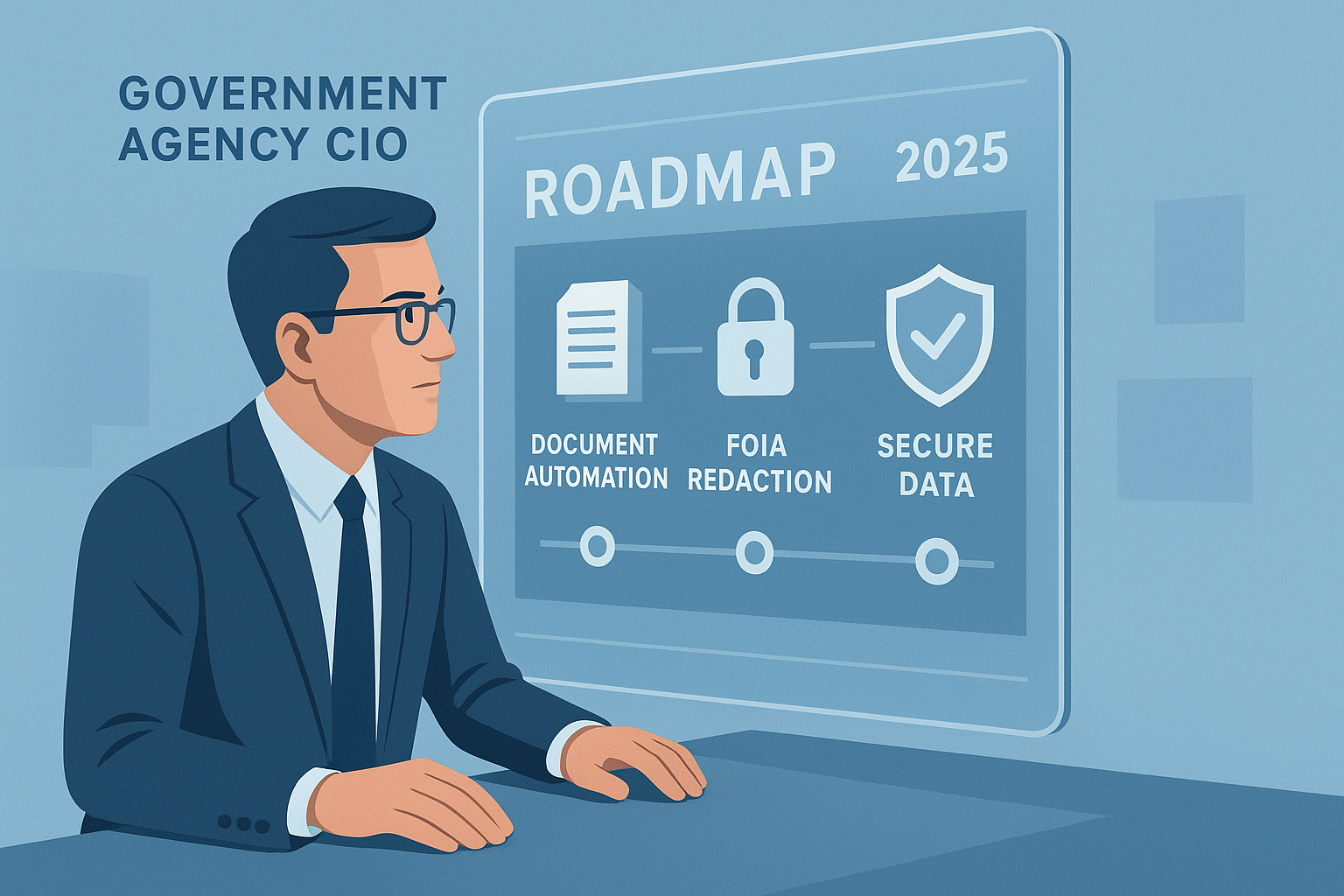
When agency leaders hear about AI today, the headlines promise dramatic leaps in efficiency and instant automation of complex workflows. The reality inside government organizations is different: strict appropriation calendars, records retention obligations, FOIA requests, and auditability requirements all shape what is feasible and how fast. A government AI roadmap that ignores procurement timelines and transparency obligations is a plan for disappointment.

Flowchart showing three prioritized AI use cases for citizen services: intake triage, document extraction, knowledge search; clean infographic style
Flowchart of prioritized AI use cases for citizen services: intake triage, document extraction, and knowledge search.

Agency CIOs and program managers should treat narratives about consumer AI as inspiration rather than a blueprint. Consumer-focused LLMs and chat interfaces are optimized for speed and scale in unconstrained environments, not for defensible decision trails or secure handling of personally identifiable information. To manage expectations, set milestones that align with budget cycles and appropriation timelines and require traceability that satisfies oversight offices. When you frame success around demonstrable changes—reduced cycle time for specific services, fewer manual transfers between teams, improved citizen satisfaction—you create achievable targets that respect both fiscal and compliance realities.

Responsible AI government practice means baking auditability and explainability into every step. That involves simple, enforceable rules about logging, content provenance, and records retention so the agency can respond to oversight and public requests without scrambling to reconstruct what an AI system did on a particular date.

Pick the Right First 3 Use Cases

Choosing the right first use cases is the fastest way to build momentum. The three priorities we recommend for agencies starting out are intake triage for citizen requests, document classification and extraction, and internal knowledge search for staff. Each of these delivers visible customer service improvements without exposing high-risk decision-making to immature models.

Intake triage reduces the time a citizen waits to reach the correct team. A lightweight automation layer can route requests, surface missing attachments, and flag urgent matters. Document classification and extraction automate routine data capture from forms and letters, cutting backlog and freeing caseworkers for exceptions. Knowledge search connects staff to policy, prior decisions, and FAQs, which reduces rework and speeds case resolution.

Don’t underestimate equity wins: language support and accessibility features are low-friction improvements that expand access. Prioritize multilingual intake and assistive formats early, and you will show measurable service improvement while meeting statutory access obligations.

Quantify benefits in the terms your stakeholders understand—cycle time in days, percentage backlog reduction, and citizen satisfaction scores. These metrics become proof points that justify further investment in public sector automation and support an agency CIO AI strategy that is rooted in value.

Data Readiness and Responsible AI by Default

One of the reasons projects stall is data immaturity. A pragmatic government AI roadmap begins with a lightweight data inventory and strong data minimization principles. Identify the inputs required for your initial use cases and make conservative decisions about what data needs to leave agency boundaries. For generative systems, redact PII from prompts and ensure that any third-party vendor cannot inadvertently retain sensitive content.

Provenance matters. Implement content watermarking and metadata tagging strategies so that generated communications can be identified and traced back to the system that produced them. Publish model cards and maintain a public FAQ that describes what models do, where they are used, and the limitations stakeholders should expect. Those artifacts support both transparency and the agency’s legal obligations.

Procurement-Smart Pilots

Procurement rules are not a barrier to experimentation if pilots are scoped smartly. Structure contracts with modular scopes: an initial proof phase, followed by options for expansion and a scaling phase. This lets you use competitive procurement vehicles to test concepts without committing an entire appropriation to unproven outcomes.

Government procurement document with stamps like 'FedRAMP' and 'StateRAMP' and checkboxes for security and SLA; flat lay overhead photo
Procurement document visual highlighting FedRAMP/StateRAMP and security/SLA checkboxes.

When working with LLMs or other hosted models, require security and privacy addenda in vendor agreements. Align evaluations with FedRAMP or StateRAMP where possible and include explicit clauses about data handling and breach notification. Include performance SLAs and clear exit criteria in statements of work so the agency can measure ROI and terminate or pivot if a pilot does not meet predefined success metrics.

LLM procurement government teams should insist on vendor commitments to not retain agency data unless explicitly authorized, and to provide technical details about model provenance and training data constraints where feasible. Those requirements keep pilots compliant and defensible.

Change Management and Upskilling for Frontline Staff

Tools alone do not create sustained improvements; people do. Invest in role-based AI literacy so caseworkers, supervisors, and program managers understand both the capabilities and the failure modes of the systems they will use. Teach prompt safety, exception handling, and escalation paths so staff can intervene effectively when automation is uncertain.

A team of frontline caseworkers co-designing with IT staff, notebooks and laptops on a table, collaborative, candid photography
Frontline caseworkers co-designing with IT staff to improve workflows and usability.

Co-design with frontline staff from day one. That reduces resistance and surfaces edge cases before a system is scaled. Practical job aids—cheat sheets, quick decision trees, and in-application guidance—accelerate adoption. Put simple feedback loops in place so users can report incorrect outputs or confusing behavior; measure adoption, rework rates, and error reduction as part of your program dashboard.

How We Help Agencies Deliver Early Wins

For agencies starting an agency CIO AI strategy, focused support makes the difference between stalled pilots and meaningful improvements. A short AI strategy sprint aligned to budget calendars builds a pragmatic government AI roadmap that prioritizes quick wins and compliance. Automation discovery workshops can identify intake and processing opportunities and produce low-code prototypes that show value to stakeholders without lengthy procurement cycles.

Secure AI development and MLOps tailored to government clouds ensure models run where policy requires, and staff enablement programs build the internal capability to operate and govern systems over time. This approach is designed to convert early public sector automation wins into sustainable programs while maintaining the standards of responsible AI government practice.

Agency CIOs who approach AI without the hype and with a concrete plan that aligns procurement, data, and people will find that measurable citizen service improvements are achievable. The path is less about chasing the newest model and more about delivering the right capabilities, responsibly and repeatably, within the constraints that define public service work.